5.2 Sine and Cosine
In high-school you have seen the trigonometric functions \(\sin\) and \(\cos.\) There they have probably been introduced with the help of an orthogonal triangle whose hypotenuse (i. e., its longest edge) has length equal to one. Then the cosine of the angle \(x\) can be defined as the length of the adjacent side (that encloses the angle \(x\) together with the hypotenuse), while the sine is defined as the length of the opposite side of the angle. This is illustrated in Figure 5.2. The hypotenuse is the black arrow while the adjacent side is marked by red and the opposite side by green.
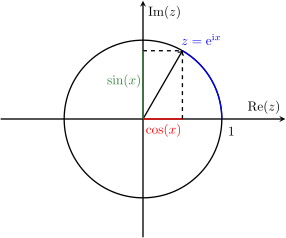
With the help of the complex exponential function we can now define the sine and cosine functions differently. Our considerations are based on the observation that \[\left|\mathrm{e}^{\mathrm{i}x}\right|^2 = \mathrm{e}^{\mathrm{i}x} \cdot \overline{\mathrm{e}^{\mathrm{i}x}} = \mathrm{e}^{\mathrm{i}x} \cdot \mathrm{e}^{-\mathrm{i}x} = \mathrm{e}^{\mathrm{i}x - \mathrm{i}x} = \mathrm{e}^0 = 1,\] i. e., \(\left|\mathrm{e}^{\mathrm{i}x}\right| = 1.\) Hence, \(\mathrm{e}^{\mathrm{i}x}\) is on the unit circle in the complex plane. We will prove later that hereby, \(x\) corresponds to the length of the arc between the point \(1 = \mathrm{e}^{\mathrm{i}\cdot0}\) and \(\mathrm{e}^{\mathrm{i}x}.\) Based on the our preliminary consideration it makes sense to define sine and cosine as follows.
Definition 5.9 • Cosine function, sine function
For \(x \in {\mathbb{R}}\) we define \[\cos(x) := \mathop{\mathrm{Re}}\left(\mathrm{e}^{\mathrm{i}x}\right) \quad \text{and} \quad \sin(x) := \mathop{\mathrm{Im}}\left(\mathrm{e}^{\mathrm{i}x}\right).\] The functions \(\cos:{\mathbb{R}}\to {\mathbb{R}},\) \(x \mapsto \cos(x)\) and \(\sin:{\mathbb{R}}\to {\mathbb{R}},\) \(x \mapsto \sin(x)\) are called cosine and sine function, respectively.
As for the exponential and logarithm function we sometimes omit the delimiters and simply write \(\cos x\) and \(\sin x\) instead of \(\cos(x)\) and \(\sin(x).\) Moreover, we make use of the standard notations \(\cos^2 x\) and \(\sin^2 x\) for \((\cos x)^2\) and \((\sin x)^2.\)
Remark 5.6
Let \(x \in {\mathbb{R}}.\) Then with the properties of the real and imaginary part we directly obtain the following identities:
\(\mathrm{e}^{\mathrm{i}x} = \cos(x) + \mathrm{i}\sin(x)\) (Euler’s formula),
\(\cos(x) = \frac{1}{2}\left( \mathrm{e}^{\mathrm{i}x} + \mathrm{e}^{-\mathrm{i}x} \right)\) and \(\sin(x) = \frac{1}{2\mathrm{i}}\left( \mathrm{e}^{\mathrm{i}x} - \mathrm{e}^{-\mathrm{i}x} \right),\)
\(\cos(-x) = \cos(x),\) because \(\mathop{\mathrm{Re}}\left(\mathrm{e}^{-\mathrm{i}x}\right) = \mathop{\mathrm{Re}}\left(\overline{\mathrm{e}^{\mathrm{i}x}}\right) = \mathop{\mathrm{Re}}\left(\mathrm{e}^{\mathrm{i}x} \right),\)
\(\sin(-x) = -\sin(x),\) because \(\mathop{\mathrm{Im}}\left(\mathrm{e}^{-\mathrm{i}x}\right) = \mathop{\mathrm{Im}}\left(\overline{\mathrm{e}^{\mathrm{i}x}}\right) = -\mathop{\mathrm{Im}}\left(\mathrm{e}^{\mathrm{i}x} \right),\)
\(\cos^{2}(x) + \sin^2(x) = 1,\) since \(1 = \left| \mathrm{e}^{\mathrm{i}x}\right|^2 = \mathop{\mathrm{Re}}\left(\mathrm{e}^{\mathrm{i}x}\right)^2 + \mathop{\mathrm{Im}}\left(\mathrm{e}^{\mathrm{i}x}\right)^2.\)
Theorem 5.7
The functions \(\cos:{\mathbb{R}}\to {\mathbb{R}},\) \(x \mapsto \cos(x)\) and \(\sin:{\mathbb{R}}\to {\mathbb{R}},\) \(x \mapsto \sin(x)\) are continuous.
Proof. This follows from Theorem 5.4 and the continuity of the complex exponential function.
We have seen that the complex exponential function can be expressed by a series. Therefore, it is not surprising that also cosine and sine can be expressed by series. This is done in the next theorem.
Theorem 5.8
Let \(x \in {\mathbb{R}}.\) Then the following series are absolutely convergent and it holds that \[\begin{alignedat}{3} \cos(x) &= \sum_{\ell = 0}^\infty (-1)^\ell \frac{x^{2\ell}}{(2\ell)!} = 1 - \frac{x^2}{2!} + \frac{x^4}{4!} - \frac{x^6}{6!} + \frac{x^8}{8!} \mp \ldots && \quad\text{(cosine series),} \\ \sin(x) &= \sum_{\ell = 0}^\infty (-1)^\ell \frac{x^{2\ell+1}}{(2\ell+1)!} = x - \frac{x^3}{3!} + \frac{x^5}{5!} - \frac{x^7}{7!} + \frac{x^9}{9!} \mp \ldots && \quad \text{(sine series).} \end{alignedat}\]
Proof. The proof of absolute convergence follows from the majorant criterion (cf. Theorem 3.9). We define \(a_{2\ell} := (-1)^\ell \frac{x^{2\ell}}{(2\ell)!}\) and \(a_{2\ell+1} := 0\) for \(\ell \in {\mathbb{N}}.\) Then \[\sum_{\ell = 0}^\infty (-1)^\ell \frac{x^{2\ell}}{(2\ell)!} = \sum_{k = 0}^\infty a_k = 1 + 0 - \frac{x^2}{2!} + 0 + \frac{x^4}{4!} + \ldots.\] Since \(|a_k| \le \frac{|x|^k}{k!}\) for all \(k \in {\mathbb{N}},\) the exponential series \(\exp(|x|) = \sum_{k=0}^\infty \frac{|x|^k}{k!}\) is a convergent majorant of the cosine series. Analogous considerations yield the absolute convergence of the sine series.
For the rest of the proof we make use of the fact that \[\mathrm{i}^0 = 1, \quad \mathrm{i}^1 = \mathrm{i}, \quad \mathrm{i}^2 = -1, \quad \mathrm{i}^3 = -\mathrm{i}, \quad \mathrm{i}^4 = 1.\] By induction we obtain \[\mathrm{i}^k = \begin{cases} 1, & \text{if } k = 4m \text{ for } m \in {\mathbb{N}}, \\ \mathrm{i}, & \text{if } k = 4m+1 \text{ for } m \in {\mathbb{N}}, \\ -1, & \text{if } k = 4m+2 \text{ for } m \in {\mathbb{N}}, \\ -\mathrm{i}, & \text{if } k = 4m+3 \text{ for } m \in {\mathbb{N}}. \\ \end{cases}\] In particular, we have \(\mathrm{i}^{2\ell} = (-1)^\ell\) and \((-\mathrm{i})^{2\ell+1} = (-1)^\ell \mathrm{i}\) for all \(\ell \in {\mathbb{N}}.\) By applying the theorem about rearrangements of absolute convergent series (Theorem 3.7) we get \[\begin{aligned} \cos(x) + \mathrm{i}\sin(x) = \mathrm{e}^{\mathrm{i}x} &= \sum_{k=0}^\infty \frac{(\mathrm{i}x)^k}{k!} \\ &= \sum_{k=0}^\infty \mathrm{i}^k \frac{x^k}{k!} = \sum_{\ell = 0}^\infty (-1)^\ell \frac{x^{2\ell}}{(2\ell)!} + \mathrm{i}\sum_{\ell = 0}^\infty (-1)^\ell \frac{x^{2\ell+1}}{(2\ell+1)!}. \end{aligned}\] Comparing the real and imaginary parts on both sides then gives the result.
Video 5.3. Sine and cosine.
Our next goal is to find a definition of the number \(\pi\) that denotes the ratio between the circumference of a circle and its diameter. Here we are going to use that \(\frac{\pi}{2}\) is the first positive root of the cosine function. Hence, we will first prove that our cosine function has a first positive root. For this we will need some preliminaries.
Lemma 5.9
Let \(x \in [0,2].\) Then the sequence \(\left(\frac{x^n}{n!}\right)_{n \ge 1}\) is monotonically decreasing.
Proof. Because of \(x \in [0,2]\) it holds that \(x \le n+1\) for all \(n \in {\mathbb{N}}\setminus\{0\}.\) With this we obtain \[\frac{x^{n+1}}{(n+1)!} \le \frac{x^n(n+1)}{(n+1)!} = \frac{x^n}{n!} \quad \text{for all } n \ge 1.\]
Corollary 5.10
Let \(x \in [0,2].\) Then it holds that
\(1 - \frac{x^2}{2!} \le \cos(x) \le 1 - \frac{x^2}{2!} + \frac{x^4}{4!},\)
\(x \ge \sin(x) \ge x- \frac{x^3}{3!}.\)
Proof. By Lemma 5.9 we have for \(x\in [0,2]\) that \[\frac{x^{n}}{n!} - \frac{x^{n+2}}{(n+2)!} \ge 0 \quad \text{for all } n \ge 1.\] This implies \[1 - \frac{x^2}{2!} \le 1 - \frac{x^2}{2!} + \left( \frac{x^4}{4!} - \frac{x^6}{6!}\right) \le \ldots \le \sum_{\ell = 0}^\infty (-1)^\ell \frac{x^{2\ell}}{(2\ell)!} = \cos(x).\] This shows the first inequality in i. The remaining inequalities can be shown by similar arguments.
Lemma 5.11
Let \(f:[a,b] \to {\mathbb{R}}\) be continuous. If \(f\) has a zero in \([a,b],\) then \(f\) also has its smallest zero in \([a,b],\) i. e., there exists \[\min\left\{ x \in [a,b] \; | \; f(x) = 0 \right\}.\]
Proof. Let \(M:=\{ x \in [a,b] \; | \; f(x) = 0 \}\) be the set of zeros of \(f.\) Then there exists \(\widetilde{x} := \inf M \in {\mathbb{R}}\) since \(M\) is nonempty by assumption and bounded from below. By Lemma 4.8, there exists a sequence \({(x_n)}_{n \in {\mathbb{N}}}\) in \(M\) with \(\lim_{n \to \infty} x_n = \widetilde{x}.\) With Corollary 2.6, we have \(\widetilde{x} \in [a,b].\) Since \(f\) is continuous, we further have \[f\left(\widetilde{x}\right) = f\left(\lim_{n \to \infty} x_n\right) = \lim_{n \to \infty} f(x_n) = 0,\] i. e., \(\widetilde{x} \in M.\) Hence, \(\widetilde{x}\) is the minimum of \(M.\)
Theorem 5.12
The cosine function \(\cos:{\mathbb{R}}\to {\mathbb{R}},\) \(x \mapsto \cos(x)\) has a smallest positive root \(x_0 \in [0,2]\) and \(\cos(x) > 0\) for all \(x \in [0,x_0).\)
Proof. From the series representation of the cosine function we obtain \(\cos(0) = 1 > 0.\) With Corollary 5.10 we obtain \[\cos(2) \le 1 - \frac{2^2}{2!} + \frac{4^2}{4!} = 1-2+ \frac{16}{24} = -\frac{1}{3} < 0.\] By the intermediate value theorem (Theorem 4.7), \(\cos\) has a zero in the interval \((0,2) \subset [0,2].\) By Lemma 5.11, there exists a smallest positive zero \(x_0\) of \(\cos\) in the interval \([0,2]\) (more precisely, \(x_0 \in (0,2),\) since \(\cos(0),\,\cos(2) \neq 0\)). Moreover, \(\cos(x) > 0\) for all \(x \in [0,x_0),\) otherwise there would exist another zero in the interval \((0,x_0).\) This would be a contradiction to the fact that \(x_0\) is the minimal positive zero of \(\cos.\)
Definition 5.10
(The number \(\pi\)). Let \(x_0\) be the smallest positive root of the cosine function \(\cos.\) Then we define the constant \[\pi := 2x_0.\]
Corollary 5.13
It holds that \(\cos \frac{\pi}{2} = 0\) and \(\sin \frac{\pi}{2} = 1.\)
Proof. The identity \(\cos \frac{\pi}{2} = 0\) holds by construction. From \(\cos^2(x) + \sin^2(x) = 1\) (cf. Remark 5.6 v), we further obtain \(\left| \sin \frac{\pi}{2} \right| = 1.\) By Corollary 5.10 we obtain for \(x \in [0,2]\) that \[\sin(x) \ge x - \frac{x^3}{3!} = x\cdot \left(1-\frac{x^2}{3!} \right) \ge 0,\] since \(x^2 \le 4 < 6 = 3!.\) Since \(\frac{\pi}{2} \in [0,2]\) we obtain \(\sin \frac{\pi}{2} = 1.\)
Corollary 5.14
It holds that \(\mathrm{e}^{\mathrm{i}k \frac{\pi}{2}} = \mathrm{i}^k\) for all \(k \in {\mathbb{N}}.\)
Proof. By Remark 5.6 i we obtain \[\mathrm{e}^{\mathrm{i}k \frac{\pi}{2}} = \left(\mathrm{e}^{\mathrm{i}\frac{\pi}{2}}\right)^k = \left(\cos \frac{\pi}{2} + \mathrm{i}\sin \frac{\pi}{2} \right)^k = \mathrm{i}^k.\]
There are many more consequences of Theorem 5.12 which we summarize in the following remark.
Remark 5.7
In constrast to the real exponential function, the complex exponential function \(\exp :{\mathbb{C}}\to {\mathbb{C}}\) is not injective. For instance we have \[1 = \mathrm{e}^0 = \mathrm{e}^{2\pi\mathrm{i}}.\] Thus it is a nontrivial task to generalize the logarithm to complex numbers. First we must restrict the domain of the exponential function such that it becomes injective. You will learn how to do this in module M07: “Analysis III”.
For the special case that \(k=2\) in Corollary 5.14 we obtain Euler’s identity \(\mathrm{e}^{\mathrm{i}\pi} = -1.\) It can be written as \[\mathrm{e}^{\mathrm{i}\pi} + 1 = 0.\] This formula is particularly aesthetic since it combines five of the most important constants in mathematics: the neutral elements with respect to addition and multiplication \(0\) and \(1,\) Euler’s number \(\mathrm{e},\) the imaginary unit \(\mathrm{i},\) and the number \(\pi.\)
One should be careful when taking powers of complex numbers. Simply using the power laws we have derived in Section 4.5 leads to the contradication \[1 = 1^{\frac{1}{2}} = \left( \mathrm{e}^{2\pi\mathrm{i}} \right)^{\frac{1}{2}} = \mathrm{e}^{\frac{1}{2}\cdot2\pi\mathrm{i}} = \mathrm{e}^{\pi\mathrm{i}} = -1.\] The problem is that the power laws in Theorem 4.18 are in general not valid for complex bases and non-integer exponents. We have already defined \(z^n\) for \(z \in {\mathbb{C}}\) and for \(n \in {\mathbb{N}}\) and we can further define \[z^{-n} := \frac{1}{z^n}\] to allow integer exponents. However, as the example above illustrates, we will already get problems when the exponent is rational. For this reason we also avoid the definition of the square-root of complex numbers.
In Corollary 5.14 we have still used the power law \(\left(\mathrm{e}^z\right)^k = \mathrm{e}^{kz}\) for \(z \in {\mathbb{C}}\) and \(k \in {\mathbb{N}}.\) This can be shown by induction and by using that \(\mathrm{e}^{z_1+z_2} = \mathrm{e}^{z_1}\cdot \mathrm{e}^{z_2}\) for \(z_1,\,z_2 \in {\mathbb{C}}.\) The result even remains true for \(k \in {\mathbb{Z}},\) since \(\mathrm{e}^{-z} = \frac{1}{\mathrm{e}^z} = \left(\mathrm{e}^z\right)^{-1}.\)
By considering the real and imaginary parts of \(\mathrm{e}^{\mathrm{i}k \frac{\pi}{2}} = \mathrm{i}^k\) and comparing them with Remark 5.6 i we can derive the table in Figure 5.3 that contains the values of \(\sin(x)\) and \(\cos(x)\) for \(x = k\frac{\pi}{2}\) and different values of \(k.\)
With the help of Figure 5.3, the identity \(\cos^2(x) + \sin^2(x) = 1\) for all \(x \in {\mathbb{R}},\) and the intermediate value theorem (Theorem 4.7) we obtain \[\cos({\mathbb{R}}) = [-1,1] \quad \text{and} \quad \sin({\mathbb{R}}) = [-1,1].\]
Using the series representations of \(\cos(x)\) and \(\sin(x)\) we can determine approximate functions values with arbitrary accuracy by evaluating the partial sums. Using Bolzano’s theorem (Lemma 4.6) and the method of nested intervals we can approximate the root of \(\cos\) in \([0,2]\) arbitrarily accurately, similarly as in the proof of Lemma 4.6. We obtain \[\pi = 3.141592653589793238462643383279\ldots.\] It can further be shown that \(\pi\) is an irrational number, i. e., \(\pi \in {\mathbb{R}}\setminus{\mathbb{Q}}.\) It is even a transcentendal number, i. e., it is not a root of any polynomial function with integer coefficients.
| \(x\) | \(0\) | \(\frac{\pi}{2}\) | \(\pi\) | \(\frac{3\pi}{2}\) | \(2\pi\) |
|---|---|---|---|---|---|
| \(\cos(x)\) | \(1\) | \(0\) | \(-1\) | \(0\) | \(1\) |
| \(\sin(x)\) | \(0\) | \(1\) | \(0\) | \(-1\) | \(0\) |
Theorem 5.15 • Angle addition theorems
For \(x,\,y \in {\mathbb{R}}\) it holds that
\(\sin(x+y) = \sin x\cos y + \cos x \sin y,\)
\(\cos(x+y) = \cos x\cos y - \sin x \sin y.\)
Proof. Exercise!
Corollary 5.16
Let \(x \in {\mathbb{R}}.\) Then it holds that
\(\sin(x+2\pi) = \sin x\) and \(\cos(x+2\pi) = \cos x\) (i. e., \(\sin\) and \(\cos\) are \(2\pi\)-periodic),
\(\sin(x+\pi) = -\sin x\) and \(\cos(x+\pi) = -\cos x,\)
\(\sin x = \cos\left(\frac{\pi}{2} - x\right) = \cos\left(x - \frac{\pi}{2}\right)\) and \(\cos x = \sin\left(\frac{\pi}{2} - x\right) = -\sin\left(x - \frac{\pi}{2}\right).\)
Proof. Exercise!
Corollary 5.17
It holds that
\(\left\{ x\in{\mathbb{R}}\;\middle| \; \sin x = 0 \right\} = \left\{ k\pi \;\middle| \; k \in {\mathbb{Z}}\right\},\)
\(\left\{ x\in{\mathbb{R}}\;\middle| \; \cos x = 0 \right\} = \left\{ \frac{\pi}{2} + k\pi \;\middle| \; k \in {\mathbb{Z}}\right\},\)
\(\left\{ x\in{\mathbb{R}}\;\middle| \; \mathrm{e}^{\mathrm{i}x} = 1 \right\} = \left\{ 2k\pi \;\middle| \; k \in {\mathbb{Z}}\right\}.\)
Proof.
The inclusion “\(\supseteq\)” follows directly from \(\sin(0) = 0 = \sin(\pi)\) and \(\sin(x+2k\pi) = \sin(x)\) for all \(x \in {\mathbb{R}}\) and for all \(k \in {\mathbb{Z}}\) that can be easily obtained by the \(2\pi\)-periodicity in Corollary 5.16 i by induction.
For the inclusion “\(\subseteq\)” we note that \(\cos(x) = \cos(-x)\) for all \(x \in {\mathbb{R}}\) and Theorem 5.12 imply that \(\cos(x) > 0\) for all \(x \in \left(-\frac{\pi}{2},\frac{\pi}{2}\right).\) Since \(\sin(x) = \cos\left(x - \frac{\pi}{2}\right)\) for all \(x \in {\mathbb{R}}\) we obtain that \(\sin(x) > 0\) for all \(x \in (0,\pi).\) Since \(\sin(x+\pi) = -\sin(x)\) for all \(x \in {\mathbb{R}}\) we also have \(\sin(x) < 0\) for all \(x \in (\pi,2\pi).\) But this implies that \(0\) and \(\pi\) are the only roots of \(\sin\) in the interval \([0,2\pi).\) Now the claim follows from the \(2\pi\)-periodicity of the sine function.
This claim follows analogously to i or by using that \(\cos(x) = - \sin\left(x-\frac{\pi}{2} \right)\) for all \(x \in {\mathbb{R}}.\)
It holds that \(1 = \mathrm{e}^{\mathrm{i}x} = \cos(x) + \mathrm{i}\sin(x),\) if and only if \(\cos(x) = 1\) and \(\sin(x) = 0.\) Since \(\cos(0) = 1\) and \(\cos(\pi) = -1\) and the \(2\pi\)-periodicity of the cosine function as well as i, we obtain that \(\mathrm{e}^{\mathrm{i}x} = 1,\) if and only if \(x = 2k\pi\) for \(k \in {\mathbb{Z}}.\)
Remark 5.8
With the help of the angle addition theorems we can determine the function value of \(\sin\) and \(\cos\) exactly at some specific points. For instance, we have \[\begin{aligned} 0 = \cos \frac{\pi}{2} = \cos\left( \frac{\pi}{4} + \frac{\pi}{4} \right) &= \cos^2 \frac{\pi}{4} - \sin^2 \frac{\pi}{4} \\ &= \cos^2 \frac{\pi}{4} - \left(1-\cos^2 \frac{\pi}{4}\right) = 2\cos^2 \frac{\pi}{4} - 1, \end{aligned}\] hence \(\cos^2 \frac{\pi}{4} = \frac{1}{2}.\) Since \(\cos (x) > 0\) for all \(x \in [0,\frac{\pi}{2})\) we can take the square root and obtain \[\cos \frac{\pi}{4} = \frac{1}{\sqrt{2}} = \frac{\sqrt{2}}{2}.\] Similar calculations can also be carried out for other arguments. The results are summarized in the table in Figure 5.4. There are also exact values for more unusual arguments. For example, with \(\psi:=17-\sqrt{17},\) Gauß calculated that \[\begin{gathered} \sin\left( \frac{\pi}{17} \right) \\= \frac{1}{8} \sqrt{2} \sqrt{\psi -\sqrt{2}\left( \sqrt{34+6\sqrt{17} + \sqrt{2}\left( \sqrt{17}-1 \right)\sqrt{\psi} - 8\sqrt{2}\sqrt{\psi}} +\sqrt{\psi} \right)} \\=0.1837495178\ldots. \end{gathered}\] This calculation is the basis for showing that a regular heptadecagon (a regular polygon with \(17\) corners) can be constructed only with the help of compass and ruler.
| \(x\) | \(0\) | \(\frac{\pi}{6}\) | \(\frac{\pi}{4}\) | \(\frac{\pi}{3}\) | \(\frac{\pi}{2}\) |
|---|---|---|---|---|---|
| \(\cos(x)\) | \(\frac{\sqrt{4}}{2}\) | \(\frac{\sqrt{3}}{2}\) | \(\frac{\sqrt{2}}{2}\) | \(\frac{\sqrt{1}}{2}\) | \(\frac{\sqrt{0}}{2}\) |
| \(\sin(x)\) | \(\frac{\sqrt{0}}{2}\) | \(\frac{\sqrt{1}}{2}\) | \(\frac{\sqrt{2}}{2}\) | \(\frac{\sqrt{3}}{2}\) | \(\frac{\sqrt{4}}{2}\) |
As classical trigonometric functions we also have the tangent and cotangent.
Definition 5.11 • Tangent function, cotangent function
The function \(\tan:D \to {\mathbb{R}},\) \(x \mapsto \frac{\sin x}{\cos x}\) with \(D = {\mathbb{R}}\setminus \left\{ \frac{\pi}{2} + k\pi \; \middle| \; k \in {\mathbb{Z}}\right\}\) is called the tangent function.
The function \(\cot:\widetilde{D} \to {\mathbb{R}},\) \(x \mapsto \frac{\cos x}{\sin x}\) with \(\widetilde{D} = {\mathbb{R}}\setminus \left\{k\pi \; \middle| \; k \in {\mathbb{Z}}\right\}\) is called the cotangent function.
Because of their periodicity, the sine and cosine functions (as well as the tangent and cotangent functions) are not injective. However, by restricting their domains they can be made injective and hence, their inverse functions exist. We will do this in the upcoming chapter.
5.3 Polar Form of Complex Numbers
We have seen that we can visualize complex numbers by drawing them as points in the complex plane. Then the real and the imaginary parts correspond to their Cartesian coordinates. On the other hand, complex numbers can be written in polar coordinates. Except for the number \(0,\) every complex number \(z\) is uniquely determined by its distance from the origin and the angle \(\varphi\) that is enclosed by the vector that connects \(z\) with the origin and the “positive \(x\)-axis”, see also Figure 5.5 for a graphical depiction. (For \(z=0,\) no unique angle is defined.)
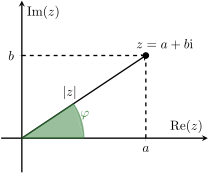
If we recall our geometric derivation of the sine and cosine, we obtain \[a = |z|\cos \varphi \quad \text{and} \quad b = |z|\sin \varphi.\] From this we obtain \[z = a + b\mathrm{i}= |z|\cdot(\cos \varphi + \mathrm{i}\sin \varphi) = |z|\cdot \mathrm{e}^{\mathrm{i}\varphi}.\] However, we aim to base our entire analysis on the axioms provided in Chapter 1, hence such geometric considerations are useful as a motivation, but not as a proof technique. We proceed differently.
Theorem 5.18 • Polar form
For every \(z \in {\mathbb{C}}\setminus\{0\}\) there exist two uniquely determined numbers \(r \in (0,\infty)\) and \(\varphi \in (-\pi,\pi]\) such that \[z = r\cdot\mathrm{e}^{\mathrm{i}\varphi}.\] In particular, it holds that \(r = |z|.\)
Proof. First, we show the uniqueness. Let \(z=r\cdot\mathrm{e}^{\mathrm{i}\varphi} = s\cdot\mathrm{e}^{\mathrm{i}\psi}\) with \(r,\,s \in (0,\infty)\) and \(\varphi,\,\psi \in (-\pi,\pi].\) Since \(\left|\mathrm{e}^{\mathrm{i}x}\right| = 1\) for all \(x \in {\mathbb{R}}\) we obtain \[r = |r| \cdot \left|\mathrm{e}^{\mathrm{i}\varphi}\right| = \left|r\mathrm{e}^{\mathrm{i}\varphi} \right| = \left|s\mathrm{e}^{\mathrm{i}\psi} \right| = |s| \cdot \left|\mathrm{e}^{\mathrm{i}\psi} \right| = s.\] From that we obtain \(\mathrm{e}^{\mathrm{i}\varphi} = \mathrm{e}^{\mathrm{i}\psi},\) hence \(\mathrm{e}^{\mathrm{i}(\varphi-\psi)} = 1.\) Then with Corollary 5.17 iii it follows that \(\varphi - \psi \in \{2k\pi \;|\; k\in{\mathbb{Z}}\}.\) Since \(\varphi,\,\psi \in (-\pi,\pi]\) we have \(\varphi = \psi.\)
To prove the existence we set \(r:=|z|.\) Because \(z \neq 0\) we have \(r > 0\) and \[z = r \cdot \frac{z}{r}, \quad \text{where } \left|\frac{z}{r} \right| = 1.\] Let \(a := \mathop{\mathrm{Re}}(z)\) and \(b := \mathop{\mathrm{Im}}(z),\) i. e., \(z = a + b\mathrm{i}\) and hence, \(\frac{z}{r} = \frac{a}{r} + \frac{b}{r}\mathrm{i}.\) This implies \[\left| \frac{a}{r} \right| = \left| \mathop{\mathrm{Re}}\left( \frac{z}{r} \right) \right| \le \left| \frac{z}{r} \right| = 1,\] in other words, \(-1\le \frac{a}{r} \le 1.\) Due to the continuity of the cosine function and since \(\cos(0) = 1\ge \frac{a}{r} \ge -1 = \cos(\pi),\) there exists an \(\alpha \in [0,\pi]\) with \(\cos \alpha = \frac{a}{r}.\) Further, we have \[\sin^2 \alpha = 1 - \cos^2 \alpha = 1 - \frac{a^2}{r^2} = \frac{b^2}{r^2},\] since \(1 = \frac{a^2}{r^2} + \frac{b^2}{r^2}.\) We distinguish two cases:
Case 1: \(\sin \alpha = \frac{b}{r}.\) In this case we set \(\varphi := \alpha.\) Then we have \[\frac{z}{r} = \cos \varphi+ \mathrm{i}\sin \varphi = \mathrm{e}^{\mathrm{i}\varphi}, \quad \text{where } \varphi \in [0,\pi].\]
Case 2: \(\sin \alpha = - \frac{b}{r} \neq 0.\) Note that the case \(\sin \alpha = 0\) is already covered by Case 1. Hence we have \(\alpha \in (0,\pi).\) We set \(\varphi := -\alpha \in (-\pi,0).\) Then \[\frac{z}{r} = \cos \alpha - \mathrm{i}\sin \alpha = \cos(-\alpha) + \mathrm{i}\sin(-\alpha) = \cos \varphi + \mathrm{i}\sin \varphi = \mathrm{e}^{\mathrm{i}\varphi},\] where we have used Remark 5.6 iii and iv.
In both cases we have \(z=r\cdot\mathrm{e}^{\mathrm{i}\varphi}.\)
Video 5.4. Polar form of complex numbers.
The representation \(z=r\mathrm{e}^{\mathrm{i}\varphi}\) with \(r \in (0,\infty)\) and \(\varphi \in {\mathbb{R}}\) the is called polar form of \(z \in {\mathbb{C}}\setminus \{0\}.\) Because of \(\mathrm{e}^{\mathrm{i}\varphi} = \mathrm{e}^{\mathrm{i}(\varphi+2k\pi)}\) for \(k \in {\mathbb{Z}},\) this form is not unique unless we restrict the possible values of \(\varphi,\) for example \(\varphi \in (-\pi,\pi].\) We call \[\arg(z) := \left\{ \varphi \in {\mathbb{R}}\;\middle|\; z = |z|\cdot \mathrm{e}^{\mathrm{i}\varphi} \right\}\] the argument of \(z\) and \(\varphi\) its principal value, if \(\varphi \in (-\pi,\pi].\) Unfortunately, the literature is ambiguous about the definition of the principal value since sometimes \(\varphi \in [0,2\pi)\) is assumed for the principal value. Luckily, in most cases, it is not important to take the principal value of the argument and one can take any value \(\varphi \in \arg(z)\) instead.
Remark 5.9
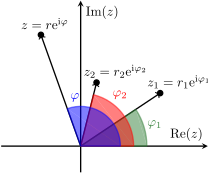
Using the polar form of complex numbers we can find a geometric interpretation of the multiplication of two complex numbers. For \(z_1,\,z_2 \in {\mathbb{C}}\) with \(z_1 = r_1\cdot\mathrm{e}^{\mathrm{i}\varphi_1}\) and \(z_2 = r_2\cdot\mathrm{e}^{\mathrm{i}\varphi_2}\) with \(r_1,\,r_2 \in (0,\infty)\) and \(\varphi_1,\,\varphi_2 \in (-\pi,\pi]\) it holds that \[z:=z_1z_2 = r_1r_2\mathrm{e}^{\mathrm{i}(\varphi_1+\varphi_2)} = r\mathrm{e}^{\mathrm{i}\varphi},\] i. e., we obtain the absolute values of \(z\) by multiplying the absolute values of \(z_1\) and \(z_2\) and the angle \(\varphi\) by adding the angles \(\varphi_1\) and \(\varphi_2.\) This is illustrated in Figure 5.6. Note that we may have \(\varphi \notin (-\pi,\pi],\) so \(\varphi\) may not be the principal value of \(\arg(z).\)
The geometric interpretation of the complex multiplication has some further implications.
Theorem 5.19
The equation \(z^n = 1\) has \(n\) pairwise distinct solutions in \({\mathbb{C}}\) which are given by \[z_k = \mathrm{e}^{\mathrm{i}\left(2\pi\frac{k}{n}\right)}, \quad k=0,\,\ldots,\,n-1.\]
Proof. We first show that \(z_k,\) \(k=0,\,\ldots,\,n-1\) are indeed solutions of \(z^n = 1.\) We have \[z_k^n = \left(\mathrm{e}^{\mathrm{i}\left(2\pi\frac{k}{n}\right)}\right)^n = \mathrm{e}^{\mathrm{i}\left(2\pi k\right)} = 1.\]
It remains to show that any other solution also has this form. Let \(z \in {\mathbb{C}}\) be such that \(z^n = 1.\) Obviously, \(z \neq 0\) and hence, by Theorem 5.18 there exist \(r \in (0,\infty)\) and \(\varphi \in {\mathbb{R}}\) such that \[z = r\mathrm{e}^{\mathrm{i}\varphi}.\] Because of \(1 = \left| z^n \right| = |z|^n,\) we have \(r = |z| = 1.\) Consequently, \[1 = z^n = \left( \mathrm{e}^{\mathrm{i}\varphi}\right)^n = \mathrm{e}^{\mathrm{i}\varphi n}.\] With Corollary 5.17 iii we have \[\varphi \cdot n \in \left\{2\pi k \; \middle| \; k \in {\mathbb{Z}}\right\},\] or in other words, \[\mathrm{e}^{\mathrm{i}\varphi} \in \left\{\mathrm{e}^{\mathrm{i}\left(2\pi \frac{k}{n}\right)} \; \middle| \; k \in {\mathbb{Z}}\right\}.\] Because of the \(2\pi\)-periodicity of the function \(x \mapsto \mathrm{e}^{\mathrm{i}x}\) (cf. Corollary 5.16 i), this set consists of exactly \(n\) elements that contains the elements \(z_0,\,\ldots,\,z_{n-1}.\)
Remark 5.10
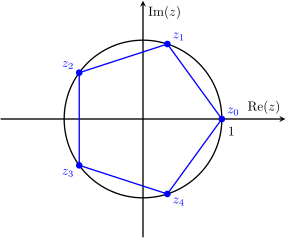
The \(n\) complex solutions of \(z^n = 1\) are called the \(n\)-th unit roots. In the complex plane, they form the corners of a regular polygon as depicted in Figure 5.7 for the case \(n=5.\) There we have \[z_k = \mathrm{e}^{\mathrm{i}\left(2\pi\frac{k}{5}\right)}, \quad k=0,\,1,\,2,\,3,\,4.\] Obviously, \(z_0 = 1\) is always a solution of \(z^n=1,\) hence the point \((1,0)\) is always a corner of the corresponding regular polygon.
Remark 5.11
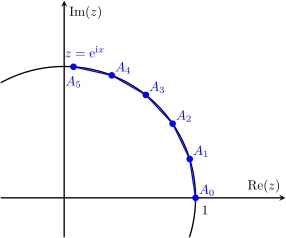
Finally, we discuss the idea for proving the fact the “\(x\)” in \(\mathrm{e}^{\mathrm{i}x}\) corresponds to the length of the arc on the unit circle from the point \(1\) to the point \(\mathrm{e}^{\mathrm{i}x},\) if \(x \in [0,2\pi).\)
For \(n \in {\mathbb{N}}\) we define the points \[A_k := \mathrm{e}^{\mathrm{i}k \frac{x}{n}}, \quad k=0,\,\ldots,\,n\] on the unit circle which are depicted in Figure 5.8. Let \(\ell_n\) denote the length of the polygonal chain through the points \(A_0,\,\ldots,\,A_n.\) Then \[\ell_n = \sum_{k=1}^n |A_k - A_{k-1}|\] and the length of the arc between the points \(1\) and \(\mathrm{e}^{\mathrm{i}x}\) is given by \(\lim_{n \to \infty} \ell_n.\) The claim then follows by showing that (exercise!) \[\ell_n = 2n\left| \sin \frac{x}{2n} \right| \quad \text{and} \quad \lim_{n \to \infty} 2n \sin \frac{x}{2n} = x.\]
One important point remains to mention: It can be shown that not only the equation \(z^2 = -1\) has a solution in the complex numbers (namely \(\mathrm{i}\) and \(-\mathrm{i}\)) but more generally, every nonconstant polynomial has at least one complex zero (equivalently, every non-trivial polynomial equation has at least one solution in \({\mathbb{C}}\)).
Theorem 5.20 • Fundamental theorem of algebra
Let \(p : {\mathbb{C}}\to {\mathbb{C}}\) be a polynomial of the form \[p(z) = \sum_{k = 0}^n a_k z^k \quad \text{for all } z \in {\mathbb{C}},\] such that \(a_0,\,\ldots,\,a_n \in {\mathbb{C}}\) with \(a_n \neq 0\) and \(n \ge 1.\) Then \(p\) has at least one zero in \({\mathbb{C}},\) i. e., there exists a \(z_0 \in {\mathbb{C}}\) such that \(p(z_0) = 0.\)
The theorem is often stated differently by stating that any polynomial with complex coefficients of degree \(n\) has exactly \(n\) complex roots. There are many different ways to prove this result and this is most often done in courses on linear algebra. Hence, we will skip the further details at this point.