3.7 Matrix representation of linear maps
Proposition 3.80 ➔
implies that every finite dimensional \(\mathbb{K}\)-vector space \(V\) is isomorphic to \(\mathbb{K}^n,\) where \(n=\dim(V).\) Choosing an isomorphism from \(V\) to \(\mathbb{K}^n\) allows to uniquely describe each vector of \(V\) in terms of \(n\) scalars, its coordinates.Let \(V,W\) be finite dimensional \(\mathbb{K}\)-vector spaces. Then there exists an isomorphism \(\Theta : V \to W\) if and only if \(\dim(V)=\dim(W).\)
Definition 3.82 • Linear coordinate system
Let \(V\) be a \(\mathbb{K}\)-vector space of dimension \(n \in \mathbb{N}.\) A linear coordinate system is an injective linear map \(\boldsymbol{\varphi}: V \to \mathbb{K}^n.\) The entries of the vector \(\boldsymbol{\varphi}(v)\in \mathbb{K}^n\) are called the coordinates of the vector \(v\in V\) with respect to the coordinate system \(\boldsymbol{\varphi}.\)
Corollary 3.77 ➔
.Let \(V,W\) be finite dimensional \(\mathbb{K}\)-vector spaces with \(\dim(V)=\dim(W)\) and \(f : V \to W\) a linear map. Then the following statements are equivalent:
\(f\) is injective;
\(f\) is surjective;
\(f\) is bijective.
Example 3.83 • Standard coordinates
On the vector space \(\mathbb{K}^n\) we have a linear coordinate system defined by the identity mapping, that is, we define \(\boldsymbol{\varphi}(\vec{v})=\vec{v}\) for all \(\vec{v} \in \mathbb{K}^n.\) We call this coordinate system the standard coordinate system of \(\mathbb{K}^n.\)
Example 3.84 • Non-linear coordinates
In Linear Algebra we only consider linear coordinate systems, but in other areas of mathematics non-linear coordinate systems are also used. An example are the so-called polar coordinates \[\boldsymbol{\rho}: \mathbb{R}^2\setminus\{0_{\mathbb{R}^2}\} \to (0,\infty)\times (-\pi,\pi]\subset \mathbb{R}^2, \qquad \vec{x}\mapsto \begin{pmatrix} r \\ \phi\end{pmatrix}=\begin{pmatrix} \sqrt{(x_1)^2+(x_2)^2} \\ \arg(\vec{x}) \end{pmatrix},\] where \(\arg(\vec{x})=\arccos(x_1/r)\) for \(x_2\geqslant 0\) and \(\arg(\vec{x})=-\arccos(x_1/r)\) for \(x_2<0.\) Notice that the polar coordinates are only defined on \(\mathbb{R}^2\setminus\{0_{\mathbb{R}^2}\}.\) For further details we refer to the Analysis module.
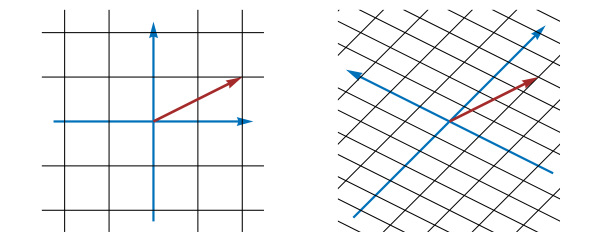
A convenient way to visualise a linear coordinate system \(\boldsymbol{\varphi}: \mathbb{R}^2 \to \mathbb{R}^2\) is to consider the preimage \(\boldsymbol{\varphi}^{-1}(\mathcal{C})\) of the standard coordinate grid \[\tag{3.13} \mathcal{C}=\left\{s \vec{e}_1+k\vec{e}_2| s \in \mathbb{R}, k \in \mathbb{Z}\right\}\cup \left\{k \vec{e}_1+s\vec{e}_2| s \in \mathbb{R}, k \in \mathbb{Z}\right\}\] under \(\boldsymbol{\varphi}.\) The first set in the union (3.13) of sets are the horizontal coordinate lines and the second set the vertical coordinate lines.
Example 3.85 • see Figure 3.1
The vector \(\vec{v}=\begin{pmatrix} 2 \\ 1 \end{pmatrix}\) has coordinates \(\begin{pmatrix} 2 \\ 1 \end{pmatrix}\) with respect to the standard coordinate system of \(\mathbb{R}^2.\) The same vector has coordinates \(\boldsymbol{\varphi}(\vec{v})=\begin{pmatrix} 4 \\ -1 \end{pmatrix}\) with respect to the coordinate system \(\boldsymbol{\varphi}\left(\begin{pmatrix}v_1 \\ v_2\end{pmatrix}\right)=\begin{pmatrix}v_1+2v_2 \\ -v_1+v_2\end{pmatrix}.\)
While \(\mathbb{K}^n\) is equipped with the standard coordinate system, in an abstract vector space \(V\) there is no preferred linear coordinate system and a choice of linear coordinate system amounts to choosing a so-called ordered basis of \(V.\)
Definition 3.86 • Ordered basis
Let \(V\) be a finite dimensional \(\mathbb{K}\)-vector space. An (ordered) \(n\)-tuple \(\mathbf{b}=(v_1,\ldots,v_n)\) of vectors from \(V\) is called an ordered basis of \(V\) if the set \(\{v_1,\ldots,v_n\}\) is a basis of \(V.\)
That there is a bijective correspondence between ordered bases of \(V\) and linear coordinate systems on \(V\) is a consequence of the following very important lemma which states in particular that two linear maps \(f, g : V \to W\) are the same if and only if they agree on a basis of \(V.\)
Lemma 3.87
Let \(V,W\) be finite dimensional \(\mathbb{K}\)-vector spaces.
Suppose \(f,g : V \to W\) are linear maps and \(\mathbf{b}=(v_1,\ldots,v_n)\) is an ordered basis of \(V.\) Then \(f=g\) if and only if \(f(v_i)=g(v_i)\) for all \(1\leqslant i\leqslant n.\)
If \(\dim V=\dim W\) and \(\mathbf{b}=(v_1,\ldots,v_n)\) is an ordered basis of \(V\) and \(\mathbf{c}=(w_1,\ldots,w_n)\) an ordered basis of \(W,\) then there exists a unique isomorphism \(f : V \to W\) such that \(f(v_i)=w_i\) for all \(1\leqslant i\leqslant n.\)
Proof. (i) \(\Rightarrow\) If \(f=g\) then \(f(v_i)=g(v_i)\) for all \(1\leqslant i\leqslant n.\) \(\Leftarrow\) Let \(v \in V.\) Since \(\mathbf{b}\) is an ordered basis of \(V\) there exist unique scalars \(s_1,\ldots,s_n \in \mathbb{K}\) such that \(v=\sum_{i=1}^n s_i v_i.\) Using the linearity of \(f\) and \(g,\) we compute \[f(v)=f\left(\sum_{i=1}^n s_i v_i\right)=\sum_{i=1}^ns_if(v_i)=\sum_{i=1}^ns_ig(v_i)=g\left(\sum_{i=1}^n s_i v_i\right)=g(v)\] so that \(f=g.\)
Lemma 3.31 ➔
implies that \(f\) is injective and hence an isomorphism by Corollary 3.77A linear map \(f : V \to W\) is injective if and only if \(\operatorname{Ker}(f)=\{0_V\}.\)
Corollary 3.77 ➔
. The uniqueness of \(f\) follows from (i).Let \(V,W\) be finite dimensional \(\mathbb{K}\)-vector spaces with \(\dim(V)=\dim(W)\) and \(f : V \to W\) a linear map. Then the following statements are equivalent:
\(f\) is injective;
\(f\) is surjective;
\(f\) is bijective.
Remark 3.88 Notice that Lemma 3.87
Lemma 3.87 ➔
is wrong for maps that are not linear. Consider \[f : \mathbb{R}^2\to \mathbb{R}, \quad \begin{pmatrix} x_1 \\ x_2\end{pmatrix} \mapsto x_1x_2\] and \[g : \mathbb{R}^2 \to \mathbb{R}\quad \begin{pmatrix} x_1 \\ x_2\end{pmatrix} \mapsto (x_1-1)(x_2-1).\] Then \(f(\vec{e}_1)=g(\vec{e}_1)\) and \(f(\vec{e}_2)=g(\vec{e}_2),\) but \(f\neq g.\)Let \(V,W\) be finite dimensional \(\mathbb{K}\)-vector spaces.
Suppose \(f,g : V \to W\) are linear maps and \(\mathbf{b}=(v_1,\ldots,v_n)\) is an ordered basis of \(V.\) Then \(f=g\) if and only if \(f(v_i)=g(v_i)\) for all \(1\leqslant i\leqslant n.\)
If \(\dim V=\dim W\) and \(\mathbf{b}=(v_1,\ldots,v_n)\) is an ordered basis of \(V\) and \(\mathbf{c}=(w_1,\ldots,w_n)\) an ordered basis of \(W,\) then there exists a unique isomorphism \(f : V \to W\) such that \(f(v_i)=w_i\) for all \(1\leqslant i\leqslant n.\)
Given an ordered basis \(\mathbf{b}=(v_1,\ldots,v_n)\) of \(V,\) the previous lemma implies that there is a unique linear coordinate system \(\boldsymbol{\beta}: V \to \mathbb{K}^n\) such that \[\tag{3.14} \boldsymbol{\beta}(v_i)=\vec{e}_i\] for \(1\leqslant i \leqslant n,\) where \(\{\vec{e}_1,\ldots,\vec{e}_n\}\) denotes the standard basis of \(\mathbb{K}^n.\) Conversely, if \(\boldsymbol{\beta}: V \to \mathbb{K}^n\) is a linear coordinate system, we obtain an ordered basis of \(V\) \[\mathbf{b}=(\boldsymbol{\beta}^{-1}(\vec{e}_1),\ldots,\boldsymbol{\beta}^{-1}(\vec{e}_n))\] and these assignments are inverse to each other. Notice that for all \(v \in V\) we have \[\boldsymbol{\beta}(v)=\begin{pmatrix} s_1 \\ \vdots \\ s_n\end{pmatrix} \qquad \iff \qquad v=s_1v_1+\cdots+s_n v_n.\]
Remark 3.89 • Notation
We will denote an ordered basis by an upright bold Roman letter, such as \(\mathbf{b},\mathbf{c},\mathbf{d}\) or \(\mathbf{e}.\) We will denote the corresponding linear coordinate system by the corresponding bold Greek letter \(\boldsymbol{\beta},\)\(\boldsymbol{\gamma},\)\(\boldsymbol{\delta}\) or \(\boldsymbol{\varepsilon},\) respectively.
Example 3.90
Let \(V=\mathbb{K}^3\) and \(\mathbf{e}=(\vec{e}_1,\vec{e}_2,\vec{e}_3)\) denote the ordered standard basis. Then for all \(\vec{x}=(x_i)_{1\leqslant i\leqslant 3}\in \mathbb{R}^3\) we have \[\boldsymbol{\varepsilon}(\vec{x})=\vec{x}.\] where \(\boldsymbol{\varepsilon}\) denotes the linear coordinate system corresponding to \(\mathbf{e}.\) Notice that \(\boldsymbol{\varepsilon}\) is the standard coordinate system on \(\mathbb{K}^n.\) Considering instead the ordered basis \(\mathbf{b}=(\vec{v}_1,\vec{v}_2,\vec{v}_3)=(\vec{e}_1+\vec{e}_3,\vec{e}_3,\vec{e}_2-\vec{e}_1),\) we obtain \[\boldsymbol{\beta}(\vec{x})=\begin{pmatrix} x_1+x_2 \\ x_3-x_1-x_2 \\ x_2\end{pmatrix}\] since \[\vec{x}=\begin{pmatrix} x_1 \\ x_2 \\ x_3\end{pmatrix}=(x_1+x_2)\underbrace{\begin{pmatrix}1 \\ 0 \\ 1 \end{pmatrix}}_{=\vec{v}_1}+(x_3-x_1-x_2)\underbrace{\begin{pmatrix} 0 \\ 0 \\ 1 \end{pmatrix}}_{=\vec{v}_2}+x_2\underbrace{\begin{pmatrix}-1 \\ 1 \\ 0 \end{pmatrix}}_{=\vec{v}_3}.\]
Fixing linear coordinate systems – or equivalently ordered bases – on finite dimensional vector spaces \(V,W\) allows to describe each linear map \(g :V \to W\) in terms of a matrix:
Definition 3.91 • Matrix representation of a linear map
Let \(V,W\) be finite dimensional \(\mathbb{K}\)-vector spaces, \(\mathbf{b}\) an ordered basis of \(V\) and \(\mathbf{c}\) an ordered basis of \(W.\) The matrix representation of a linear map \(g : V \to W\) with respect to the ordered bases \(\mathbf{b}\) and \(\mathbf{c}\) is the unique matrix \(\mathbf{M}(g,\mathbf{b},\mathbf{c}) \in M_{m,n}(\mathbb{K})\) such that \[f_{\mathbf{M}(g,\mathbf{b},\mathbf{c})}=\boldsymbol{\gamma}\circ g \circ \boldsymbol{\beta}^{-1},\] where \(\boldsymbol{\beta}\) and \(\boldsymbol{\gamma}\) denote the linear coordinate systems corresponding to \(\mathbf{b}\) and \(\mathbf{c},\) respectively.
The role of the different mappings can be summarised in terms of the following diagram: \[\begin{CD} V @>g>> W \\ @A{\boldsymbol{\beta}^{-1}}AA @VV{\boldsymbol{\gamma}}V\\ \mathbb{K}^n @>f_{\mathbf{M}(g,\mathbf{b},\mathbf{c})}>> \mathbb{K}^m \\ \end{CD}\] In practise, we can compute the matrix representation of a linear map as follows:
Proposition 3.92
Let \(V,W\) be finite dimensional \(\mathbb{K}\)-vector spaces, \(\mathbf{b}=(v_1,\ldots,v_n)\) an ordered basis of \(V,\) \(\mathbf{c}=(w_1,\ldots,w_m)\) an ordered basis of \(W\) and \(g : V \to W\) a linear map. Then there exist unique scalars \(A_{ij} \in \mathbb{K},\) where \(1\leqslant i\leqslant m, 1\leqslant j \leqslant n\) such that \[\tag{3.15} g(v_j)=\sum_{i=1}^m A_{ij}w_i, \qquad 1\leqslant j\leqslant n.\] Furthermore, the matrix \(\mathbf{A}=(A_{ij})_{1\leqslant i\leqslant m, 1\leqslant j \leqslant n}\) satisfies \[f_\mathbf{A}=\boldsymbol{\gamma}\circ g \circ \boldsymbol{\beta}^{-1}\] and hence is the matrix representation of \(g\) with respect to the ordered bases \(\mathbf{b}\) and \(\mathbf{c}.\)
Remark 3.93
Notice that we sum over the first index of \(A_{ij}\) in (3.15).
Proposition 3.92 ➔
. For all \(1\leqslant j\leqslant n\) the vector \(g(v_j)\) is an element of \(W\) and hence a linear combination of the vectors \(\mathbf{c}=(w_1,\ldots,w_m),\) as \(\mathbf{c}\) is an ordered basis of \(W.\) We thus have scalars \(A_{ij}\in \mathbb{K}\) with \(1\leqslant i\leqslant m, 1\leqslant j \leqslant n\) such that \(g(v_j)=\sum_{i=1}^m A_{ij}w_i.\) If \(\hat{A}_{ij} \in \mathbb{K}\) with \(1\leqslant i\leqslant m, 1\leqslant j \leqslant n\) also satisfy \(g(v_j)=\sum_{i=1}^m\hat{A}_{ij}w_i,\) then subtracting the two equations gives \[g(v_j)-g(v_j)=0_{W}=\sum_{i=1}^m(A_{ij}-\hat{A}_{ij})w_i\] so that \(0=A_{ij}-\hat{A}_{ij}\) for \(1\leqslant i\leqslant m, 1\leqslant j \leqslant n,\) since the vectors \((w_1,\ldots,w_m)\) are linearly independent. It follows that the scalars \(A_{ij}\) are unique.Let \(V,W\) be finite dimensional \(\mathbb{K}\)-vector spaces, \(\mathbf{b}=(v_1,\ldots,v_n)\) an ordered basis of \(V,\) \(\mathbf{c}=(w_1,\ldots,w_m)\) an ordered basis of \(W\) and \(g : V \to W\) a linear map. Then there exist unique scalars \(A_{ij} \in \mathbb{K},\) where \(1\leqslant i\leqslant m, 1\leqslant j \leqslant n\) such that \[\tag{3.15} g(v_j)=\sum_{i=1}^m A_{ij}w_i, \qquad 1\leqslant j\leqslant n.\] Furthermore, the matrix \(\mathbf{A}=(A_{ij})_{1\leqslant i\leqslant m, 1\leqslant j \leqslant n}\) satisfies \[f_\mathbf{A}=\boldsymbol{\gamma}\circ g \circ \boldsymbol{\beta}^{-1}\] and hence is the matrix representation of \(g\) with respect to the ordered bases \(\mathbf{b}\) and \(\mathbf{c}.\)
Lemma 3.87 ➔
it is sufficient to show that \((f_{\mathbf{A}}\circ \boldsymbol{\beta})(v_j)=(\boldsymbol{\gamma}\circ g)(v_j)\) for \(1\leqslant j\leqslant n.\) Let \(\{\vec{e}_1,\ldots,\vec{e_n}\}\) denote the standard basis of \(\mathbb{K}^n\) so that \(\boldsymbol{\beta}(v_j)=\vec{e}_j\) and \(\{\vec{d}_1,\ldots,\vec{d}_m\}\) the standard basis of \(\mathbb{K}^m\) so that \(\boldsymbol{\gamma}(w_i)=\vec{d}_i.\) We compute \[\begin{aligned}
(f_\mathbf{A}\circ \boldsymbol{\beta})(v_j)&=f_\mathbf{A}(\vec{e}_j)=\mathbf{A}\vec{e}_j=\sum_{i=1}^mA_{ij}\vec{d}_i=\sum_{i=1}^mA_{ij}\boldsymbol{\gamma}(w_i)=\boldsymbol{\gamma}\left(\sum_{i=1}^m A_{ij}w_i\right)\\
&=\boldsymbol{\gamma}(g(v_j))=(\boldsymbol{\gamma}\circ g)(v_j)
\end{aligned}\] where we have used the linearity of \(\boldsymbol{\gamma}\) and (3.15).Let \(V,W\) be finite dimensional \(\mathbb{K}\)-vector spaces.
Suppose \(f,g : V \to W\) are linear maps and \(\mathbf{b}=(v_1,\ldots,v_n)\) is an ordered basis of \(V.\) Then \(f=g\) if and only if \(f(v_i)=g(v_i)\) for all \(1\leqslant i\leqslant n.\)
If \(\dim V=\dim W\) and \(\mathbf{b}=(v_1,\ldots,v_n)\) is an ordered basis of \(V\) and \(\mathbf{c}=(w_1,\ldots,w_n)\) an ordered basis of \(W,\) then there exists a unique isomorphism \(f : V \to W\) such that \(f(v_i)=w_i\) for all \(1\leqslant i\leqslant n.\)
This all translates to a simple recipe for calculating the matrix representation of a linear map, which we now illustrate in some examples.
Example 3.94
Let \(V=\mathsf{P}_{2}(\mathbb{R})\) and \(W=\mathsf{P}_{1}(\mathbb{R})\) and \(g=\frac{\mathrm{d}}{\mathrm{d}x}.\) We consider the ordered basis \(\mathbf{b}=(v_1,v_2,v_3)=((1/2)(3x^2-1),x,1)\) of \(V\) and \(\mathbf{c}=(w_1,w_2)=(x,1)\) of \(W.\)
Compute the image under \(g\) of the elements \(v_i\) of the ordered basis \(\mathbf{b}.\) \[\begin{aligned} g\left(\frac{1}{2}(3x^2-1)\right)&=\frac{\mathrm{d}}{\mathrm{d}x}\left(\frac{1}{2}(3x^2-1)\right)=3x\\ g\left(x\right)&=\frac{\mathrm{d}}{\mathrm{d}x}(x)=1\\ g\left(1\right)&=\frac{\mathrm{d}}{\mathrm{d}x}(1)=0. \end{aligned}\]
Write the image vectors as linear combinations of the elements of the ordered basis \(\mathbf{c}.\) \[\tag{3.16} \begin{aligned} 3x &=3\cdot w_1+ 0\cdot w_2 \\ 1 & = 0\cdot w_1+ 1 \cdot w_2 \\ 0 & = 0\cdot w_1+0 \cdot w_2 \end{aligned}\]
Taking the transpose of the matrix of coefficients appearing in (3.16) gives the matrix representation \[\mathbf{M}\left(\frac{\mathrm{d}}{\mathrm{d}x},\mathbf{b},\mathbf{c}\right)=\begin{pmatrix} 3 & 0 & 0 \\ 0 & 1 & 0 \end{pmatrix}.\] of the linear map \(g=\frac{\mathrm{d}}{\mathrm{d}x}\) with respect to the bases \(\mathbf{b},\mathbf{c}.\)
Example 3.95
Let \(\mathbf{e}=(\vec{e}_1,\ldots,\vec{e}_n)\) and \(\mathbf{d}=(\vec{d}_1,\ldots,\vec{d}_m)\) denote the ordered standard basis of \(\mathbb{K}^n\) and \(\mathbb{K}^m,\) respectively. Then for \(\mathbf{A}\in M_{m,n}(\mathbb{K}),\) we have \[\mathbf{A}=\mathbf{M}(f_\mathbf{A},\mathbf{e},\mathbf{d}),\] that is, the matrix representation of the mapping \(f_\mathbf{A}: \mathbb{K}^n \to \mathbb{K}^m\) with respect to the standard bases is simply the matrix \(\mathbf{A}.\) Indeed, we have \[f_\mathbf{A}(\vec{e}_j)=\mathbf{A}\vec{e}_j=\begin{pmatrix} A_{1j} \\ \vdots \\ A_{mj} \end{pmatrix}=\sum_{i=1}^m A_{ij}\vec{d}_i.\]
Example 3.96
Let \(\mathbf{e}=(\vec{e}_1,\vec{e}_2)\) denote the ordered standard basis of \(\mathbb{R}^2.\) Consider the matrix \[\mathbf{A}=\begin{pmatrix} 5 & 1 \\ 1 & 5 \end{pmatrix}=\mathbf{M}(f_\mathbf{A},\mathbf{e},\mathbf{e}).\] We want to compute \(\mathrm{Mat}(f_\mathbf{A},\mathbf{b},\mathbf{b}),\) where \(\mathbf{b}=(\vec{v}_1,\vec{v}_2)=(\vec{e}_1+\vec{e}_2,\vec{e}_2-\vec{e}_1)\) is not the standard basis of \(\mathbb{R}^2.\) We obtain \[\begin{aligned} f_\mathbf{A}(\vec{v}_1)&=A\vec{v}_1=\begin{pmatrix} 5 & 1 \\ 1 & 5 \end{pmatrix}\begin{pmatrix} 1 \\ 1 \end{pmatrix}=\begin{pmatrix} 6 \\ 6 \end{pmatrix}=6\cdot \vec{v}_1+ 0\cdot \vec{v}_2\\ f_\mathbf{A}(\vec{v}_2)&=A\vec{v}_2=\begin{pmatrix} 5 & 1 \\ 1 & 5 \end{pmatrix}\begin{pmatrix} -1 \\ 1 \end{pmatrix}=\begin{pmatrix} -4 \\ 4 \end{pmatrix}=0\cdot \vec{v}_1+ 4\cdot \vec{v}_2 \end{aligned}\] Therefore, we have \[\mathbf{M}(f_\mathbf{A},\mathbf{b},\mathbf{b})=\begin{pmatrix} 6 & 0 \\ 0 & 4\end{pmatrix}.\]
Proposition 3.97
Let \(V,W\) be finite dimensional \(\mathbb{K}\)-vector spaces, \(\mathbf{b}\) an ordered basis of \(V\) with corresponding linear coordinate system \(\boldsymbol{\beta},\) \(\mathbf{c}\) an ordered basis of \(W\) with corresponding linear coordinate system \(\boldsymbol{\gamma}\) and \(g : V \to W\) a linear map. Then for all \(v \in V\) we have \[\boldsymbol{\gamma}(g(v))=\mathbf{M}(g,\mathbf{b},\mathbf{c})\boldsymbol{\beta}(v).\]
Definition 3.91 • Matrix representation of a linear map ➔
Let \(V,W\) be finite dimensional \(\mathbb{K}\)-vector spaces, \(\mathbf{b}\) an ordered basis of \(V\) and \(\mathbf{c}\) an ordered basis of \(W.\) The matrix representation of a linear map \(g : V \to W\) with respect to the ordered bases \(\mathbf{b}\) and \(\mathbf{c}\) is the unique matrix \(\mathbf{M}(g,\mathbf{b},\mathbf{c}) \in M_{m,n}(\mathbb{K})\) such that \[f_{\mathbf{M}(g,\mathbf{b},\mathbf{c})}=\boldsymbol{\gamma}\circ g \circ \boldsymbol{\beta}^{-1},\] where \(\boldsymbol{\beta}\) and \(\boldsymbol{\gamma}\) denote the linear coordinate systems corresponding to \(\mathbf{b}\) and \(\mathbf{c},\) respectively.
Remark 3.98 Explicitly, Proposition 3.97
Proposition 3.97 ➔
states the following. Let \(\mathbf{A}=\mathbf{M}(g,\mathbf{b},\mathbf{c})\) and let \(v \in V.\) Since \(\mathbf{b}\) is an ordered basis of \(V,\) there exist unique scalars \(s_i \in \mathbb{K},\) \(1\leqslant i\leqslant n\) such that \[v=s_1v_1+\cdots+s_n v_n.\] Then we have \[g(v)=t_1w_1+\cdots+t_m w_m,\] where \[\begin{pmatrix} t_1 \\ \vdots \\ t_m\end{pmatrix}=\mathbf{A}\begin{pmatrix} s_1 \\ \vdots \\ s_n\end{pmatrix}.\]Let \(V,W\) be finite dimensional \(\mathbb{K}\)-vector spaces, \(\mathbf{b}\) an ordered basis of \(V\) with corresponding linear coordinate system \(\boldsymbol{\beta},\) \(\mathbf{c}\) an ordered basis of \(W\) with corresponding linear coordinate system \(\boldsymbol{\gamma}\) and \(g : V \to W\) a linear map. Then for all \(v \in V\) we have \[\boldsymbol{\gamma}(g(v))=\mathbf{M}(g,\mathbf{b},\mathbf{c})\boldsymbol{\beta}(v).\]
Example 3.99(Example 3.94
Example 3.94 ➔
continued). With respect to the ordered basis \(\mathbf{b}=\left(\frac{1}{2}(3x^2-1),x,1\right),\) the polynomial \(a_2x^2+a_1x+a_0 \in V=\mathsf{P}_2(\mathbb{R})\) is represented by the vector \[\boldsymbol{\beta}(a_2x^2+a_1x+a_0)=\begin{pmatrix} \frac{2}{3}a_2 \\ a_1 \\ \frac{a_2}{3}+a_0\end{pmatrix}\] Indeed \[a_2x^2+a_1x+a_0=\frac{2}{3}a_2\left(\frac{1}{2}(3x^2-1)\right)+a_1x+\left(\frac{a_2}{3}+a_0\right)1.\] Computing \(\mathbf{M}(\frac{\mathrm{d}}{\mathrm{d}x},\mathbf{b},\mathbf{c})\boldsymbol{\beta}(a_2x^2+a_1x+a_0)\) gives \[\begin{pmatrix} 3 & 0 & 0 \\ 0 & 1 & 0 \end{pmatrix}\begin{pmatrix} \frac{2}{3}a_2 \\ a_1 \\ \frac{a_2}{3}+a_0\end{pmatrix}=\begin{pmatrix} 2a_2 \\ a_1 \end{pmatrix}\] and this vector represents the polynomial \(2a_2\cdot x+a_1\cdot 1=\frac{\mathrm{d}}{\mathrm{d}x}(a_2x^2+a_1x+a_0)\) with respect to the basis \(\mathbf{c}=(x,1)\) of \(\mathsf{P}_1(\mathbb{R}).\)Let \(V=\mathsf{P}_{2}(\mathbb{R})\) and \(W=\mathsf{P}_{1}(\mathbb{R})\) and \(g=\frac{\mathrm{d}}{\mathrm{d}x}.\) We consider the ordered basis \(\mathbf{b}=(v_1,v_2,v_3)=((1/2)(3x^2-1),x,1)\) of \(V\) and \(\mathbf{c}=(w_1,w_2)=(x,1)\) of \(W.\)
Compute the image under \(g\) of the elements \(v_i\) of the ordered basis \(\mathbf{b}.\) \[\begin{aligned} g\left(\frac{1}{2}(3x^2-1)\right)&=\frac{\mathrm{d}}{\mathrm{d}x}\left(\frac{1}{2}(3x^2-1)\right)=3x\\ g\left(x\right)&=\frac{\mathrm{d}}{\mathrm{d}x}(x)=1\\ g\left(1\right)&=\frac{\mathrm{d}}{\mathrm{d}x}(1)=0. \end{aligned}\]
Write the image vectors as linear combinations of the elements of the ordered basis \(\mathbf{c}.\) \[\tag{3.16} \begin{aligned} 3x &=3\cdot w_1+ 0\cdot w_2 \\ 1 & = 0\cdot w_1+ 1 \cdot w_2 \\ 0 & = 0\cdot w_1+0 \cdot w_2 \end{aligned}\]
Taking the transpose of the matrix of coefficients appearing in (3.16) gives the matrix representation \[\mathbf{M}\left(\frac{\mathrm{d}}{\mathrm{d}x},\mathbf{b},\mathbf{c}\right)=\begin{pmatrix} 3 & 0 & 0 \\ 0 & 1 & 0 \end{pmatrix}.\] of the linear map \(g=\frac{\mathrm{d}}{\mathrm{d}x}\) with respect to the bases \(\mathbf{b},\mathbf{c}.\)
Proposition 3.92 ➔
we obtain:Let \(V,W\) be finite dimensional \(\mathbb{K}\)-vector spaces, \(\mathbf{b}=(v_1,\ldots,v_n)\) an ordered basis of \(V,\) \(\mathbf{c}=(w_1,\ldots,w_m)\) an ordered basis of \(W\) and \(g : V \to W\) a linear map. Then there exist unique scalars \(A_{ij} \in \mathbb{K},\) where \(1\leqslant i\leqslant m, 1\leqslant j \leqslant n\) such that \[\tag{3.15} g(v_j)=\sum_{i=1}^m A_{ij}w_i, \qquad 1\leqslant j\leqslant n.\] Furthermore, the matrix \(\mathbf{A}=(A_{ij})_{1\leqslant i\leqslant m, 1\leqslant j \leqslant n}\) satisfies \[f_\mathbf{A}=\boldsymbol{\gamma}\circ g \circ \boldsymbol{\beta}^{-1}\] and hence is the matrix representation of \(g\) with respect to the ordered bases \(\mathbf{b}\) and \(\mathbf{c}.\)
Corollary 3.100
Let \(V_1,V_2,V_3\) be finite dimensional \(\mathbb{K}\)-vector spaces and \(\mathbf{b}_i\) an ordered basis of \(V_i\) for \(i=1,2,3.\) Let \(g_1 : V_1 \to V_2\) and \(g_2 : V_2 \to V_3\) be linear maps. Then \[\mathbf{M}(g_2\circ g_1,\mathbf{b}_1,\mathbf{b}_3)=\mathbf{M}(g_2,\mathbf{b}_2,\mathbf{b}_3)\mathbf{M}(g_1,\mathbf{b}_1,\mathbf{b}_2).\]
Proposition 2.20 ➔
and Theorem 2.21Let \(\mathbf{A},\mathbf{B}\in M_{m,n}(\mathbb{K}).\) Then \(f_\mathbf{A}=f_\mathbf{B}\) if and only if \(\mathbf{A}=\mathbf{B}.\)
Theorem 2.21 ➔
it suffices to show that \(f_\mathbf{C}=f_{\mathbf{A}_2\mathbf{A}_1}=f_{\mathbf{A}_2}\circ f_{\mathbf{A}_1}.\) Now Proposition 3.92Let \(\mathbf{A}\in M_{m,n}(\mathbb{K})\) and \(\mathbf{B}\in M_{n,{\tilde{m}}}(\mathbb{K})\) so that \(f_\mathbf{A}: \mathbb{K}^n \to \mathbb{K}^m\) and \(f_\mathbf{B}: \mathbb{K}^{{\tilde{m}}} \to \mathbb{K}^n\) and \(f_{\mathbf{A}\mathbf{B}} : \mathbb{K}^{{\tilde{m}}} \to \mathbb{K}^{m}.\) Then \(f_{\mathbf{A}\mathbf{B}}=f_\mathbf{A}\circ f_\mathbf{B}.\)
Proposition 3.92 ➔
gives \[f_{\mathbf{A}_2}\circ f_{\mathbf{A}_1}=\boldsymbol{\beta}_3\circ g_2 \circ \boldsymbol{\beta}_2^{-1}\circ \boldsymbol{\beta}_2\circ g_1 \circ \boldsymbol{\beta}_1^{-1}=\boldsymbol{\beta}_3\circ g_2\circ g_1\circ \boldsymbol{\beta}_{1}^{-1}=f_\mathbf{C}.\]Let \(V,W\) be finite dimensional \(\mathbb{K}\)-vector spaces, \(\mathbf{b}=(v_1,\ldots,v_n)\) an ordered basis of \(V,\) \(\mathbf{c}=(w_1,\ldots,w_m)\) an ordered basis of \(W\) and \(g : V \to W\) a linear map. Then there exist unique scalars \(A_{ij} \in \mathbb{K},\) where \(1\leqslant i\leqslant m, 1\leqslant j \leqslant n\) such that \[\tag{3.15} g(v_j)=\sum_{i=1}^m A_{ij}w_i, \qquad 1\leqslant j\leqslant n.\] Furthermore, the matrix \(\mathbf{A}=(A_{ij})_{1\leqslant i\leqslant m, 1\leqslant j \leqslant n}\) satisfies \[f_\mathbf{A}=\boldsymbol{\gamma}\circ g \circ \boldsymbol{\beta}^{-1}\] and hence is the matrix representation of \(g\) with respect to the ordered bases \(\mathbf{b}\) and \(\mathbf{c}.\)
Proposition 3.101
Let \(V,W\) be finite dimensional \(\mathbb{K}\)-vector spaces, \(\mathbf{b}\) an ordered basis of \(V\) and \(\mathbf{c}\) an ordered basis of \(W.\) A linear map \(g : V \to W\) is bijective if and only if \(\mathbf{M}(g,\mathbf{b},\mathbf{c})\) is invertible. Moreover, in the case where \(g\) is bijective we have \[\mathbf{M}(g^{-1},\mathbf{c},\mathbf{b})=(\mathbf{M}(g,\mathbf{b},\mathbf{c}))^{-1}.\]
Proof. Let \(n=\dim(V)\) and \(m=\dim(W).\)
Proposition 3.80 ➔
. Then Corollary 3.100Let \(V,W\) be finite dimensional \(\mathbb{K}\)-vector spaces. Then there exists an isomorphism \(\Theta : V \to W\) if and only if \(\dim(V)=\dim(W).\)
Corollary 3.100 ➔
gives \[\mathbf{M}(g^{-1},\mathbf{c},\mathbf{b})\mathbf{M}(g,\mathbf{b},\mathbf{c})=\mathbf{M}(g^{-1}\circ g,\mathbf{b},\mathbf{b})=\mathbf{M}(\mathrm{Id}_{V},\mathbf{b},\mathbf{b})=\mathbf{1}_{n}\] and \[\mathbf{M}(g,\mathbf{b},\mathbf{c})\mathbf{M}(g^{-1},\mathbf{c},\mathbf{b})=\mathbf{M}(g\circ g^{-1},\mathbf{c},\mathbf{c})=\mathbf{M}(\mathrm{Id}_{W},\mathbf{c},\mathbf{c})=\mathbf{1}_{n}\] so that \(\mathbf{M}(g,\mathbf{b},\mathbf{c})\) is invertible with inverse \(\mathbf{M}(g^{-1},\mathbf{c},\mathbf{b}).\)Let \(V_1,V_2,V_3\) be finite dimensional \(\mathbb{K}\)-vector spaces and \(\mathbf{b}_i\) an ordered basis of \(V_i\) for \(i=1,2,3.\) Let \(g_1 : V_1 \to V_2\) and \(g_2 : V_2 \to V_3\) be linear maps. Then \[\mathbf{M}(g_2\circ g_1,\mathbf{b}_1,\mathbf{b}_3)=\mathbf{M}(g_2,\mathbf{b}_2,\mathbf{b}_3)\mathbf{M}(g_1,\mathbf{b}_1,\mathbf{b}_2).\]
Corollary 3.81 ➔
. We consider \(h=\boldsymbol{\beta}^{-1}\circ f_{\mathbf{A}^{-1}}\circ \boldsymbol{\gamma}: W \to V\) and since \(f_\mathbf{A}=\boldsymbol{\gamma}\circ g \circ \boldsymbol{\beta}^{-1}\) by Proposition 3.92Suppose \(\mathbf{A}\in M_{m,n}(\mathbb{K})\) is invertible with inverse \(\mathbf{A}^{-1} \in M_{n,m}(\mathbb{K}).\) Then \(n=m,\) hence \(\mathbf{A}\) is a square matrix.
Proposition 3.92 ➔
, we have \[g\circ h=\boldsymbol{\gamma}^{-1}\circ f_\mathbf{A}\circ \boldsymbol{\beta}\circ \boldsymbol{\beta}^{-1}\circ f_{\mathbf{A}^{-1}}\circ \boldsymbol{\gamma}=\boldsymbol{\gamma}^{-1}\circ f_{\mathbf{A}\mathbf{A}^{-1}}\circ \boldsymbol{\gamma}=\mathrm{Id}_{W}.\] Likewise, we have \[h\circ g=\boldsymbol{\beta}^{-1}\circ f_{\mathbf{A}^{-1}}\circ \boldsymbol{\gamma}\circ \boldsymbol{\gamma}^{-1}\circ f_\mathbf{A}\circ \boldsymbol{\beta}=\boldsymbol{\beta}^{-1}\circ f_{\mathbf{A}^{-1}\mathbf{A}}\circ\boldsymbol{\beta}=\mathrm{Id}_{V},\] showing that \(g\) admits an inverse mapping \(h : W \to V\) and hence \(g\) is bijective.Let \(V,W\) be finite dimensional \(\mathbb{K}\)-vector spaces, \(\mathbf{b}=(v_1,\ldots,v_n)\) an ordered basis of \(V,\) \(\mathbf{c}=(w_1,\ldots,w_m)\) an ordered basis of \(W\) and \(g : V \to W\) a linear map. Then there exist unique scalars \(A_{ij} \in \mathbb{K},\) where \(1\leqslant i\leqslant m, 1\leqslant j \leqslant n\) such that \[\tag{3.15} g(v_j)=\sum_{i=1}^m A_{ij}w_i, \qquad 1\leqslant j\leqslant n.\] Furthermore, the matrix \(\mathbf{A}=(A_{ij})_{1\leqslant i\leqslant m, 1\leqslant j \leqslant n}\) satisfies \[f_\mathbf{A}=\boldsymbol{\gamma}\circ g \circ \boldsymbol{\beta}^{-1}\] and hence is the matrix representation of \(g\) with respect to the ordered bases \(\mathbf{b}\) and \(\mathbf{c}.\)
Recall that a mapping \(f : \mathcal{X} \to \mathcal{Y}\) between sets \(\mathcal{X},\mathcal{Y}\) is said to admit a left inverse if there exists a mapping \(g : \mathcal{Y} \to \mathcal{X}\) such that \(g\circ f=\mathrm{Id}_\mathcal{X}.\) Likewise, a right inverse is a mapping \(h : \mathcal{Y} \to \mathcal{X}\) such that \(f\circ h=\mathrm{Id}_\mathcal{Y}.\)
We now have:
Proposition 3.102
Let \(n \in \mathbb{N}\) and \(\mathbf{A}\in M_{n,n}(\mathbb{K})\) a square matrix. Then the following statements are equivalent:
The matrix \(\mathbf{A}\) admits a left inverse, that is, a matrix \(\mathbf{B}\in M_{n,n}(\mathbb{K})\) such that \(\mathbf{B}\mathbf{A}=\mathbf{1}_{n}\);
The matrix \(\mathbf{A}\) admits a right inverse, that is, a matrix \(\mathbf{B}\in M_{n,n}(\mathbb{K})\) such that \(\mathbf{A}\mathbf{B}=\mathbf{1}_{n}\);
The matrix \(\mathbf{A}\) is invertible.
Proof. By the definition of the invertability of a matrix, (iii) implies both (i) and (ii).
Theorem 2.21 ➔
and hence \(f_\mathbf{B}\) is a left inverse for \(f_\mathbf{A}.\) Therefore, by the above exercise, \(f_\mathbf{A}\) is injective. Corollary 3.77Let \(\mathbf{A}\in M_{m,n}(\mathbb{K})\) and \(\mathbf{B}\in M_{n,{\tilde{m}}}(\mathbb{K})\) so that \(f_\mathbf{A}: \mathbb{K}^n \to \mathbb{K}^m\) and \(f_\mathbf{B}: \mathbb{K}^{{\tilde{m}}} \to \mathbb{K}^n\) and \(f_{\mathbf{A}\mathbf{B}} : \mathbb{K}^{{\tilde{m}}} \to \mathbb{K}^{m}.\) Then \(f_{\mathbf{A}\mathbf{B}}=f_\mathbf{A}\circ f_\mathbf{B}.\)
Corollary 3.77 ➔
implies that \(f_\mathbf{A}\) is also bijective. Denoting the ordered standard basis of \(\mathbb{K}^n\) by \(\mathbf{e},\) we have \(\mathbf{M}(f_\mathbf{A},\mathbf{e},\mathbf{e})=\mathbf{A}\) and hence Proposition 3.101Let \(V,W\) be finite dimensional \(\mathbb{K}\)-vector spaces with \(\dim(V)=\dim(W)\) and \(f : V \to W\) a linear map. Then the following statements are equivalent:
\(f\) is injective;
\(f\) is surjective;
\(f\) is bijective.
Proposition 3.101 ➔
implies that \(\mathbf{A}\) is invertible.Let \(V,W\) be finite dimensional \(\mathbb{K}\)-vector spaces, \(\mathbf{b}\) an ordered basis of \(V\) and \(\mathbf{c}\) an ordered basis of \(W.\) A linear map \(g : V \to W\) is bijective if and only if \(\mathbf{M}(g,\mathbf{b},\mathbf{c})\) is invertible. Moreover, in the case where \(g\) is bijective we have \[\mathbf{M}(g^{-1},\mathbf{c},\mathbf{b})=(\mathbf{M}(g,\mathbf{b},\mathbf{c}))^{-1}.\]
(ii) \(\Rightarrow\) (iii) is completely analogous to (i) \(\Rightarrow\) (iii).
3.7.1 Change of basis
It is natural to ask how the choice of bases affects the matrix representation of a linear map.
Definition 3.103 • Change of basis matrix
Let \(V\) be a finite dimensional \(\mathbb{K}\)-vector space and \(\mathbf{b}, \mathbf{b}^{\prime}\) be ordered bases of \(V\) with corresponding linear coordinate systems \(\boldsymbol{\beta},\boldsymbol{\beta}^{\prime}.\) The change of basis matrix from \(\mathbf{b}\) to \(\mathbf{b}^{\prime}\) is the matrix \(\mathbf{C}\in M_{n,n}(\mathbb{K})\) satisfying \[f_\mathbf{C}=\boldsymbol{\beta}^{\prime}\circ \boldsymbol{\beta}^{-1}\] We will write \(\mathbf{C}(\mathbf{b},\mathbf{b}^{\prime})\) for the change of basis matrix from \(\mathbf{b}\) to \(\mathbf{b}^{\prime}.\)
Remark 3.104 Notice that by definition \[\mathbf{C}(\mathbf{b},\mathbf{b}^{\prime})=\mathbf{M}(\mathrm{Id}_V,\mathbf{b},\mathbf{b}^{\prime}).\] Since the identity map \(\mathrm{Id}_V : V \to V\) is bijective with inverse \((\mathrm{Id}_V)^{-1}=\mathrm{Id}_V,\) Proposition 3.101
Proposition 3.101 ➔
implies that the change of basis matrix \(\mathbf{C}(\mathbf{b},\mathbf{b}^{\prime})\) is invertible with inverse \[\mathbf{C}(\mathbf{b},\mathbf{b}^{\prime})^{-1}=\mathbf{C}(\mathbf{b}^{\prime},\mathbf{b}).\]Let \(V,W\) be finite dimensional \(\mathbb{K}\)-vector spaces, \(\mathbf{b}\) an ordered basis of \(V\) and \(\mathbf{c}\) an ordered basis of \(W.\) A linear map \(g : V \to W\) is bijective if and only if \(\mathbf{M}(g,\mathbf{b},\mathbf{c})\) is invertible. Moreover, in the case where \(g\) is bijective we have \[\mathbf{M}(g^{-1},\mathbf{c},\mathbf{b})=(\mathbf{M}(g,\mathbf{b},\mathbf{c}))^{-1}.\]
Example 3.105 Let \(V=\mathbb{R}^2\) and \(\mathbf{e}=(\vec{e}_1,\vec{e}_2)\) be the ordered standard basis and \(\mathbf{b}=(\vec{v}_1,\vec{v}_2)=(\vec{e}_1+\vec{e}_2,\vec{e}_2-\vec{e}_1)\) another ordered basis. According to the recipe mentioned in Example 3.94
Example 3.94 ➔
, if we want to compute \(\mathbf{C}(\mathbf{e},\mathbf{b})\) we simply need to write each vector of \(\mathbf{e}\) as a linear combination of the elements of \(\mathbf{b}.\) The transpose of the resulting coefficient matrix is then \(\mathbf{C}(\mathbf{e},\mathbf{b}).\) We obtain \[\begin{aligned}
\vec{e}_1&=\frac{1}{2}\vec{v}_1-\frac{1}{2}\vec{v}_2,\\
\vec{e}_2&=\frac{1}{2}\vec{v}_1+\frac{1}{2}\vec{v}_2,
\end{aligned}\] so that \[\mathbf{C}(\mathbf{e},\mathbf{b})=\begin{pmatrix} \frac{1}{2} & \frac{1}{2} \\ -\frac{1}{2} & \frac{1}{2}\end{pmatrix}.\] Reversing the role of \(\mathbf{e}\) and \(\mathbf{b}\) gives \(\mathbf{C}(\mathbf{b},\mathbf{e})\) \[\begin{aligned}
\vec{v}_1&=1\vec{e}_1+1\vec{e}_2,\\
\vec{v}_2&=-1 \vec{e}_1+1\vec{e}_2,
\end{aligned}\] so that \[\mathbf{C}(\mathbf{b},\mathbf{e})=\begin{pmatrix} 1 & -1 \\ 1 & 1 \end{pmatrix}.\] Notice that indeed we have \[\mathbf{C}(\mathbf{e},\mathbf{b})\mathbf{C}(\mathbf{b},\mathbf{e})=\begin{pmatrix} \frac{1}{2} & \frac{1}{2} \\ -\frac{1}{2} & \frac{1}{2}\end{pmatrix}\begin{pmatrix} 1 & -1 \\ 1 & 1 \end{pmatrix}=\begin{pmatrix} 1 & 0 \\ 0 & 1 \end{pmatrix}\] so that \(\mathbf{C}(\mathbf{e},\mathbf{b})^{-1}=\mathbf{C}(\mathbf{b},\mathbf{e}).\)Let \(V=\mathsf{P}_{2}(\mathbb{R})\) and \(W=\mathsf{P}_{1}(\mathbb{R})\) and \(g=\frac{\mathrm{d}}{\mathrm{d}x}.\) We consider the ordered basis \(\mathbf{b}=(v_1,v_2,v_3)=((1/2)(3x^2-1),x,1)\) of \(V\) and \(\mathbf{c}=(w_1,w_2)=(x,1)\) of \(W.\)
Compute the image under \(g\) of the elements \(v_i\) of the ordered basis \(\mathbf{b}.\) \[\begin{aligned} g\left(\frac{1}{2}(3x^2-1)\right)&=\frac{\mathrm{d}}{\mathrm{d}x}\left(\frac{1}{2}(3x^2-1)\right)=3x\\ g\left(x\right)&=\frac{\mathrm{d}}{\mathrm{d}x}(x)=1\\ g\left(1\right)&=\frac{\mathrm{d}}{\mathrm{d}x}(1)=0. \end{aligned}\]
Write the image vectors as linear combinations of the elements of the ordered basis \(\mathbf{c}.\) \[\tag{3.16} \begin{aligned} 3x &=3\cdot w_1+ 0\cdot w_2 \\ 1 & = 0\cdot w_1+ 1 \cdot w_2 \\ 0 & = 0\cdot w_1+0 \cdot w_2 \end{aligned}\]
Taking the transpose of the matrix of coefficients appearing in (3.16) gives the matrix representation \[\mathbf{M}\left(\frac{\mathrm{d}}{\mathrm{d}x},\mathbf{b},\mathbf{c}\right)=\begin{pmatrix} 3 & 0 & 0 \\ 0 & 1 & 0 \end{pmatrix}.\] of the linear map \(g=\frac{\mathrm{d}}{\mathrm{d}x}\) with respect to the bases \(\mathbf{b},\mathbf{c}.\)
Theorem 3.106
Let \(V,W\) be finite dimensional \(\mathbb{K}\)-vector spaces and \(\mathbf{b},\mathbf{b}^{\prime}\) ordered bases of \(V\) and \(\mathbf{c},\mathbf{c}^{\prime}\) ordered bases of \(W.\) Let \(g : V \to W\) be a linear map. Then we have \[\mathbf{M}(g,\mathbf{b}^{\prime},\mathbf{c}^{\prime})=\mathbf{C}(\mathbf{c},\mathbf{c}^{\prime})\mathbf{M}(g,\mathbf{b},\mathbf{c})\mathbf{C}(\mathbf{b}^{\prime},\mathbf{b})\] In particular, for a linear map \(g : V \to V\) we have \[\mathbf{M}(g,\mathbf{b}^{\prime},\mathbf{b}^{\prime})=\mathbf{C}\,\mathbf{M}(g,\mathbf{b},\mathbf{b})\,\mathbf{C}^{-1},\] where we write \(\mathbf{C}=\mathbf{C}(\mathbf{b},\mathbf{b}^{\prime}).\)
Remark 3.104 ➔
we have \(\mathbf{C}^{-1}=\mathbf{C}(\mathbf{b}^{\prime},\mathbf{b}),\) hence applying Proposition 2.20Notice that by definition \[\mathbf{C}(\mathbf{b},\mathbf{b}^{\prime})=\mathbf{M}(\mathrm{Id}_V,\mathbf{b},\mathbf{b}^{\prime}).\] Since the identity map \(\mathrm{Id}_V : V \to V\) is bijective with inverse \((\mathrm{Id}_V)^{-1}=\mathrm{Id}_V,\) Proposition 3.101 implies that the change of basis matrix \(\mathbf{C}(\mathbf{b},\mathbf{b}^{\prime})\) is invertible with inverse \[\mathbf{C}(\mathbf{b},\mathbf{b}^{\prime})^{-1}=\mathbf{C}(\mathbf{b}^{\prime},\mathbf{b}).\]
Proposition 2.20 ➔
and Theorem 2.21Let \(\mathbf{A},\mathbf{B}\in M_{m,n}(\mathbb{K}).\) Then \(f_\mathbf{A}=f_\mathbf{B}\) if and only if \(\mathbf{A}=\mathbf{B}.\)
Theorem 2.21 ➔
and Corollary 2.22Let \(\mathbf{A}\in M_{m,n}(\mathbb{K})\) and \(\mathbf{B}\in M_{n,{\tilde{m}}}(\mathbb{K})\) so that \(f_\mathbf{A}: \mathbb{K}^n \to \mathbb{K}^m\) and \(f_\mathbf{B}: \mathbb{K}^{{\tilde{m}}} \to \mathbb{K}^n\) and \(f_{\mathbf{A}\mathbf{B}} : \mathbb{K}^{{\tilde{m}}} \to \mathbb{K}^{m}.\) Then \(f_{\mathbf{A}\mathbf{B}}=f_\mathbf{A}\circ f_\mathbf{B}.\)
Corollary 2.22 ➔
, we need to show that \[f_\mathbf{B}=f_\mathbf{D}\circ f_\mathbf{A}\circ f_{\mathbf{C}^{-1}}.\] By Definition 3.91Let \(\mathbf{A}\in M_{m,n}(\mathbb{K}),\) \(\mathbf{B}\in M_{n,{\tilde{m}}}(\mathbb{K})\) and \(\mathbf{C}\in M_{{\tilde{m}},{\tilde{n}}}(\mathbb{K}).\) Then \[(\mathbf{A}\mathbf{B})\mathbf{C}=\mathbf{A}(\mathbf{B}\mathbf{C}),\] that is, the matrix product is associative.
Definition 3.91 • Matrix representation of a linear map ➔
Let \(V,W\) be finite dimensional \(\mathbb{K}\)-vector spaces, \(\mathbf{b}\) an ordered basis of \(V\) and \(\mathbf{c}\) an ordered basis of \(W.\) The matrix representation of a linear map \(g : V \to W\) with respect to the ordered bases \(\mathbf{b}\) and \(\mathbf{c}\) is the unique matrix \(\mathbf{M}(g,\mathbf{b},\mathbf{c}) \in M_{m,n}(\mathbb{K})\) such that \[f_{\mathbf{M}(g,\mathbf{b},\mathbf{c})}=\boldsymbol{\gamma}\circ g \circ \boldsymbol{\beta}^{-1},\] where \(\boldsymbol{\beta}\) and \(\boldsymbol{\gamma}\) denote the linear coordinate systems corresponding to \(\mathbf{b}\) and \(\mathbf{c},\) respectively.
Definition 3.103 • Change of basis matrix ➔
we have \[\begin{aligned}
f_{\mathbf{C}^{-1}}&=\boldsymbol{\beta}\circ (\boldsymbol{\beta}^{\prime})^{-1},\\
f_\mathbf{D}&=\boldsymbol{\gamma}^{\prime}\circ \boldsymbol{\gamma}^{-1}.
\end{aligned}\] Hence we obtain \[f_\mathbf{D}\circ f_\mathbf{A}\circ f_{\mathbf{C}^{-1}}=\boldsymbol{\gamma}^{\prime}\circ \boldsymbol{\gamma}^{-1}\circ \boldsymbol{\gamma}\circ g \circ \boldsymbol{\beta}^{-1}\circ \boldsymbol{\beta}\circ (\boldsymbol{\beta}^{\prime})^{-1}=\boldsymbol{\gamma}^{\prime}\circ g \circ (\boldsymbol{\beta}^{\prime})^{-1}=f_\mathbf{B},\] as claimed. The second statement follows again by applying Remark 3.104Let \(V\) be a finite dimensional \(\mathbb{K}\)-vector space and \(\mathbf{b}, \mathbf{b}^{\prime}\) be ordered bases of \(V\) with corresponding linear coordinate systems \(\boldsymbol{\beta},\boldsymbol{\beta}^{\prime}.\) The change of basis matrix from \(\mathbf{b}\) to \(\mathbf{b}^{\prime}\) is the matrix \(\mathbf{C}\in M_{n,n}(\mathbb{K})\) satisfying \[f_\mathbf{C}=\boldsymbol{\beta}^{\prime}\circ \boldsymbol{\beta}^{-1}\] We will write \(\mathbf{C}(\mathbf{b},\mathbf{b}^{\prime})\) for the change of basis matrix from \(\mathbf{b}\) to \(\mathbf{b}^{\prime}.\)
Remark 3.104 ➔
.Notice that by definition \[\mathbf{C}(\mathbf{b},\mathbf{b}^{\prime})=\mathbf{M}(\mathrm{Id}_V,\mathbf{b},\mathbf{b}^{\prime}).\] Since the identity map \(\mathrm{Id}_V : V \to V\) is bijective with inverse \((\mathrm{Id}_V)^{-1}=\mathrm{Id}_V,\) Proposition 3.101 implies that the change of basis matrix \(\mathbf{C}(\mathbf{b},\mathbf{b}^{\prime})\) is invertible with inverse \[\mathbf{C}(\mathbf{b},\mathbf{b}^{\prime})^{-1}=\mathbf{C}(\mathbf{b}^{\prime},\mathbf{b}).\]
Example 3.107(Example 3.96
Example 3.96 ➔
and Example 3.105Let \(\mathbf{e}=(\vec{e}_1,\vec{e}_2)\) denote the ordered standard basis of \(\mathbb{R}^2.\) Consider the matrix \[\mathbf{A}=\begin{pmatrix} 5 & 1 \\ 1 & 5 \end{pmatrix}=\mathbf{M}(f_\mathbf{A},\mathbf{e},\mathbf{e}).\] We want to compute \(\mathrm{Mat}(f_\mathbf{A},\mathbf{b},\mathbf{b}),\) where \(\mathbf{b}=(\vec{v}_1,\vec{v}_2)=(\vec{e}_1+\vec{e}_2,\vec{e}_2-\vec{e}_1)\) is not the standard basis of \(\mathbb{R}^2.\) We obtain \[\begin{aligned} f_\mathbf{A}(\vec{v}_1)&=A\vec{v}_1=\begin{pmatrix} 5 & 1 \\ 1 & 5 \end{pmatrix}\begin{pmatrix} 1 \\ 1 \end{pmatrix}=\begin{pmatrix} 6 \\ 6 \end{pmatrix}=6\cdot \vec{v}_1+ 0\cdot \vec{v}_2\\ f_\mathbf{A}(\vec{v}_2)&=A\vec{v}_2=\begin{pmatrix} 5 & 1 \\ 1 & 5 \end{pmatrix}\begin{pmatrix} -1 \\ 1 \end{pmatrix}=\begin{pmatrix} -4 \\ 4 \end{pmatrix}=0\cdot \vec{v}_1+ 4\cdot \vec{v}_2 \end{aligned}\] Therefore, we have \[\mathbf{M}(f_\mathbf{A},\mathbf{b},\mathbf{b})=\begin{pmatrix} 6 & 0 \\ 0 & 4\end{pmatrix}.\]
Example 3.105 ➔
continued). Let \(\mathbf{e}=(\vec{e}_1,\vec{e}_2)\) denote the ordered standard basis of \(\mathbb{R}^2\) and \[\mathbf{A}=\begin{pmatrix} 5 & 1 \\ 1 & 5 \end{pmatrix}=\mathbf{M}(f_\mathbf{A},\mathbf{e},\mathbf{e}).\] Let \(\mathbf{b}=(\vec{e}_1+\vec{e}_2,\vec{e}_2-\vec{e}_1).\) We computed that \[\mathbf{M}(f_\mathbf{A},\mathbf{b},\mathbf{b})=\begin{pmatrix} 6 & 0 \\ 0 & 4\end{pmatrix}\] as well as \[\mathbf{C}(\mathbf{e},\mathbf{b})=\begin{pmatrix} \frac{1}{2} & \frac{1}{2} \\ -\frac{1}{2} & \frac{1}{2}\end{pmatrix} \quad \text{and} \quad \mathbf{C}(\mathbf{b},\mathbf{e})=\begin{pmatrix} 1 & -1 \\ 1 & 1 \end{pmatrix}.\] According to Theorem 3.106Let \(V=\mathbb{R}^2\) and \(\mathbf{e}=(\vec{e}_1,\vec{e}_2)\) be the ordered standard basis and \(\mathbf{b}=(\vec{v}_1,\vec{v}_2)=(\vec{e}_1+\vec{e}_2,\vec{e}_2-\vec{e}_1)\) another ordered basis. According to the recipe mentioned in Example 3.94, if we want to compute \(\mathbf{C}(\mathbf{e},\mathbf{b})\) we simply need to write each vector of \(\mathbf{e}\) as a linear combination of the elements of \(\mathbf{b}.\) The transpose of the resulting coefficient matrix is then \(\mathbf{C}(\mathbf{e},\mathbf{b}).\) We obtain \[\begin{aligned} \vec{e}_1&=\frac{1}{2}\vec{v}_1-\frac{1}{2}\vec{v}_2,\\ \vec{e}_2&=\frac{1}{2}\vec{v}_1+\frac{1}{2}\vec{v}_2, \end{aligned}\] so that \[\mathbf{C}(\mathbf{e},\mathbf{b})=\begin{pmatrix} \frac{1}{2} & \frac{1}{2} \\ -\frac{1}{2} & \frac{1}{2}\end{pmatrix}.\] Reversing the role of \(\mathbf{e}\) and \(\mathbf{b}\) gives \(\mathbf{C}(\mathbf{b},\mathbf{e})\) \[\begin{aligned} \vec{v}_1&=1\vec{e}_1+1\vec{e}_2,\\ \vec{v}_2&=-1 \vec{e}_1+1\vec{e}_2, \end{aligned}\] so that \[\mathbf{C}(\mathbf{b},\mathbf{e})=\begin{pmatrix} 1 & -1 \\ 1 & 1 \end{pmatrix}.\] Notice that indeed we have \[\mathbf{C}(\mathbf{e},\mathbf{b})\mathbf{C}(\mathbf{b},\mathbf{e})=\begin{pmatrix} \frac{1}{2} & \frac{1}{2} \\ -\frac{1}{2} & \frac{1}{2}\end{pmatrix}\begin{pmatrix} 1 & -1 \\ 1 & 1 \end{pmatrix}=\begin{pmatrix} 1 & 0 \\ 0 & 1 \end{pmatrix}\] so that \(\mathbf{C}(\mathbf{e},\mathbf{b})^{-1}=\mathbf{C}(\mathbf{b},\mathbf{e}).\)
Theorem 3.106 ➔
we must have \[\mathbf{M}(f_\mathbf{A},\mathbf{b},\mathbf{b})=\mathbf{C}(\mathbf{e},\mathbf{b})\mathbf{M}(f_\mathbf{A},\mathbf{e},\mathbf{e})\mathbf{C}(\mathbf{b},\mathbf{e})\] and indeed \[\begin{pmatrix} 6 & 0 \\ 0 & 4\end{pmatrix} =\begin{pmatrix} \frac{1}{2} & \frac{1}{2} \\ -\frac{1}{2} & \frac{1}{2}\end{pmatrix}\begin{pmatrix} 5 & 1 \\ 1 & 5 \end{pmatrix}\begin{pmatrix} 1 & -1 \\ 1 & 1 \end{pmatrix}.\]Let \(V,W\) be finite dimensional \(\mathbb{K}\)-vector spaces and \(\mathbf{b},\mathbf{b}^{\prime}\) ordered bases of \(V\) and \(\mathbf{c},\mathbf{c}^{\prime}\) ordered bases of \(W.\) Let \(g : V \to W\) be a linear map. Then we have \[\mathbf{M}(g,\mathbf{b}^{\prime},\mathbf{c}^{\prime})=\mathbf{C}(\mathbf{c},\mathbf{c}^{\prime})\mathbf{M}(g,\mathbf{b},\mathbf{c})\mathbf{C}(\mathbf{b}^{\prime},\mathbf{b})\] In particular, for a linear map \(g : V \to V\) we have \[\mathbf{M}(g,\mathbf{b}^{\prime},\mathbf{b}^{\prime})=\mathbf{C}\,\mathbf{M}(g,\mathbf{b},\mathbf{b})\,\mathbf{C}^{-1},\] where we write \(\mathbf{C}=\mathbf{C}(\mathbf{b},\mathbf{b}^{\prime}).\)
Finally, we observe that every invertible matrix can be realised as a change of basis matrix:
Lemma 3.108
Let \(V\) be a finite dimensional \(\mathbb{K}\)-vector space, \(\mathbf{b}=(v_1,\ldots,v_n)\) an ordered basis of \(V\) and \(\mathbf{C}\in M_{n,n}(\mathbb{K})\) an invertible \(n\times n\)-matrix. Define \(v^{\prime}_j=\sum_{i=1}^n C_{ij}v_i\) for \(1\leqslant i\leqslant n.\) Then \(\mathbf{b}^{\prime}=(v^{\prime}_1,\ldots,v^{\prime}_n)\) is an ordered basis of \(V\) and \(\mathbf{C}(\mathbf{b}^{\prime},\mathbf{b})=\mathbf{C}.\)
Proposition 3.74 ➔
implies that \(U=V,\) so that \(\mathbf{b}^{\prime}\) is an ordered basis of \(V.\) Suppose we have scalars \(s_1,\ldots,s_n\) such that \[0_V=\sum_{j=1}^n s_ jv^{\prime}_j=\sum_{j=1}^n\sum_{i=1}^n s_j C_{ij}v_i=\sum_{i=1}^n \Big(\sum_{j=1}^n C_{ij}s_j\Big)v_i.\] Since \(\{v_1,\ldots,v_n\}\) is a basis of \(V\) we must have \(\sum_{j=1}^n C_{ij}s_j=0\) for all \(i=1,\ldots,n.\) In matrix notation this is equivalent to the conditon \(\mathbf{C}\vec{s}=0_{\mathbb{K}^n},\) where \(\vec{s}=(s_i)_{1\leqslant i\leqslant n}.\) Since \(\mathbf{C}\) is invertible, we can multiply this last equation from the left with \(\mathbf{C}^{-1}\) to obtain \(\mathbf{C}^{-1}\mathbf{C}\vec{s}=\mathbf{C}^{-1}0_{\mathbb{K}^n}\) which is equivalent to \(\vec{s}=0_{\mathbb{K}^n}.\) It follows that \(\mathbf{b}^{\prime}\) is an ordered basis of \(V.\) By definition we have \(\mathbf{C}(\mathbf{b}^{\prime},\mathbf{b})=\mathbf{C}.\)Let \(V\) be a finite dimensional \(\mathbb{K}\)-vector space. Then for any subspace \(U\subset V\) \[0\leqslant \dim(U)\leqslant \dim(V).\] Furthermore \(\dim(U)=0\) if and only if \(U=\{0_V\}\) and \(\dim(U)=\dim(V)\) if and only if \(V=U.\)
Exercises
Exercise 3.109
By Definition 3.91
we have \[f_{\mathbf{M}(\mathrm{Id}_V,\mathbf{b},\mathbf{b})} = \boldsymbol{\beta}\circ \mathrm{Id} \circ \boldsymbol{\beta}^{-1}=\mathrm{Id}_{\mathbb{K}^n}=f_{\mathbf{1}_{n}}\] and hence \(\mathbf{M}(\mathrm{Id}_V,\mathbf{b},\mathbf{b})=\mathbf{1}_{n}.\)
Let \(\mathrm{Id}_V : V \to V\) denote the identity mapping of the finite dimensional \(\mathbb{K}\)-vector space \(V\) and let \(\mathbf{b}=(v_1,\ldots,v_n)\) be any ordered basis of \(V.\) Show that \(\mathbf{M}(\mathrm{Id}_V,\mathbf{b},\mathbf{b})=\mathbf{1}_{n}.\)
Solution
Definition 3.91 • Matrix representation of a linear map ➔
Let \(V,W\) be finite dimensional \(\mathbb{K}\)-vector spaces, \(\mathbf{b}\) an ordered basis of \(V\) and \(\mathbf{c}\) an ordered basis of \(W.\) The matrix representation of a linear map \(g : V \to W\) with respect to the ordered bases \(\mathbf{b}\) and \(\mathbf{c}\) is the unique matrix \(\mathbf{M}(g,\mathbf{b},\mathbf{c}) \in M_{m,n}(\mathbb{K})\) such that \[f_{\mathbf{M}(g,\mathbf{b},\mathbf{c})}=\boldsymbol{\gamma}\circ g \circ \boldsymbol{\beta}^{-1},\] where \(\boldsymbol{\beta}\) and \(\boldsymbol{\gamma}\) denote the linear coordinate systems corresponding to \(\mathbf{b}\) and \(\mathbf{c},\) respectively.
Exercise 3.110
Show that \(f :\mathcal{X} \to \mathcal{Y}\) admits a left inverse if and only if \(f\) is injective and that \(f : \mathcal{X} \to \mathcal{Y}\) admits a right inverse if and only if \(f\) is surjective.
Solution
We first show the first equivalence: Suppose \(f:\mathcal X\to\mathcal Y\) admits a left inverse, i.e. there exists a map \(g:\mathcal Y\to\mathcal X\) such that \(g\circ f = \mathrm {Id}_{\mathcal X}.\) Let \(x_1,x_2\in\mathcal X\) such that \(f(x_1)=f(x_2).\) Applying \(g\) to both sides of this equations leads to \((g\circ f)(x_1) = (g\circ f)(x_2)\Longrightarrow x_1=x_2\) and hence \(f\) is injective.
Conversely, if \(f\) is injective, for each given \(y\in\mathrm{Im}f\) there is a unique preimage \(x\in\mathcal X\) such that \(f(x) = y.\) Now define \(g:\mathcal Y\to\mathcal X\) in such a way that \(y\in\mathrm{Im}f\) is assigned to its unique preimage \(x\) and let \(\mathrm{Im}f\not\ni y\mapsto x_0,\) where \(x_0\in \mathcal X\) is arbitrary. By construction \(g\circ f=\mathrm{Id}_{\mathcal X}.\)
For the second equivalence, suppose \(f:\mathcal X\to\mathcal Y\) admits a right inverse, i.e. there exists a map \(g:\mathcal Y\to\mathcal X\) such that \(f\circ g = \mathrm {Id}_{\mathcal Y}.\) Given any \(y\in\mathcal Y,\) we have \(f(g(y))=(f\circ g)(y) = y.\) Therefore \(g(y)\in \mathcal X\) is an element of \(f^{-1}(y)\) and hence \(f\) is surjective.
Conversely, if \(f\) is surjective, given any \(y\in\mathcal Y,\) the set \(f^{-1}(y)\) is non-empty. We construct \(g:\mathcal Y\to\mathcal X\) by assigning to every \(y\in\mathcal Y\) an element of \(f^{-1}(y)\) which is possible by the axiom of choice. By construction, \(f\circ g=\mathrm{Id}_{\mathcal Y}.\)
Exercise 3.111
Let \(\mathbf{b}\) and \(\mathbf{b}'\) be two ordered bases of \(V\) with corresponding coordinate systems \(\boldsymbol{\beta}\) and \(\boldsymbol{\beta}'.\) Then, according to Definition 3.103
Let \(V\) be a finite dimensional \(\mathbb{K}\)-vector space and \(\mathbf{b},\mathbf{b}^{\prime}\) be ordered bases of \(V.\) Show that for all \(v \in V\) we have \[\boldsymbol{\beta}^{\prime}(v)=\mathbf{C}(\mathbf{b},\mathbf{b}^{\prime})\boldsymbol{\beta}(v).\]
Solution
Definition 3.103 • Change of basis matrix ➔
: \[\boldsymbol{\beta}'(v) = (\boldsymbol{\beta}'\circ \boldsymbol{\beta}^{-1}\circ \boldsymbol{\beta})(v) = (\boldsymbol{\beta}'\circ \boldsymbol{\beta}^{-1})(\boldsymbol{\beta}(v)) = f_{\mathbf{C}(\mathbf{b},\mathbf{b}')}( \boldsymbol{\beta}(v))=\mathbf{C}(\mathbf{b},\mathbf{b}')\boldsymbol{\beta}(v)\]Let \(V\) be a finite dimensional \(\mathbb{K}\)-vector space and \(\mathbf{b}, \mathbf{b}^{\prime}\) be ordered bases of \(V\) with corresponding linear coordinate systems \(\boldsymbol{\beta},\boldsymbol{\beta}^{\prime}.\) The change of basis matrix from \(\mathbf{b}\) to \(\mathbf{b}^{\prime}\) is the matrix \(\mathbf{C}\in M_{n,n}(\mathbb{K})\) satisfying \[f_\mathbf{C}=\boldsymbol{\beta}^{\prime}\circ \boldsymbol{\beta}^{-1}\] We will write \(\mathbf{C}(\mathbf{b},\mathbf{b}^{\prime})\) for the change of basis matrix from \(\mathbf{b}\) to \(\mathbf{b}^{\prime}.\)