3.7 Matrix representation of linear maps
Notice that Proposition 3.80 implies that every finite dimensional \(\mathbb{K}\)-vector space \(V\) is isomorphic to \(\mathbb{K}^n,\) where \(n=\dim(V).\) Choosing an isomorphism from \(V\) to \(\mathbb{K}^n\) allows to uniquely describe each vector of \(V\) in terms of \(n\) scalars, its coordinates.
Definition 3.85 • Linear coordinate system
Let \(V\) be a \(\mathbb{K}\)-vector space of dimension \(n \in \mathbb{N}.\) A linear coordinate system is an injective linear map \(\boldsymbol{\beta}: V \to \mathbb{K}^n.\) The entries of the vector \(\boldsymbol{\beta}(v)\in \mathbb{K}^n\) are called the coordinates of the vector \(v\in V\) with respect to the coordinate system \(\boldsymbol{\beta}.\)
We only request that \(\boldsymbol{\beta}\) is injective, but the mapping \(\boldsymbol{\beta}\) is automatically bijective by Corollary 3.77.
Example 3.86 • Standard coordinates
On the vector space \(\mathbb{K}^n\) we have a linear coordinate system defined by the identity mapping, that is, we define \(\boldsymbol{\beta}(\vec{v})=\vec{v}\) for all \(\vec{v} \in \mathbb{K}^n.\) We call this coordinate system the standard coordinate system of \(\mathbb{K}^n.\)
Example 3.87 • Linear coordinate system on matrices
Recall that \(M_{2,2}(\mathbb{K})\) has dimension \(4.\) As a linear coordinate system we may choose \[\boldsymbol{\beta}: M_{2,2}(\mathbb{K}) \to \mathbb{K}^4, \qquad \begin{pmatrix} A_{11} & A_{12} \\ A_{21} & A_{22} \end{pmatrix} \mapsto \begin{pmatrix} A_{11} \\ A_{12} \\ A_{21} \\ A_{22} \end{pmatrix}.\]
Example 3.88 • Linear coordinate system on polynomials
Recall that \(\mathsf{P}_2(\mathbb{R})\) has dimension \(3.\) As a linear coordinate system we may choose \[\boldsymbol{\beta}: \mathsf{P}_2(\mathbb{R}) \to \mathbb{R}^3, \qquad a_2x^2+a_1x+a_0 \mapsto \begin{pmatrix} a_2 \\ a_1 \\ a_0 \end{pmatrix}.\]
Example 3.89 • Non-linear coordinates
In Linear Algebra we only consider linear coordinate systems, but in other areas of mathematics non-linear coordinate systems are also used. An example are the so-called polar coordinates \[\boldsymbol{\rho}: \mathbb{R}^2\setminus\{0_{\mathbb{R}^2}\} \to (0,\infty)\times (-\pi,\pi]\subset \mathbb{R}^2, \qquad \vec{x}\mapsto \begin{pmatrix} r \\ \phi\end{pmatrix}=\begin{pmatrix} \sqrt{(x_1)^2+(x_2)^2} \\ \arg(\vec{x}) \end{pmatrix},\] where \(\arg(\vec{x})=\arccos(x_1/r)\) for \(x_2\geqslant 0\) and \(\arg(\vec{x})=-\arccos(x_1/r)\) for \(x_2<0.\) Notice that the polar coordinates are only defined on \(\mathbb{R}^2\setminus\{0_{\mathbb{R}^2}\}.\) For further details we refer to the Analysis module.
A convenient way to visualise a linear coordinate system \(\boldsymbol{\beta}: \mathbb{R}^2 \to \mathbb{R}^2\) is to consider the preimage \(\boldsymbol{\beta}^{-1}(\mathcal{C})\) of the standard coordinate grid \[\tag{3.13} \mathcal{C}=\left\{s \vec{e}_1+k\vec{e}_2| s \in \mathbb{R}, k \in \mathbb{Z}\right\}\cup \left\{k \vec{e}_1+s\vec{e}_2| s \in \mathbb{R}, k \in \mathbb{Z}\right\}\] under \(\boldsymbol{\beta}.\) The first set in the union (3.13) of sets are the horizontal coordinate lines and the second set the vertical coordinate lines.
Example 3.90
The vector \(\vec{v}=\left(\begin{smallmatrix} 2 \\ 1 \end{smallmatrix}\right)\) has coordinates \(\left(\begin{smallmatrix} 2 \\ 1 \end{smallmatrix}\right)\) with respect to the standard coordinate system of \(\mathbb{R}^2.\) The same vector has coordinates \(\boldsymbol{\beta}(\vec{v})=\left(\begin{smallmatrix} 4 \\ -1 \end{smallmatrix}\right)\) with respect to the coordinate system (see Figure 3.1) \[\boldsymbol{\beta}: \mathbb{R}^2 \to \mathbb{R}^2, \qquad \vec{v}=\begin{pmatrix}v_1 \\ v_2\end{pmatrix} \mapsto \begin{pmatrix}v_1+2v_2 \\ -v_1+v_2\end{pmatrix}=\begin{pmatrix} 1 & 2 \\ -1 & 1 \end{pmatrix}\vec{v}.\]
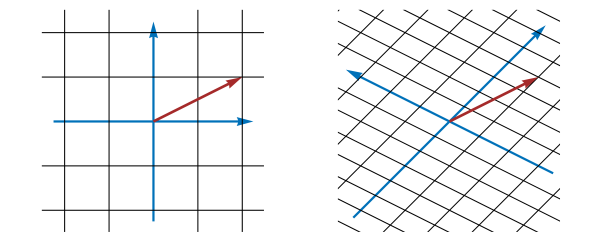
While \(\mathbb{K}^n\) is equipped with the standard coordinate system, in an abstract vector space \(V\) there is no preferred linear coordinate system and a choice of linear coordinate system corresponds to choosing a so-called ordered basis of \(V.\)
Definition 3.91 • Ordered basis
Let \(V\) be a finite dimensional \(\mathbb{K}\)-vector space. An (ordered) \(n\)-tuple \(\mathbf{b}=(v_1,\ldots,v_n)\) of vectors from \(V\) is called an ordered basis of \(V\) if the set \(\{v_1,\ldots,v_n\}\) is a basis of \(V.\)
Ordered bases correspond to linear coordinate systems in the following sense:
Proposition 3.92
On a finite dimensional \(\mathbb{K}\)-vector space \(V\) there is a bijective correspondence between the set of linear coordinate systems and the set of ordered bases.
For the proof of Proposition 3.92 we need the following important lemma which states in particular that two linear maps \(f, g : V \to W\) are the same if and only if they agree on an ordered basis of \(V.\)
Lemma 3.93
Let \(V,W\) be finite dimensional \(\mathbb{K}\)-vector spaces.
Suppose \(f,g : V \to W\) are linear maps and \(\mathbf{b}=(v_1,\ldots,v_n)\) is an ordered basis of \(V.\) Then \(f=g\) if and only if \(f(v_i)=g(v_i)\) for all \(1\leqslant i\leqslant n.\)
If \(\dim V=\dim W\) and \(\mathbf{b}=(v_1,\ldots,v_n)\) is an ordered basis of \(V\) and \(\mathbf{c}=(w_1,\ldots,w_n)\) an ordered basis of \(W,\) then there exists a unique isomorphism \(f : V \to W\) such that \(f(v_i)=w_i\) for all \(1\leqslant i\leqslant n.\)
Proof. (i) \(\Rightarrow\) If \(f=g\) then \(f(v_i)=g(v_i)\) for all \(1\leqslant i\leqslant n.\) \(\Leftarrow\) Let \(v \in V.\) Since \(\mathbf{b}\) is an ordered basis of \(V\) there exist unique scalars \(s_1,\ldots,s_n \in \mathbb{K}\) such that \(v=\sum_{i=1}^n s_i v_i.\) Using the linearity of \(f\) and \(g,\) we compute \[f(v)=f\left(\sum_{i=1}^n s_i v_i\right)=\sum_{i=1}^ns_if(v_i)=\sum_{i=1}^ns_ig(v_i)=g\left(\sum_{i=1}^n s_i v_i\right)=g(v)\] so that \(f=g.\)
(ii) Let \(v \in V.\) Since \(\{v_1,\ldots,v_n\}\) is a basis of \(V\) there exist unique scalars \(s_1,\ldots,s_n\) such that \(v=\sum_{i=1}^n s_i v_i.\) We define \(f(v)=\sum_{i=1}^ns_i w_i,\) so that in particular \(f(v_i)=w_i\) for \(1\leqslant i\leqslant n.\) Since \(\{w_1,\ldots,w_n\}\) are linearly independent we have \(f(v)=0_W\) if and only if \(s_1=\cdots=s_n=0,\) that is \(v=0_V.\) Lemma 3.31 implies that \(f\) is injective and hence an isomorphism by Corollary 3.77. The uniqueness of \(f\) follows from (i).
Remark 3.94
Lemma 3.93 fails for maps which are not linear. Consider \[f : \mathbb{R}^2\to \mathbb{R}, \quad \begin{pmatrix} x_1 \\ x_2\end{pmatrix} \mapsto x_1x_2\] and \[g : \mathbb{R}^2 \to \mathbb{R}\quad \begin{pmatrix} x_1 \\ x_2\end{pmatrix} \mapsto (x_1-1)(x_2-1).\] Then \(f(\vec{e}_1)=g(\vec{e}_1)\) and \(f(\vec{e}_2)=g(\vec{e}_2),\) but \(f\neq g.\)
Proof of Proposition 3.92. Given an ordered basis \(\mathbf{b}=(v_1,\ldots,v_n)\) of \(V,\) the previous lemma implies that there is a unique linear coordinate system \(\boldsymbol{\beta}: V \to \mathbb{K}^n\) such that \[\tag{3.14} \boldsymbol{\beta}(v_i)=\vec{e}_i\] for \(1\leqslant i \leqslant n,\) where \(\{\vec{e}_1,\ldots,\vec{e}_n\}\) denotes the standard basis of \(\mathbb{K}^n.\) Conversely, if \(\boldsymbol{\beta}: V \to \mathbb{K}^n\) is a linear coordinate system, we obtain an ordered basis of \(V\) \[\mathbf{b}=(\boldsymbol{\beta}^{-1}(\vec{e}_1),\ldots,\boldsymbol{\beta}^{-1}(\vec{e}_n))\] and these assignments are clearly inverse to each other.
In the special case where \(V=\mathbb{K}^n,\) the bijective correspondence between linear coordinate systems and ordered bases can be made more explicit. Given an ordered basis \(\mathbf{b}=(\vec{v}_1,\ldots,\vec{v}_n)\) of \(\mathbb{K}^n,\) we can form an invertible matrix \(\mathbf{B}=(B_{ij})_{1\leqslant i,j\leqslant n} \in M_{n,n}(\mathbb{K})\) whose columns are the elements of the ordered basis \(\mathbf{b}.\) That is, we have \(B_{ij}=[\vec{v}_j]_i\) for \(1\leqslant i,j\leqslant n.\) The linear coordinate system corresponding to \(\mathbf{b}\) is a linear map \(\boldsymbol{\beta}: \mathbb{K}^n \to \mathbb{K}^n\) and hence \(\boldsymbol{\beta}=f_{\mathbf{A}}\) for some matrix \(\mathbf{A}=(A_{ij})_{1\leqslant i,j\leqslant n} \in M_{n,n}(\mathbb{K}).\) It is natural to wonder how the matrices \(\mathbf{A}\) and \(\mathbf{B}\) are related. By definition of \(\boldsymbol{\beta},\) we have for all \(1\leqslant j\leqslant n\) \[\boldsymbol{\beta}(\vec{v}_j)=\vec{e}_j=\mathbf{A}\vec{v}_j.\] Taking the \(k\)-th entry of the previous vector, where \(1\leqslant k\leqslant n,\) we obtain \[[\vec{e}_j]_k=\delta_{kj}=[\mathbf{A}\vec{v}_j]_k.\] Recall that for \(\vec{x} \in \mathbb{K}^n\) and \(\mathbf{C}=(C_{ij})_{1\leqslant i,j\leqslant n} \in M_{n,n}(\mathbb{K}),\) we have \[[\mathbf{C}\vec{x}]_k=\sum_{i=1}^nC_{ki}[\vec{x}]_i.\] Hence we have for all \(1\leqslant j,k\leqslant n\) \[\delta_{kj}=[\mathbf{A}\vec{v}_j]_k=\sum_{i=1}^nA_{ki}[\vec{v}_j]_i=\sum_{i=1}^nA_{ki}B_{ij}\] which is equivalent to the statement that \(\mathbf{1}_{n}=\mathbf{A}\mathbf{B}.\) Proposition 3.83 implies that \(\mathbf{A}=\mathbf{B}^{-1}.\) We have thus shown:
Proposition 3.95
Let \(\mathbf{b}=(\vec v_1,\ldots,\vec v_n)\) be an ordered basis of \(\mathbb{K}^n\) and let \(\mathbf{B}\) denote the invertible matrix whose columns are the vectors of \(\mathbf{b}.\) Then the linear coordinate system \(\boldsymbol{\beta}\) corresponding to \(\mathbf{b}\) is given by \[\boldsymbol{\beta}: \mathbb{K}^n \to \mathbb{K}^n, \qquad \vec{v} \mapsto \boldsymbol{\beta}(\vec{v})=\mathbf{B}^{-1}\vec{v}.\]
Remark 3.96 • Notation
We will denote an ordered basis by an upright bold Roman letter, such as \(\mathbf{b},\mathbf{c},\mathbf{d}\) or \(\mathbf{e}.\) We will denote the corresponding linear coordinate system by the corresponding bold Greek letter \(\boldsymbol{\beta},\)\(\boldsymbol{\gamma},\)\(\boldsymbol{\delta}\) or \(\boldsymbol{\varepsilon},\) respectively.
Example 3.97 • Example 3.90 continued
The ordered basis corresponding to \(\boldsymbol{\beta}: \mathbb{R}^2 \to \mathbb{R}^2\) is given by \[\mathbf{b}=\left(\tfrac{1}{3}\vec{e}_1+\tfrac{1}{3}\vec{e}_2,-\tfrac{2}{3}\vec{e}_1+\tfrac{1}{3}\vec{e}_2\right)=\left(\left(\begin{smallmatrix} 1/3 \\ 1/3 \end{smallmatrix}\right), \left(\begin{smallmatrix} -2/3 \\ 1/3 \end{smallmatrix}\right)\right).\] Indeed, we have \[\boldsymbol{\beta}\left(\tfrac{1}{3}\vec{e}_1+\tfrac{1}{3}\vec{e}_2\right)=\boldsymbol{\beta}\left(\left(\begin{smallmatrix} 1/3 \\ 1/3 \end{smallmatrix}\right)\right)=\left(\begin{smallmatrix} 1 \\ 0 \end{smallmatrix}\right)=\vec{e}_1\] and \[\boldsymbol{\beta}\left(-\tfrac{2}{3}\vec{e}_1+\tfrac{1}{3}\vec{e}_2\right)=\boldsymbol{\beta}\left(\left(\begin{smallmatrix} -2/3 \\ 1/3 \end{smallmatrix}\right)\right)=\left(\begin{smallmatrix} 0 \\ 1 \end{smallmatrix}\right)=\vec{e}_2.\] Notice that the matrix \[\mathbf{B}=\frac{1}{3}\begin{pmatrix} 1 & -2 \\ 1 & 1 \end{pmatrix}\] whose columns are the vectors of the ordered basis \(\mathbf{b}\) satisfies \[\mathbf{B}^{-1}=\begin{pmatrix} 1 & 2 \\ -1 & 1 \end{pmatrix}\] and that \(\boldsymbol{\beta}(\vec{v})=f_{\mathbf{B}^{-1}}(\vec{v})=\mathbf{B}^{-1}\vec{v}\) for all \(\vec{v} \in \mathbb{R}^2,\) as predicted by Proposition 3.95.
Example 3.98
On the vector space of \(2\)-by-\(2\) matrices \(V=M_{2,2}(\mathbb{K})\) we consider the ordered basis \(\mathbf{b}=(\mathbf{E}_{1,1},\mathbf{E}_{1,2},\mathbf{E}_{2,1},\mathbf{E}_{2,2}).\) Then the corresponding linear coordinate system \(\boldsymbol{\beta}: M_{2,2} \to \mathbb{K}^4\) is given by Example 3.87.
Example 3.99
On the vector space of polynomials of degree at most two \(V=\mathsf{P}_2(\mathbb{R})\) we consider the ordered basis \(\mathbf{b}=(x^2,x,1).\) Then the corresponding linear coordinate system \(\boldsymbol{\beta}: \mathsf{P}_2(\mathbb{R}) \to \mathbb{R}^3\) is given by Example 3.88.
Example 3.100
Let \(V=\mathbb{K}^3\) and \(\mathbf{e}=(\vec{e}_1,\vec{e}_2,\vec{e}_3)\) denote the ordered standard basis. Then for all \(\vec{x}=(x_i)_{1\leqslant i\leqslant 3}\in \mathbb{R}^3\) we have \[\boldsymbol{\varepsilon}(\vec{x})=\vec{x}.\] where \(\boldsymbol{\varepsilon}\) denotes the linear coordinate system corresponding to \(\mathbf{e}.\) Notice that \(\boldsymbol{\varepsilon}\) is the standard coordinate system on \(\mathbb{K}^n.\) Considering instead the ordered basis \(\mathbf{b}=(\vec{v}_1,\vec{v}_2,\vec{v}_3)=(\vec{e}_1+\vec{e}_3,\vec{e}_3,\vec{e}_2-\vec{e}_1),\) we obtain \[\boldsymbol{\beta}(\vec{x})=\begin{pmatrix} x_1+x_2 \\ -x_1-x_2+x_3 \\ x_2\end{pmatrix}=\underbrace{\begin{pmatrix} 1 & 1 & 0 \\ -1 & -1 & 1 \\ 0 & 1 & 0 \end{pmatrix}}_{=\mathbf{A}}\vec{x}\] since \[\vec{x}=\begin{pmatrix} x_1 \\ x_2 \\ x_3\end{pmatrix}=(x_1+x_2)\underbrace{\begin{pmatrix}1 \\ 0 \\ 1 \end{pmatrix}}_{=\vec{v}_1}+(x_3-x_1-x_2)\underbrace{\begin{pmatrix} 0 \\ 0 \\ 1 \end{pmatrix}}_{=\vec{v}_2}+x_2\underbrace{\begin{pmatrix}-1 \\ 1 \\ 0 \end{pmatrix}}_{=\vec{v}_3}.\] Notice that the matrix \(\mathbf{B}\) whose columns are the vectors of \(\mathbf{b}\) is given by \[\mathbf{B}=\begin{pmatrix} 1 & 0 & -1 \\ 0 & 0 & 1 \\ 1 & 1 & 0 \end{pmatrix}\] and that \(\mathbf{A}\mathbf{B}=\mathbf{1}_{3},\) as predicted by Proposition 3.95.
3.7.1 Change of basis
It is natural to ask how a change of basis affects the coordinates of a vector. To answer this we need the following:
Definition 3.101 • Change of basis matrix
Let \(V\) be a \(\mathbb{K}\)-vector space of dimension \(n\) and \(\mathbf{b}, \mathbf{b}^{\prime}\) be ordered bases of \(V\) with corresponding linear coordinate systems \(\boldsymbol{\beta},\boldsymbol{\beta}^{\prime}.\) The change of basis matrix from \(\mathbf{b}\) to \(\mathbf{b}^{\prime}\) is the matrix \(\mathbf{C}\in M_{n,n}(\mathbb{K})\) satisfying \[\tag{3.15} f_\mathbf{C}=\boldsymbol{\beta}^{\prime}\circ \boldsymbol{\beta}^{-1}.\] We will write \(\mathbf{C}(\mathbf{b},\mathbf{b}^{\prime})\) for the change of basis matrix from \(\mathbf{b}\) to \(\mathbf{b}^{\prime}.\)
Remark 3.102
From (3.15) we obtain \(\boldsymbol{\beta}^{\prime}(v)=\left(\boldsymbol{\beta}^{\prime}\circ \boldsymbol{\beta}^{-1}\circ\boldsymbol{\beta}\right)(v)=f_{\mathbf{C}}(\boldsymbol{\beta}(v)).\) Using that we write \(\mathbf{C}(\mathbf{b},\mathbf{b}^{\prime})\) for \(\mathbf{C}\) we thus have \[\tag{3.16} \boldsymbol{\beta}^{\prime}(v)=\mathbf{C}(\mathbf{b},\mathbf{b}^{\prime})\boldsymbol{\beta}(v).\]
The change of basis matrix can be computed as follows:
Lemma 3.103
Let \(V\) be a \(\mathbb{K}\)-vector space of dimension \(n\) and \(\mathbf{b}=(v_1,\ldots,v_n)\) and \(\mathbf{b}^{\prime}=(v_1^{\prime},\ldots,v_n^{\prime})\) ordered bases on \(V.\) Then there are unique scalars \(C_{ij},\) \(1\leqslant i,j\leqslant n\) so that \(v_j=\sum_{i=1}^n C_{ij}v_i^{\prime}.\) Setting \(\mathbf{C}=(C_{ij})_{1\leqslant i,j\leqslant n},\) the matrix \(\mathbf{C}\) is the change of basis matrix from \(\mathbf{b}\) to \(\mathbf{b}^{\prime},\) that is \(\mathbf{C}=\mathbf{C}(\mathbf{b},\mathbf{b}^{\prime}).\)
Remark 3.104
For \(1\leqslant j\leqslant n\) let \(\vec{c}_{j}\) denote the \(j\)-th column vector of the change of basis matrix \(\mathbf{C}(\mathbf{b},\mathbf{b}^{\prime})\) so that \[\vec{c}_j=\begin{pmatrix} C_{1j} \\ C_{2j} \\ \vdots \\ C_{nj} \end{pmatrix}.\] By the previous lemma, we have \[v_j=C_{1j}\vec{v}_1^{\prime}+C_{2j}\vec{v}_2^{\prime}+\cdots+C_{nj}\vec{v}_n^{\prime}.\] The \(j\)-th column vector of \(\mathbf{C}(\mathbf{b},\mathbf{b}^{\prime})\) thus arises by expressing the \(j\)-th basis vector \(v_j\) of \(\mathbf{b}\) as a linear combination of the elements of the ordered basis \(\mathbf{b}^{\prime}=(v_1^{\prime},\ldots,v_n^{\prime})\) and writing the corresponding coefficients into a column vector.
Proof of Lemma 3.103. Fix \(j\in \{1,\ldots,n\}.\) Then the scalars \(C_{ij}\in \mathbb{K}\) for \(1\leqslant i\leqslant n\) exist, since the vectors \(\{v^{\prime}_1,\ldots,v^{\prime}_n\}\) are a basis of \(V.\) If \(\hat{C}_{ij}\) for \(1\leqslant i\leqslant n\) are also scalars so that \(v_j=\sum_{i=1}^n \hat{C}_{ij}v^{\prime}_i,\) then \[v_j-v_j=0_V=\sum_{i=1}^n C_{ij}v^{\prime}_j-\sum_{i=1}^n \hat{C}_{ij}v^{\prime}_j=\sum_{i=1}^n (C_{ij}-\hat{C}_{ij})v^{\prime}_j\] which is only possibly if \(C_{ij}=\hat{C}_{ij}\) for all \(1\leqslant i\leqslant n,\) since \(\{v^{\prime}_1,\ldots,v^{\prime}_n\}\) are linearly independent. It follows that \(\mathbf{C}=(C_{ij})_{1\leqslant i,j\leqslant n}\) is well-defined.
We next argue that \(\boldsymbol{\beta}^{\prime}\circ \boldsymbol{\beta}^{-1}=f_{\mathbf{C}}.\) Using Lemma 3.93 it is sufficient to show that \((\boldsymbol{\beta}^{\prime}\circ \boldsymbol{\beta}^{-1})(\vec{e}_j)=f_{\mathbf{C}}(\vec{e}_j)\) for \(1\leqslant j\leqslant n,\) where \((\vec{e}_1,\ldots,\vec{e}_n)\) denotes the ordered standard basis of \(\mathbb{K}^n.\) Using the definition of \(\mathbf{C}\) and the linearity of \(\boldsymbol{\beta}^{\prime},\) we obtain \[\begin{aligned} \left(\boldsymbol{\beta}^{\prime}\circ \boldsymbol{\beta}^{-1}\right)(\vec{e}_j)&=\boldsymbol{\beta}^{\prime}(\boldsymbol{\beta}^{-1}(\vec{e}_j))=\boldsymbol{\beta}^{\prime}(v_j)=\boldsymbol{\beta}^{\prime}\left(\sum_{i=1}^n C_{ij}v_i^{\prime}\right)=\sum_{i=1}^nC_{ij}\boldsymbol{\beta}^{\prime}(v_i^{\prime})\\ &=\sum_{i=1}^nC_{ij}\vec{e}_i=\mathbf{C}\vec{e}_j=f_{\mathbf{C}}(\vec{e}_j), \end{aligned}\] where we also use that \(\boldsymbol{\beta}^{-1}(\vec{e}_j)=v_j\) and that \(\boldsymbol{\beta}^{\prime}(v^{\prime}_i)=\vec{e}_i\) for \(1\leqslant i,j\leqslant n.\)
In the case of \(V=\mathbb{K}^n\) the change of basis matrix can alternatively be computed as follows:
Proposition 3.105
On \(V=\mathbb{K}^n\) consider the ordered bases \(\mathbf{b}=(\vec v_1,\ldots,\vec v_n)\) and \(\mathbf{b}^{\prime}=(\vec v_1^{\prime},\ldots,\vec v_n^{\prime}).\) Let \(\mathbf{B}\) and \(\mathbf{B}^{\prime}\) denote the invertible matrices whose columns are the vectors of \(\mathbf{b}\) and \(\mathbf{b}^{\prime},\) respectively. Then we have \[\mathbf{C}(\mathbf{b}^{\prime},\mathbf{b})=\mathbf{B}^{-1}\mathbf{B}^{\prime}.\]
Proof. Left as an exercise.
Example 3.106 • Example 3.97 continued
Consider \(V=\mathbb{R}^2\) equipped with the ordered basis \(\mathbf{e}=(\vec{e}_1,\vec{e}_2)\) and the ordered basis \(\mathbf{b}=\left(\tfrac{1}{3}\vec{e}_1+\tfrac{1}{3}\vec{e}_2,-\tfrac{2}{3}\vec{e}_1+\tfrac{1}{3}\vec{e}_2\right).\) Then we have \[\vec{e}_1=1\cdot\left(\tfrac{1}{3}\vec{e}_1+\tfrac{1}{3}\vec{e}_2\right)+(-1)\cdot\left(-\tfrac{2}{3}\vec{e}_1+\tfrac{1}{3}\vec{e}_2\right).\] Therefore, the first column vector of the change of basis matrix \(\mathbf{C}(\mathbf{e},\mathbf{b})\) is given by \[\vec{c}_1=\begin{pmatrix} 1 \\ -1 \end{pmatrix}.\] Likewise, we obtain \[\vec{e}_2=2\cdot\left(\tfrac{1}{3}\vec{e}_1+\tfrac{1}{3}\vec{e}_2\right)+1\cdot\left(-\tfrac{2}{3}\vec{e}_1+\tfrac{1}{3}\vec{e}_2\right)\] so that \[\vec{c}_2=\begin{pmatrix} 2 \\ 1 \end{pmatrix}\] and hence \[\mathbf{C}(\mathbf{e},\mathbf{b})=\begin{pmatrix} 1 & 2 \\ -1 & 1 \end{pmatrix}.\] Alternatively, we have \[\mathbf{B}=\frac{1}{3}\begin{pmatrix} 1 & -2 \\ 1 & 1 \end{pmatrix} \qquad \text{and} \qquad \mathbf{E}=\begin{pmatrix} 1 & 0 \\ 0 & 1 \end{pmatrix}=\mathbf{1}_{2}\] so that by Proposition 3.105 we obtain \[\mathbf{C}(\mathbf{e},\mathbf{b})=\mathbf{B}^{-1}\mathbf{E}=\mathbf{B}^{-1}=\begin{pmatrix} 1 & 2 \\ -1 & 1 \end{pmatrix}.\] Recall from Example 3.90 that the vector \(\vec{v}=2\vec{e}_1+\vec{e}_2\) satisfies \[\boldsymbol{\varepsilon}(\vec{v})=\begin{pmatrix} 2 \\ 1 \end{pmatrix} \qquad \text{and} \qquad \boldsymbol{\beta}(\vec{v})=\begin{pmatrix} 4 \\ -1 \end{pmatrix}\] where \(\boldsymbol{\varepsilon}\) and \(\boldsymbol{\beta}\) denotes the linear coordinate system corresponding to \(\mathbf{e}\) and \(\mathbf{b},\) respectively. Indeed we have \[\boldsymbol{\beta}(v)=\begin{pmatrix} 4 \\ -1 \end{pmatrix}=\begin{pmatrix} 1 & 2 \\ -1 & 1 \end{pmatrix}\begin{pmatrix} 2 \\ 1 \end{pmatrix}=\mathbf{C}(\mathbf{e},\mathbf{b})\boldsymbol{\varepsilon}(v),\] in agreement with (3.16).
Fixing linear coordinate systems – or equivalently ordered bases – on finite dimensional vector spaces \(V,W\) also allows to describe each linear map \(g :V \to W\) in terms of a matrix:
Definition 3.107 • Matrix representation of a linear map
Let \(V,W\) be finite dimensional \(\mathbb{K}\)-vector spaces, \(\mathbf{b}\) an ordered basis of \(V\) and \(\mathbf{c}\) an ordered basis of \(W.\) The matrix representation of a linear map \(g : V \to W\) with respect to the ordered bases \(\mathbf{b}\) and \(\mathbf{c}\) is the unique matrix \(\mathbf{M}(g,\mathbf{b},\mathbf{c}) \in M_{m,n}(\mathbb{K})\) such that \[f_{\mathbf{M}(g,\mathbf{b},\mathbf{c})}=\boldsymbol{\gamma}\circ g \circ \boldsymbol{\beta}^{-1},\] where \(\boldsymbol{\beta}\) and \(\boldsymbol{\gamma}\) denote the linear coordinate systems corresponding to \(\mathbf{b}\) and \(\mathbf{c},\) respectively.
The role of the different mappings can be summarised in terms of the following diagram: \[\begin{CD} V @>g>> W \\ @A{\boldsymbol{\beta}^{-1}}AA @VV{\boldsymbol{\gamma}}V\\ \mathbb{K}^n @>f_{\mathbf{M}(g,\mathbf{b},\mathbf{c})}>> \mathbb{K}^m \\ \end{CD}\] In practise, we can compute the matrix representation of a linear map as follows:
Proposition 3.108
Let \(V,W\) be finite dimensional \(\mathbb{K}\)-vector spaces, \(\mathbf{b}=(v_1,\ldots,v_n)\) an ordered basis of \(V,\) \(\mathbf{c}=(w_1,\ldots,w_m)\) an ordered basis of \(W\) and \(g : V \to W\) a linear map. Then there exist unique scalars \(A_{ij} \in \mathbb{K},\) where \(1\leqslant i\leqslant m, 1\leqslant j \leqslant n\) such that \[\tag{3.17} g(v_j)=\sum_{i=1}^m A_{ij}w_i, \qquad 1\leqslant j\leqslant n.\] Furthermore, the matrix \(\mathbf{A}=(A_{ij})_{1\leqslant i\leqslant m, 1\leqslant j \leqslant n}\) satisfies \[f_\mathbf{A}=\boldsymbol{\gamma}\circ g \circ \boldsymbol{\beta}^{-1}\] and hence is the matrix representation of \(g\) with respect to the ordered bases \(\mathbf{b}\) and \(\mathbf{c}.\)
The proof is very similar to the proof of Lemma 3.103.
Proof of Proposition 3.108. For all \(1\leqslant j\leqslant n\) the vector \(g(v_j)\) is an element of \(W\) and hence a linear combination of the vectors \(\mathbf{c}=(w_1,\ldots,w_m),\) as \(\mathbf{c}\) is an ordered basis of \(W.\) We thus have scalars \(A_{ij}\in \mathbb{K}\) with \(1\leqslant i\leqslant m, 1\leqslant j \leqslant n\) such that \(g(v_j)=\sum_{i=1}^m A_{ij}w_i.\) If \(\hat{A}_{ij} \in \mathbb{K}\) with \(1\leqslant i\leqslant m, 1\leqslant j \leqslant n\) also satisfy \(g(v_j)=\sum_{i=1}^m\hat{A}_{ij}w_i,\) then subtracting the two equations gives \[g(v_j)-g(v_j)=0_{W}=\sum_{i=1}^m(A_{ij}-\hat{A}_{ij})w_i\] so that \(0=A_{ij}-\hat{A}_{ij}\) for \(1\leqslant i\leqslant m, 1\leqslant j \leqslant n,\) since the vectors \((w_1,\ldots,w_m)\) are linearly independent. It follows that the scalars \(A_{ij}\) are unique.
We want to show that \(f_\mathbf{A}\circ \boldsymbol{\beta}=\boldsymbol{\gamma}\circ g.\) Using Lemma 3.93 it is sufficient to show that \((f_{\mathbf{A}}\circ \boldsymbol{\beta})(v_j)=(\boldsymbol{\gamma}\circ g)(v_j)\) for \(1\leqslant j\leqslant n.\) Let \(\{\vec{e}_1,\ldots,\vec{e}_n\}\) denote the standard basis of \(\mathbb{K}^n\) so that \(\boldsymbol{\beta}(v_j)=\vec{e}_j\) and \(\{\vec{d}_1,\ldots,\vec{d}_m\}\) the standard basis of \(\mathbb{K}^m\) so that \(\boldsymbol{\gamma}(w_i)=\vec{d}_i.\) We compute \[\begin{aligned} (f_\mathbf{A}\circ \boldsymbol{\beta})(v_j)&=f_\mathbf{A}(\vec{e}_j)=\mathbf{A}\vec{e}_j=\sum_{i=1}^mA_{ij}\vec{d}_i=\sum_{i=1}^mA_{ij}\boldsymbol{\gamma}(w_i)=\boldsymbol{\gamma}\left(\sum_{i=1}^m A_{ij}w_i\right)\\ &=\boldsymbol{\gamma}(g(v_j))=(\boldsymbol{\gamma}\circ g)(v_j) \end{aligned}\] where we have used the linearity of \(\boldsymbol{\gamma}\) and (3.17).
This all translates to a simple recipe for calculating the matrix representation of a linear map, which we now illustrate in some examples.
Example 3.109
Let \(V=\mathsf{P}_{2}(\mathbb{R})\) and \(W=\mathsf{P}_{1}(\mathbb{R})\) and \(g=\frac{\mathrm{d}}{\mathrm{d}x}.\) We consider the ordered basis \(\mathbf{b}=(v_1,v_2,v_3)=((1/2)(3x^2-1),x,1)\) of \(V\) and \(\mathbf{c}=(w_1,w_2)=(x,1)\) of \(W.\)
Compute the image under \(g\) of the elements \(v_i\) of the ordered basis \(\mathbf{b}.\) \[\begin{aligned} g\left(\frac{1}{2}(3x^2-1)\right)&=\frac{\mathrm{d}}{\mathrm{d}x}\left(\frac{1}{2}(3x^2-1)\right)=3x\\ g\left(x\right)&=\frac{\mathrm{d}}{\mathrm{d}x}(x)=1\\ g\left(1\right)&=\frac{\mathrm{d}}{\mathrm{d}x}(1)=0. \end{aligned}\]
Write the image vectors as linear combinations of the elements of the ordered basis \(\mathbf{c}.\) \[\tag{3.18} \begin{aligned} 3x &=3\cdot w_1+ 0\cdot w_2 \\ 1 & = 0\cdot w_1+ 1 \cdot w_2 \\ 0 & = 0\cdot w_1+0 \cdot w_2 \end{aligned}\]
Taking the transpose of the matrix of coefficients appearing in (3.18) gives the matrix representation \[\mathbf{M}\left(\frac{\mathrm{d}}{\mathrm{d}x},\mathbf{b},\mathbf{c}\right)=\begin{pmatrix} 3 & 0 & 0 \\ 0 & 1 & 0 \end{pmatrix}.\] of the linear map \(g=\frac{\mathrm{d}}{\mathrm{d}x}\) with respect to the bases \(\mathbf{b},\mathbf{c}.\)
Example 3.110
Let \(\mathbf{e}=(\vec{e}_1,\ldots,\vec{e}_n)\) and \(\mathbf{d}=(\vec{d}_1,\ldots,\vec{d}_m)\) denote the ordered standard basis of \(\mathbb{K}^n\) and \(\mathbb{K}^m,\) respectively. Then for \(\mathbf{A}\in M_{m,n}(\mathbb{K}),\) we have \[\mathbf{A}=\mathbf{M}(f_\mathbf{A},\mathbf{e},\mathbf{d}),\] that is, the matrix representation of the mapping \(f_\mathbf{A}: \mathbb{K}^n \to \mathbb{K}^m\) with respect to the standard bases is simply the matrix \(\mathbf{A}.\) Indeed, we have \[f_\mathbf{A}(\vec{e}_j)=\mathbf{A}\vec{e}_j=\begin{pmatrix} A_{1j} \\ \vdots \\ A_{mj} \end{pmatrix}=\sum_{i=1}^m A_{ij}\vec{d}_i.\]
Example 3.111
Let \(\mathbf{e}=(\vec{e}_1,\vec{e}_2)\) denote the ordered standard basis of \(\mathbb{R}^2.\) Consider the matrix \[\mathbf{A}=\begin{pmatrix} 5 & 1 \\ 1 & 5 \end{pmatrix}=\mathbf{M}(f_\mathbf{A},\mathbf{e},\mathbf{e}).\] We want to compute \(\mathrm{Mat}(f_\mathbf{A},\mathbf{b},\mathbf{b}),\) where \(\mathbf{b}=(\vec{v}_1,\vec{v}_2)=(\vec{e}_1+\vec{e}_2,\vec{e}_2-\vec{e}_1)\) is not the standard basis of \(\mathbb{R}^2.\) We obtain \[\begin{aligned} f_\mathbf{A}(\vec{v}_1)&=\mathbf{A}\vec{v}_1=\begin{pmatrix} 5 & 1 \\ 1 & 5 \end{pmatrix}\begin{pmatrix} 1 \\ 1 \end{pmatrix}=\begin{pmatrix} 6 \\ 6 \end{pmatrix}=6\cdot \vec{v}_1+ 0\cdot \vec{v}_2\\ f_\mathbf{A}(\vec{v}_2)&=\mathbf{A}\vec{v}_2=\begin{pmatrix} 5 & 1 \\ 1 & 5 \end{pmatrix}\begin{pmatrix} -1 \\ 1 \end{pmatrix}=\begin{pmatrix} -4 \\ 4 \end{pmatrix}=0\cdot \vec{v}_1+ 4\cdot \vec{v}_2 \end{aligned}\] Therefore, we have \[\mathbf{M}(f_\mathbf{A},\mathbf{b},\mathbf{b})=\begin{pmatrix} 6 & 0 \\ 0 & 4\end{pmatrix}.\]
Proposition 3.112
Let \(V,W\) be finite dimensional \(\mathbb{K}\)-vector spaces, \(\mathbf{b}\) an ordered basis of \(V\) with corresponding linear coordinate system \(\boldsymbol{\beta},\) \(\mathbf{c}\) an ordered basis of \(W\) with corresponding linear coordinate system \(\boldsymbol{\gamma}\) and \(g : V \to W\) a linear map. Then for all \(v \in V\) we have \[\boldsymbol{\gamma}(g(v))=\mathbf{M}(g,\mathbf{b},\mathbf{c})\boldsymbol{\beta}(v).\]
Proof. By definition we have for all \(\vec{x} \in \mathbb{K}^n\) and \(\mathbf{A}\in M_{m,n}(\mathbb{K})\) \[\mathbf{A}\vec{x}=f_\mathbf{A}(\vec{x}).\] Combining this with Definition 3.107, we obtain for all \(v \in V\) \[\mathbf{M}(g,\mathbf{b},\mathbf{c})\boldsymbol{\beta}(v)=f_{\mathbf{M}(g,\mathbf{b},\mathbf{c})}(\boldsymbol{\beta}(v))=(\boldsymbol{\gamma}\circ g \circ \boldsymbol{\beta}^{-1})(\boldsymbol{\beta}(v))=\boldsymbol{\gamma}(g(v)),\] as claimed.
Remark 3.113
Explicitly, Proposition 3.112 states the following. Let \(\mathbf{A}=\mathbf{M}(g,\mathbf{b},\mathbf{c})\) and let \(v \in V.\) Since \(\mathbf{b}\) is an ordered basis of \(V,\) there exist unique scalars \(s_i \in \mathbb{K},\) \(1\leqslant i\leqslant n\) such that \[v=s_1v_1+\cdots+s_n v_n.\] Then we have \[g(v)=t_1w_1+\cdots+t_m w_m,\] where \[\begin{pmatrix} t_1 \\ \vdots \\ t_m\end{pmatrix}=\mathbf{A}\begin{pmatrix} s_1 \\ \vdots \\ s_n\end{pmatrix}.\]
Example 3.114 • Example 3.109 continued
With respect to the ordered basis \(\mathbf{b}=\left(\frac{1}{2}(3x^2-1),x,1\right),\) the polynomial \(a_2x^2+a_1x+a_0 \in V=\mathsf{P}_2(\mathbb{R})\) is represented by the vector \[\boldsymbol{\beta}(a_2x^2+a_1x+a_0)=\begin{pmatrix} \frac{2}{3}a_2 \\ a_1 \\ \frac{a_2}{3}+a_0\end{pmatrix}\] Indeed \[a_2x^2+a_1x+a_0=\frac{2}{3}a_2\left(\frac{1}{2}(3x^2-1)\right)+a_1x+\left(\frac{a_2}{3}+a_0\right)1.\] Computing \(\mathbf{M}(\frac{\mathrm{d}}{\mathrm{d}x},\mathbf{b},\mathbf{c})\boldsymbol{\beta}(a_2x^2+a_1x+a_0)\) gives \[\begin{pmatrix} 3 & 0 & 0 \\ 0 & 1 & 0 \end{pmatrix}\begin{pmatrix} \frac{2}{3}a_2 \\ a_1 \\ \frac{a_2}{3}+a_0\end{pmatrix}=\begin{pmatrix} 2a_2 \\ a_1 \end{pmatrix}\] and this vector represents the polynomial \(2a_2\cdot x+a_1\cdot 1=\frac{\mathrm{d}}{\mathrm{d}x}(a_2x^2+a_1x+a_0)\) with respect to the basis \(\mathbf{c}=(x,1)\) of \(\mathsf{P}_1(\mathbb{R}).\)
As a corollary to Proposition 3.108 we obtain:
Corollary 3.115
Let \(V_1,V_2,V_3\) be finite dimensional \(\mathbb{K}\)-vector spaces and \(\mathbf{b}_i\) an ordered basis of \(V_i\) for \(i=1,2,3.\) Let \(g_1 : V_1 \to V_2\) and \(g_2 : V_2 \to V_3\) be linear maps. Then \[\mathbf{M}(g_2\circ g_1,\mathbf{b}_1,\mathbf{b}_3)=\mathbf{M}(g_2,\mathbf{b}_2,\mathbf{b}_3)\mathbf{M}(g_1,\mathbf{b}_1,\mathbf{b}_2).\]
Proof. Let us write \(\mathbf{C}=\mathbf{M}(g_2\circ g_1,\mathbf{b}_1,\mathbf{b}_3)\) and \(\mathbf{A}_1=\mathbf{M}(g_1,\mathbf{b}_1,\mathbf{b}_2)\) as well as \(\mathbf{A}_2=\mathbf{M}(g_2,\mathbf{b}_2,\mathbf{b}_3).\) Using Proposition 2.20 and Theorem 2.21 it suffices to show that \(f_\mathbf{C}=f_{\mathbf{A}_2\mathbf{A}_1}=f_{\mathbf{A}_2}\circ f_{\mathbf{A}_1}.\) Now Proposition 3.108 gives \[f_{\mathbf{A}_2}\circ f_{\mathbf{A}_1}=\boldsymbol{\beta}_3\circ g_2 \circ \boldsymbol{\beta}_2^{-1}\circ \boldsymbol{\beta}_2\circ g_1 \circ \boldsymbol{\beta}_1^{-1}=\boldsymbol{\beta}_3\circ g_2\circ g_1\circ \boldsymbol{\beta}_{1}^{-1}=f_\mathbf{C}.\]
Proposition 3.116
Let \(V,W\) be finite dimensional \(\mathbb{K}\)-vector spaces, \(\mathbf{b}\) an ordered basis of \(V\) and \(\mathbf{c}\) an ordered basis of \(W.\) A linear map \(g : V \to W\) is bijective if and only if \(\mathbf{M}(g,\mathbf{b},\mathbf{c})\) is invertible. Moreover, in the case where \(g\) is bijective we have \[\mathbf{M}(g^{-1},\mathbf{c},\mathbf{b})=(\mathbf{M}(g,\mathbf{b},\mathbf{c}))^{-1}.\]
Proof. Let \(n=\dim(V)\) and \(m=\dim(W).\)
\(\Rightarrow\) Let \(g : V \to W\) be bijective so that \(g\) is an isomorphism and hence \(n=\dim(V)=\dim(W)=m\) by Proposition 3.80. Then Corollary 3.115 gives \[\mathbf{M}(g^{-1},\mathbf{c},\mathbf{b})\mathbf{M}(g,\mathbf{b},\mathbf{c})=\mathbf{M}(g^{-1}\circ g,\mathbf{b},\mathbf{b})=\mathbf{M}(\mathrm{Id}_{V},\mathbf{b},\mathbf{b})=\mathbf{1}_{n}\] and \[\mathbf{M}(g,\mathbf{b},\mathbf{c})\mathbf{M}(g^{-1},\mathbf{c},\mathbf{b})=\mathbf{M}(g\circ g^{-1},\mathbf{c},\mathbf{c})=\mathbf{M}(\mathrm{Id}_{W},\mathbf{c},\mathbf{c})=\mathbf{1}_{n}\] so that \(\mathbf{M}(g,\mathbf{b},\mathbf{c})\) is invertible with inverse \(\mathbf{M}(g^{-1},\mathbf{c},\mathbf{b}).\)
\(\Leftarrow\) Conversely suppose \(\mathbf{A}=\mathbf{M}(g,\mathbf{b},\mathbf{c})\) is invertible with inverse \(\mathbf{A}^{-1}.\) It follows that \(n=m\) by Corollary 3.81. We consider \(h=\boldsymbol{\beta}^{-1}\circ f_{\mathbf{A}^{-1}}\circ \boldsymbol{\gamma}: W \to V\) and since \(f_\mathbf{A}=\boldsymbol{\gamma}\circ g \circ \boldsymbol{\beta}^{-1}\) by Proposition 3.108, we have \[g\circ h=\boldsymbol{\gamma}^{-1}\circ f_\mathbf{A}\circ \boldsymbol{\beta}\circ \boldsymbol{\beta}^{-1}\circ f_{\mathbf{A}^{-1}}\circ \boldsymbol{\gamma}=\boldsymbol{\gamma}^{-1}\circ f_{\mathbf{A}\mathbf{A}^{-1}}\circ \boldsymbol{\gamma}=\mathrm{Id}_{W}.\] Likewise, we have \[h\circ g=\boldsymbol{\beta}^{-1}\circ f_{\mathbf{A}^{-1}}\circ \boldsymbol{\gamma}\circ \boldsymbol{\gamma}^{-1}\circ f_\mathbf{A}\circ \boldsymbol{\beta}=\boldsymbol{\beta}^{-1}\circ f_{\mathbf{A}^{-1}\mathbf{A}}\circ\boldsymbol{\beta}=\mathrm{Id}_{V},\] showing that \(g\) admits an inverse mapping \(h : W \to V\) and hence \(g\) is bijective.
Remark 3.117
Notice that the change of basis matrix is also given by the matrix representation of the identity mapping on \(V\): \[\mathbf{C}(\mathbf{b},\mathbf{b}^{\prime})=\mathbf{M}(\mathrm{Id}_V,\mathbf{b},\mathbf{b}^{\prime}).\] Since the identity map \(\mathrm{Id}_V : V \to V\) is bijective with inverse \((\mathrm{Id}_V)^{-1}=\mathrm{Id}_V,\) Proposition 3.116 implies that the change of basis matrix \(\mathbf{C}(\mathbf{b},\mathbf{b}^{\prime})\) is invertible with inverse \[\mathbf{C}(\mathbf{b},\mathbf{b}^{\prime})^{-1}=\mathbf{C}(\mathbf{b}^{\prime},\mathbf{b}).\]
Example 3.118
Let \(V=\mathbb{R}^2\) and \(\mathbf{e}=(\vec{e}_1,\vec{e}_2)\) be the ordered standard basis and \(\mathbf{b}=(\vec{v}_1,\vec{v}_2)=(\vec{e}_1+\vec{e}_2,\vec{e}_2-\vec{e}_1)\) another ordered basis. Recall that if we want to compute \(\mathbf{C}(\mathbf{e},\mathbf{b}),\) we simply need to write each vector of \(\mathbf{e}\) as a linear combination of the elements of \(\mathbf{b}.\) The transpose of the resulting coefficient matrix is then \(\mathbf{C}(\mathbf{e},\mathbf{b}).\) We obtain \[\begin{aligned} \vec{e}_1&=\frac{1}{2}\vec{v}_1-\frac{1}{2}\vec{v}_2,\\ \vec{e}_2&=\frac{1}{2}\vec{v}_1+\frac{1}{2}\vec{v}_2, \end{aligned}\] so that \[\mathbf{C}(\mathbf{e},\mathbf{b})=\begin{pmatrix} \frac{1}{2} & \frac{1}{2} \\ -\frac{1}{2} & \frac{1}{2}\end{pmatrix}.\] Reversing the role of \(\mathbf{e}\) and \(\mathbf{b}\) gives \(\mathbf{C}(\mathbf{b},\mathbf{e})\) \[\begin{aligned} \vec{v}_1&=1\vec{e}_1+1\vec{e}_2,\\ \vec{v}_2&=-1 \vec{e}_1+1\vec{e}_2, \end{aligned}\] so that \[\mathbf{C}(\mathbf{b},\mathbf{e})=\begin{pmatrix} 1 & -1 \\ 1 & 1 \end{pmatrix}.\] Notice that indeed we have \[\mathbf{C}(\mathbf{e},\mathbf{b})\mathbf{C}(\mathbf{b},\mathbf{e})=\begin{pmatrix} \frac{1}{2} & \frac{1}{2} \\ -\frac{1}{2} & \frac{1}{2}\end{pmatrix}\begin{pmatrix} 1 & -1 \\ 1 & 1 \end{pmatrix}=\begin{pmatrix} 1 & 0 \\ 0 & 1 \end{pmatrix}\] so that \(\mathbf{C}(\mathbf{e},\mathbf{b})^{-1}=\mathbf{C}(\mathbf{b},\mathbf{e}).\)
Theorem 3.119
Let \(V,W\) be finite dimensional \(\mathbb{K}\)-vector spaces and \(\mathbf{b},\mathbf{b}^{\prime}\) ordered bases of \(V\) and \(\mathbf{c},\mathbf{c}^{\prime}\) ordered bases of \(W.\) Let \(g : V \to W\) be a linear map. Then we have \[\mathbf{M}(g,\mathbf{b}^{\prime},\mathbf{c}^{\prime})=\mathbf{C}(\mathbf{c},\mathbf{c}^{\prime})\mathbf{M}(g,\mathbf{b},\mathbf{c})\mathbf{C}(\mathbf{b}^{\prime},\mathbf{b})\] In particular, for a linear map \(g : V \to V\) we have \[\mathbf{M}(g,\mathbf{b}^{\prime},\mathbf{b}^{\prime})=\mathbf{C}\,\mathbf{M}(g,\mathbf{b},\mathbf{b})\,\mathbf{C}^{-1},\] where we write \(\mathbf{C}=\mathbf{C}(\mathbf{b},\mathbf{b}^{\prime}).\)
Proof. We write \(\mathbf{A}=\mathbf{M}(g,\mathbf{b},\mathbf{c})\) and \(\mathbf{B}=\mathbf{M}(g,\mathbf{b}^{\prime},\mathbf{c}^{\prime})\) and \(\mathbf{C}=\mathbf{C}(\mathbf{b},\mathbf{b}^{\prime})\) and \(\mathbf{D}=\mathbf{C}(\mathbf{c},\mathbf{c}^{\prime}).\) By Remark 3.117 we have \(\mathbf{C}^{-1}=\mathbf{C}(\mathbf{b}^{\prime},\mathbf{b}),\) hence applying Proposition 2.20 and Theorem 2.21 and Corollary 2.22, we need to show that \[f_\mathbf{B}=f_\mathbf{D}\circ f_\mathbf{A}\circ f_{\mathbf{C}^{-1}}.\] By Definition 3.107 we have \[\begin{aligned} f_\mathbf{A}&=\boldsymbol{\gamma}\circ g \circ \boldsymbol{\beta}^{-1},\\ f_\mathbf{B}&=\boldsymbol{\gamma}^{\prime}\circ g \circ (\boldsymbol{\beta}^{\prime})^{-1} \end{aligned}\] and by Definition 3.101 we have \[\begin{aligned} f_{\mathbf{C}^{-1}}&=\boldsymbol{\beta}\circ (\boldsymbol{\beta}^{\prime})^{-1},\\ f_\mathbf{D}&=\boldsymbol{\gamma}^{\prime}\circ \boldsymbol{\gamma}^{-1}. \end{aligned}\] Hence we obtain \[f_\mathbf{D}\circ f_\mathbf{A}\circ f_{\mathbf{C}^{-1}}=\boldsymbol{\gamma}^{\prime}\circ \boldsymbol{\gamma}^{-1}\circ \boldsymbol{\gamma}\circ g \circ \boldsymbol{\beta}^{-1}\circ \boldsymbol{\beta}\circ (\boldsymbol{\beta}^{\prime})^{-1}=\boldsymbol{\gamma}^{\prime}\circ g \circ (\boldsymbol{\beta}^{\prime})^{-1}=f_\mathbf{B},\] as claimed. The second statement follows again by applying Remark 3.117.
Example 3.120 • Example 3.111 and Example 3.118 continued
Let \(\mathbf{e}=(\vec{e}_1,\vec{e}_2)\) denote the ordered standard basis of \(\mathbb{R}^2\) and \[\mathbf{A}=\begin{pmatrix} 5 & 1 \\ 1 & 5 \end{pmatrix}=\mathbf{M}(f_\mathbf{A},\mathbf{e},\mathbf{e}).\] Let \(\mathbf{b}=(\vec{e}_1+\vec{e}_2,\vec{e}_2-\vec{e}_1).\) We computed that \[\mathbf{M}(f_\mathbf{A},\mathbf{b},\mathbf{b})=\begin{pmatrix} 6 & 0 \\ 0 & 4\end{pmatrix}\] as well as \[\mathbf{C}(\mathbf{e},\mathbf{b})=\begin{pmatrix} \frac{1}{2} & \frac{1}{2} \\ -\frac{1}{2} & \frac{1}{2}\end{pmatrix} \quad \text{and} \quad \mathbf{C}(\mathbf{b},\mathbf{e})=\begin{pmatrix} 1 & -1 \\ 1 & 1 \end{pmatrix}.\] According to Theorem 3.119 we must have \[\mathbf{M}(f_\mathbf{A},\mathbf{b},\mathbf{b})=\mathbf{C}(\mathbf{e},\mathbf{b})\mathbf{M}(f_\mathbf{A},\mathbf{e},\mathbf{e})\mathbf{C}(\mathbf{b},\mathbf{e})\] and indeed \[\begin{pmatrix} 6 & 0 \\ 0 & 4\end{pmatrix} =\begin{pmatrix} \frac{1}{2} & \frac{1}{2} \\ -\frac{1}{2} & \frac{1}{2}\end{pmatrix}\begin{pmatrix} 5 & 1 \\ 1 & 5 \end{pmatrix}\begin{pmatrix} 1 & -1 \\ 1 & 1 \end{pmatrix}.\]
Finally, we observe that every invertible matrix can be realised as a change of basis matrix:
Lemma 3.121
Let \(V\) be a finite dimensional \(\mathbb{K}\)-vector space, \(\mathbf{b}=(v_1,\ldots,v_n)\) an ordered basis of \(V\) and \(\mathbf{C}\in M_{n,n}(\mathbb{K})\) an invertible \(n\times n\)-matrix. Define \(v^{\prime}_j=\sum_{i=1}^n C_{ij}v_i\) for \(1\leqslant i\leqslant n.\) Then \(\mathbf{b}^{\prime}=(v^{\prime}_1,\ldots,v^{\prime}_n)\) is an ordered basis of \(V\) and \(\mathbf{C}(\mathbf{b}^{\prime},\mathbf{b})=\mathbf{C}.\)
Proof. It is sufficient to prove that the vectors \(\{v^{\prime}_1,\ldots,v^{\prime}_n\}\) are linearly independent. Indeed, if they are linearly independent, then they span a subspace \(U\) of dimension \(n\) and Proposition 3.74 implies that \(U=V,\) so that \(\mathbf{b}^{\prime}\) is an ordered basis of \(V.\) Suppose we have scalars \(s_1,\ldots,s_n\) such that \[0_V=\sum_{j=1}^n s_jv^{\prime}_j=\sum_{j=1}^n\sum_{i=1}^n s_j C_{ij}v_i=\sum_{i=1}^n \Big(\sum_{j=1}^n C_{ij}s_j\Big)v_i.\] Since \(\{v_1,\ldots,v_n\}\) is a basis of \(V\) we must have \(\sum_{j=1}^n C_{ij}s_j=0\) for all \(i=1,\ldots,n.\) In matrix notation this is equivalent to the conditon \(\mathbf{C}\vec{s}=0_{\mathbb{K}^n},\) where \(\vec{s}=(s_i)_{1\leqslant i\leqslant n}.\) Since \(\mathbf{C}\) is invertible, we can multiply this last equation from the left with \(\mathbf{C}^{-1}\) to obtain \(\mathbf{C}^{-1}\mathbf{C}\vec{s}=\mathbf{C}^{-1}0_{\mathbb{K}^n}\) which is equivalent to \(\vec{s}=0_{\mathbb{K}^n}.\) It follows that \(\mathbf{b}^{\prime}\) is an ordered basis of \(V.\) By definition we have \(\mathbf{C}(\mathbf{b}^{\prime},\mathbf{b})=\mathbf{C}.\)
Exercises
Exercise 3.122
Let \(\mathrm{Id}_V : V \to V\) denote the identity mapping of the finite dimensional \(\mathbb{K}\)-vector space \(V\) and let \(\mathbf{b}=(v_1,\ldots,v_n)\) be any ordered basis of \(V.\) Show that \(\mathbf{M}(\mathrm{Id}_V,\mathbf{b},\mathbf{b})=\mathbf{1}_{n}.\)
Solution
By Definition 3.107 we have \[f_{\mathbf{M}(\mathrm{Id}_V,\mathbf{b},\mathbf{b})} = \boldsymbol{\beta}\circ \mathrm{Id} \circ \boldsymbol{\beta}^{-1}=\mathrm{Id}_{\mathbb{K}^n}=f_{\mathbf{1}_{n}}\] and hence \(\mathbf{M}(\mathrm{Id}_V,\mathbf{b},\mathbf{b})=\mathbf{1}_{n}.\)