2 Curves
Curves are among the simplest geometric objects that we can study, but they already have non-trivial properties.
2.1 Definitions and examples
Definition 2.1 • Curve
Let \(m \in \mathbb{N}\) and \(I \subset \mathbb{R}\) be an interval. A curve in \(\mathbb{R}^m\) is a continuous map \(\gamma=(\gamma_i)_{1\leqslant i\leqslant m} : I \to \mathbb{R}^m.\) The curve \(\gamma\) is called smooth if \(\gamma : I \to \mathbb{R}^m\) is a smooth map.
Definition 2.2 • Velocity vector
Let \(\gamma=(\gamma_i)_{1\leqslant i\leqslant m} : I \to \mathbb{R}^m\) be a smooth curve.
We define the velocity vector of \(\gamma\) at time \(t \in I\) by \[\dot{\gamma}(t)=\begin{pmatrix} \gamma_1^{\prime}(t) \\ \vdots \\ \gamma_m^{\prime}(t)\end{pmatrix}_{\gamma(t)}.\] Notice that the velocity vector of \(\gamma\) at time \(t \in I\) is an element of the tangent space \(T_{\gamma(t)}\mathbb{R}^m\) at \(\gamma(t).\)
The map \[\dot{\gamma} : I \to T\mathbb{R}^m, \qquad t\mapsto \dot{\gamma}(t)\] is called the velocity vector field along \(\gamma\).
A smooth curve \(\gamma\) satisfying \(\dot{\gamma}(t)\neq 0_{T_{\gamma(t)}\mathbb{R}^m}\) for all \(t \in I\) is called an immersed curve.
Definition 2.3 • Speed and length of a curve
Let \(\gamma : I\to \mathbb{R}^m\) be a smooth curve.
The speed of \(\gamma\) at time \(t \in I\) is defined as \[\Vert \dot{\gamma}(t)\Vert=\sqrt{\langle \dot{\gamma}(t),\dot{\gamma}(t)\rangle}.\]
If \(I=[a,b]\) for real numbers \(a<b,\) we define the length of \(\gamma\) as \[\ell(\gamma)=\int_a^b\Vert \dot{\gamma}(t)\Vert \mathrm{d}t.\]
Remark 2.4
Let \(\gamma : I\to \mathbb{R}^m\) be a smooth curve. Then its Jacobian is \[\mathbf{J}\gamma(t)=\begin{pmatrix} \gamma^{\prime}_1(t) \\ \vdots \\ \gamma^{\prime}_m(t) \end{pmatrix}.\] In particular, we obtain \[\dot{\gamma}(t)=\begin{pmatrix} \gamma^{\prime}_1(t) \\ \vdots \\ \gamma^{\prime}_m(t) \end{pmatrix}_{\gamma(t)}=\vec{w}_{\gamma(t)}=\gamma_*(1_{t}),\] where \(\vec{w}=\mathbf{J}\gamma(t)1.\) The velocity vector \(\dot{\gamma}(t)\) can thus be expressed as the image of \(1_t\) under \(\gamma_*.\)
Example 2.5 • Unit circle
The curve \[\gamma : [0,2\pi] \to \mathbb{R}^2, \quad t \mapsto(\cos(t),\sin(t))\] is smooth and its image \(\gamma([0,2\pi])\) consists of the circle of radius \(1\) centred at \((0,0).\) The curve \(\gamma\) has velocity vector \[\dot{\gamma}(t)=\begin{pmatrix} -\sin(t) \\ \cos(t)\end{pmatrix}_{\gamma(t)}\] and speed \[\Vert \dot{\gamma}(t)\Vert=\sqrt{\langle \dot{\gamma}(t),\dot{\gamma}(t)}=\sqrt{(-\sin(t))^2+(\cos(t))^2}=1\] at time \(t \in [0,2\pi],\) respectively. Therefore, the unit circle has length \[\ell(\gamma)=\int_0^{2\pi}\Vert \dot{\gamma}(t)\Vert\mathrm{d}t=\int_0^{2\pi} 1 \mathrm{d}t=2\pi.\]
Example 2.6 • Non-immersed curve
The curve \[\gamma : \mathbb{R}\to \mathbb{R}^2, \qquad t \mapsto (t^3,t^2)\] is smooth with velocity vector \[\dot{\gamma}(t)=\begin{pmatrix} 3t^2 \\ 2t\end{pmatrix}_{\gamma(t)}\] and speed \[\Vert \dot{\gamma}(t)\Vert=\sqrt{9t^4+4t^2}.\] Since \(\dot{\gamma}(0) \in T_{\gamma(0)}\mathbb{R}^2\) is the zero vector, it is not an immersion.
Example 2.7 • Helix
The curve \[\gamma : \mathbb{R}\to \mathbb{R}^3, \quad t \mapsto (\cos(t),\sin(t),t)\] is smooth and its image \(\gamma(\mathbb{R})\) consists of a helix.
Example 2.8 • Figure-eight curve
The curve \[\gamma : [0,2\pi] \to \mathbb{R}^3, \quad t \mapsto ((2+\cos(2t))\cos(3t),(2+\cos(2t))\sin(3t),\sin(4t))\] is smooth and its image \(\gamma([0,2\pi])\) consists of a figure-eight knot.
Remark 2.9 • Curves and the differential
Given \(U \subset \mathbb{R}^n,\) let \(f : U \to \mathbb{R}^m\) be a smooth map. For \(p \in U\) and \(\vec{v}_{p} \in T_p\mathbb{R}^n\) we would like to interpret the tangent vector \(f_*(\vec{v}_{p}) \in T_{f(p)}\mathbb{R}^m.\) For \(\varepsilon> 0\) consider a smooth curve \(\gamma : (-\varepsilon,\varepsilon) \to U\) with \(\gamma(0)=p\) and \(\dot{\gamma}(0)=\vec{v}_{p}.\) For instance the curve \[\gamma : (-\varepsilon,\varepsilon) \to \mathbb{R}^n, \qquad t \mapsto \gamma(t)=p+tv\] satisfies \(\gamma(0)=p\) and \(\dot{\gamma}(0)=\vec{v}_p.\) Here we write \[\vec{v}_p=\begin{pmatrix} v_1 \\ \vdots \\ v_n \end{pmatrix}_p \quad \text{and} \quad v=(v_1,\ldots,v_n).\] The composition of \(f\) and \(\gamma\) is then a smooth curve \(\xi=f\circ \gamma : (-\varepsilon,\varepsilon) \to \mathbb{R}^m\) satisfying \(\xi(0)=f(\gamma(0))=f(p)\) and velocity vector \[\dot{\xi}(0)=(f\circ \gamma)_*(1_{0})=f_*(\gamma_*(1_0))=f_*(\dot{\gamma}(0))=f_*(\vec{v}_p),\] where the second equality sign uses the chain rule (1.3). The image of \(\vec{v}_{p}\) under \(f_*\) can thus be interpreted as the velocity vector at \(0\) of the curve \(\xi=f \circ \gamma.\)
If \(\gamma : I \to \mathbb{R}^m\) is a smooth curve, the map \(\dot{\gamma} : I \to T\mathbb{R}^m,\) \(t \mapsto \dot{\gamma}(t)\) assigns a tangent vector at \(\gamma(t)\) to every time \(t \in I.\) This is an example of a vector field along a curve.
Definition 2.10 • Vector field along a curve
Let \(\gamma : I \to \mathbb{R}^m\) be a curve. A map \[X : I \to T\mathbb{R}^m, \qquad t \mapsto X(t)\] is called a vector field along \(\gamma\) if \(X(t) \in T_{\gamma(t)}\mathbb{R}^m\) for all \(t \in I.\) There exist unique functions \(X_i : I \to \mathbb{R},\) \(1\leqslant i\leqslant m\) so that \[X(t)=\begin{pmatrix} X_1(t) \\ \vdots \\ X_n(t)\end{pmatrix}_{\gamma(t)}.\] The vector field \(X\) along \(\gamma\) is called smooth if the functions \(X_i : I \to \mathbb{R}\) are smooth for all \(1\leqslant i\leqslant m.\)
2.2 Unit speed curves
Definition 2.11 • Parameter on an interval
A smooth parameter on an interval \(I\) is a smooth injective map \(\varphi : I \to \mathbb{R}\) which is a diffeomorphism onto its image \(J=\varphi(I).\) The inverse map \(\varphi^{-1} : J \to I\) is called a parametrisation of \(I\).
Example 2.12 • Sigmoid function
The sigmoid function \[\varphi : \mathbb{R}\to (0,1), \qquad t \mapsto \frac{1}{1+\mathrm{e}^{-t}}\] is a smooth parameter on \(\mathbb{R}.\)
Example 2.13
The tangent function \[\varphi : (-\pi/2,\pi/2) \to \mathbb{R}, \qquad t \mapsto \tan(t)\] is a smooth parameter on \((-\pi/2,\pi/2).\)
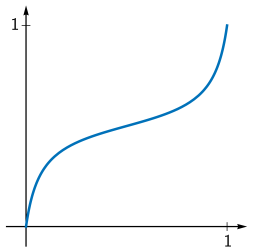
For \(\delta \in (0,\pi/2)\) we can use the tangent function to define a smooth parameter \[\tag{2.1} \varphi : [0,1] \to [0,1], \qquad t \mapsto \frac{\tan(-\delta+2t\delta)-\tan(-\delta)}{2\tan(\delta)}\] with \[\varphi^{-1} : [0,1] \to [0,1], \qquad s \mapsto \frac{1}{2}\left(1-\frac{\arctan(\beta-2\beta s)}{\arctan(\beta)}\right),\] where \(\beta=\tan(\delta).\)
Example 2.14
Recall from Linear Algebra that a linear coordinate system on a finite dimensional vector space \(V\) over \(\mathbb{R}\) is a linear injective map \(\boldsymbol{\beta}: V \to \mathbb{R}^n,\) where \(n=\dim(V).\) A linear coordinate system on \(\mathbb{R}\) –thought of as a \(1\)-dimensional vector space over \(\mathbb{R}\) – is thus also a smooth parameter on \(\mathbb{R}.\)
Remark 2.15
In light of Example 2.14 we can think of a smooth parameter on some interval \(I\) as a coordinate system on \(I\) which is allowed to be non-linear. We may think of this as a notion of non-linear time – see the animation below.
It often simplifies computations if a curve \(\gamma : [a,b] \to \mathbb{R}^n\) has constant unit speed, that is, we have \(\Vert \dot{\gamma}(t)\Vert=1\) for all \(t \in [a,b].\) Given an immersed curve \(\gamma : [a,b] \to \mathbb{R}^n\) of length \(L,\) we may thus ask whether there exists a smooth unit speed curve \(\xi : [0,L] \to \mathbb{R}^n\) such that
\(\xi([0,L])=\gamma([a,b])\);
\(\xi(0)=\gamma(a)\);
\(\xi(L)=\gamma(b).\)
Intuitively, these conditions mean that \(\xi\) travels along the same route as \(\gamma\) (condition (i)), while starting at the same point \(\xi(0)=\gamma(a)\) (condition (ii)) and ending at the same point \(\xi(L)=\gamma(b)\) (condition (iii)). In order to find \(\xi\) we thus have to find a suitable schedule of how to move along \(\gamma.\) This leads to the notion of a reparametrisation.
Definition 2.16 • Reparametrisation of a curve
Let \(\gamma : I\to \mathbb{R}^n\) be a smooth curve. A reparametrisation of \(\gamma\) is a smooth curve \(\xi=\gamma \circ\varphi^{-1} : J \to \mathbb{R}^n,\) where \(\varphi : I \to J\) is a smooth parameter on \(I.\)
Proposition 2.17 • Existence of a unit-speed parametrisation
Let \(\gamma : [a,b]\to \mathbb{R}^n\) be a smooth immersed curve of length \(L.\) Then there exists a smooth parameter \(s: [a,b] \to [0,L]\) so that the reparametrisation \[\xi=\gamma\circ s^{-1} : [0,L] \to \mathbb{R}^n\] of \(\gamma\) is a unit speed curve.
Proof. Consider the map \[s: [a,b] \to \mathbb{R}, \quad t \mapsto \int_a^t\Vert \dot{\gamma}(u)\Vert \mathrm{d}u.\] Clearly, we have \(s(a)=0\) and \(s(b)=L=\int_{a}^b\Vert \dot{\gamma}(u)\Vert \mathrm{d}u.\) By the fundamental theorem of calculus, the map \(s\) is differentiable and we have \[\tag{2.2} s^{\prime}(t)=\Vert \dot{\gamma}(t)\Vert.\] Since \(\gamma\) is an immersed curve we have \(\dot{\gamma}(t)\neq 0_{T_{\gamma(t)}\mathbb{R}^n}\) for all \(t \in [a,b]\) and hence \(s^{\prime}(t)=\Vert \dot{\gamma}(t)\Vert>0\) for all \(t \in [a,b].\) Results from Analysis I imply that \(s\) is strictly increasing and thus a bijective map onto its image \([0,L].\) Moreover \(s^{-1} : [0,L] \to [a,b]\) is differentiable for all \(u \in [0,L]\) and we have \[\tag{2.3} (s^{-1})^{\prime}(u)=\frac{1}{s^{\prime}(t)},\] where \(s(t)=u.\) In particular, \(s: [a,b] \to [0,L]\) is smooth and moreover a diffeomorphism. It remains to show that \(\xi=\gamma\circ s^{-1}\) is a unit speed curve. Using the chain rule we compute for all \(u \in [0,L]\) \[\begin{aligned} \langle \dot{\xi}(u),\dot{\xi}(u)\rangle_{\xi(u)}&=\langle \left(\gamma\circ s^{-1}\right)_*(1_u),\left(\gamma\circ s^{-1}\right)_*(1_u)\rangle_{\gamma(s^{-1}(u))}\\ &=\langle \gamma_*(s^{-1}_*(1_u)),\gamma_*(s^{-1}_*(1_u))\rangle_{\gamma(s^{-1}(u))}. \end{aligned}\] Since by (1.2) we have \[s^{-1}_*(1_u)=(s^{-1})^{\prime}(u)1_{s^{-1}(u)},\] we obtain \[\begin{aligned} \langle \dot{\xi}(u),\dot{\xi}(u)\rangle_{\xi(u)}&=\left[(s^{-1})^{\prime}(u)\right]^2\langle \gamma_*(1_{s^{-1}(u)}),\gamma_*(1_{s^{-1}(u)})\rangle_{\gamma(s^{-1}(u))}\\ &=\left[(s^{-1})^{\prime}(u)\right]^2\Vert \dot{\gamma}(s^{-1}(u))\Vert^2\\ &=\frac{\Vert \dot{\gamma}(s^{-1}(u))\Vert^2}{\left[s^{\prime}(s^{-1}(u))\right]^2}=\frac{\Vert \dot{\gamma}(s^{-1}(u))\Vert^2}{\Vert \dot{\gamma}(s^{-1}(u))\Vert^2}=1, \end{aligned}\] where we use the linearity of \(\gamma_*|_{{}s^{-1}(u)},\) the bilinearity of \(\langle\cdot{,}\cdot\rangle_{\gamma(s^{-1}(u))}\) as well as (2.2) and (2.3).
Remark 2.18 • Arc length
An arc is any smooth curve joining two points.
The parameter \(s: [a,b] \to [0,L]\) associated to a smooth curve \(\gamma : [a,b] \to \mathbb{R}^n\) of length \(L\) is called the arc length parameter of the curve, since \(s(t)\) is the length of the arc connecting \(\gamma(a)\) and \(\gamma(t).\)
The curve \(\gamma\circ s^{-1} : [0,L] \to \mathbb{R}^n\) is called the parametrisation by arc length of \(\gamma.\) For the curve \(\xi=\gamma\circ s^{-1}\) the travel time \(u \in [0,L]\) agrees with the distance travelled along \(\xi\) from \(\xi(0)\) to \(\xi(u).\)
Example 2.19 • Logarithmic spiral
For \(b>0\) and \(A>0\) and \(t_0 \in \mathbb{R}\) consider the curve \[\gamma : [t_0,\infty) \to \mathbb{R}^2, \qquad t \mapsto (A\mathrm{e}^{bt}\cos(t),A\mathrm{e}^{bt}\sin(t)).\] It has speed \[\Vert \dot{\gamma}(t)\Vert=A\mathrm{e}^{bt}\sqrt{b^2+1}\] for all \(t \in [t_0,\infty)\) and its arc length parameter is given by \[s(t)=A\sqrt{b^2+1}\int_{t_0}^t \mathrm{e}^{bu}\mathrm{d}u=A\frac{\sqrt{b^2+1}}{b}\left(\mathrm{e}^{bt}-\mathrm{e}^{bt_0}\right).\] for all \(t \in [t_0,\infty).\) Notice that \[\lim_{t_0 \to -\infty} \int_{t_0}^t\Vert \dot{\gamma}(u)\Vert\mathrm{d}u=A\frac{\sqrt{b^2+1}}{b}\mathrm{e}^{bt},\] so that the arc length parameter is also well defined when we think of \(\gamma\) being defined on all of \(\mathbb{R}.\)
2.3 Curves in the plane
2.3.1 Curvature of a plane curve
Let \(\gamma : I\to \mathbb{R}^m\) be a smooth curve with unit speed. Then we have for all \(t \in I\) \[1=\langle \dot{\gamma}(t),\dot{\gamma}(t)\rangle=\sum_{i=1}^m \left(\gamma^{\prime}_i(t)\right)^2.\] Taking the derivative with respect to \(t,\) we obtain \[\tag{2.4} 0=\sum_{i=1}^m2\gamma^{\prime}_i(t)\gamma^{\prime\prime}_i(t).\]
Definition 2.20 • Acceleration vector
Let \(\gamma : I \to \mathbb{R}^m\) be a smooth curve. Then the acceleration vector field along \(\gamma\) is defined by \[\ddot{\gamma} : I \to T\mathbb{R}^m, \qquad t \mapsto \ddot{\gamma}(t)=\begin{pmatrix} \gamma^{\prime\prime}_1(t) \\ \vdots \\ \gamma^{\prime\prime}_m(t)\end{pmatrix}_{\gamma(t)}.\] We call \(\ddot{\gamma}(t)\) the acceleration vector of \(\gamma\) at time \(t \in I.\)
Using the notion of the acceleration vector, (2.4) can be written as \[0=2\langle \dot{\gamma}(t),\ddot{\gamma}(t)\rangle.\] We conclude that for a unit speed curve the velocity vector \(\dot{\gamma}(t)\) and the acceleration vector \(\ddot{\gamma}(t)\) are orthogonal for all \(t \in I.\)
Don’t confuse \(J_p\) with the Jacobian of a map!
Example 2.21 • Circle of radius r
For \(r>0\) consider the unit speed curve \[\gamma : [0,2\pi r] \to \mathbb{R}^2, \qquad t \mapsto \left(r\cos(t/r),r\sin(t/r)\right).\] The image \(\gamma([0,2\pi r])\) consists of a circle of radius \(r\) centred at \(0_{\mathbb{R}^2}.\) We compute \[\dot{\gamma}(t)=\begin{pmatrix} -\sin(t/r) \\ \cos(t/r) \end{pmatrix}_{\gamma(t)}\] and \[\ddot{\gamma}(t)=\frac{1}{r}\begin{pmatrix} -\cos(t/r) \\ -\sin(t/r) \end{pmatrix}_{\gamma(t)}\] so that for all \(t \in [0,2\pi r]\) \[\kappa(t)=\frac{1}{r}.\] Therefore, a circle of radius \(r\) has signed curvature \(1/r\) at all of its points. Notice that the circle \[\delta : [0,2\pi r] \to \mathbb{R}^2, \qquad t \mapsto (r\cos(t/r),-r \sin(t/r))\] which travels clockwise around the origin \((0,0) \in \mathbb{R}^2\) has signed curvature \(-1/r.\)
Remark 2.22
When \(\gamma : I \to \mathbb{R}^2\) is injective it is common to say that \(\gamma\) has curvature \(\kappa(t)\) at the point \(\gamma(t) \in \mathbb{R}^2.\)
Whenever the acceleration vector is to the left of the velocity vector, the curve bends counter clockwise and the signed curvature is positive. Whenever the acceleration vector is to the right of the velocity vector, the curve bends clockwise and the signed curvature is negative.
It is desirable to also have a notion of curvature for a smooth immersed curve \(\gamma : [a,b] \to \mathbb{R}^2\) which does not necessarily have unit speed. We can derive such a formula by computing the acceleration of the reparametrisation \(\xi=\gamma \circ s^{-1} : [0,L] \to \mathbb{R}^2\) by arc-length \(s: [a,b] \to [0,L]\) of \(\gamma.\) In the proof of Proposition 2.17 we obtained the formula \[\dot{\xi}(u)=\frac{1}{\Vert \dot{\gamma}(s^{-1}(u))\Vert}\dot{\gamma}(s^{-1}(u))\] which holds for all \(u \in [0,L].\) Writing \(t=s^{-1}(u),\) we equivalently have \[\dot{\xi}(s(t))=\frac{\dot{\gamma}(t)}{\Vert \dot{\gamma}(t)\Vert}\] where \(t \in [a,b].\) Computing the time derivative of the previous equation, we obtain \[\begin{aligned} \ddot{\xi}(s(t))s^{\prime}(t)&=\ddot{\xi}(s(t))\Vert \dot{\gamma}(t)\Vert\\&=\frac{1}{\Vert \dot{\gamma}(t)\Vert}\ddot{\gamma}(t)+\dot{\gamma}(t)\frac{\mathrm{d}}{\mathrm{d}t}\left(\frac{1}{\Vert \dot{\gamma}(t)\Vert}\right)(t)\\ &=\frac{1}{\Vert \dot{\gamma}(t)\Vert}\ddot{\gamma}(t)-\frac{\langle \ddot{\gamma}(t),\dot{\gamma}(t)\rangle}{\Vert \dot{\gamma}(t)\Vert^3}\dot{\gamma}(t) \end{aligned}\] so that in summary we have \[\tag{2.8} \begin{aligned} \dot{\xi}(u)&=\frac{\dot{\gamma}(t)}{\Vert \dot{\gamma}(t)\Vert}\\ \ddot{\xi}(u)&=\frac{1}{\Vert \dot{\gamma}(t)\Vert^2}\left(\ddot{\gamma}(t)-\frac{\langle \ddot{\gamma}(t),\dot{\gamma}(t)\rangle}{\Vert \dot{\gamma}(t)\Vert^2}\dot{\gamma}(t)\right), \end{aligned}\] where again we write \(u=s(t).\) Since \(\Vert \dot{\xi}(u)\Vert=1\) for all \(u \in [0,L],\) we have \[\tag{2.9} \frac{\langle \ddot{\xi}(u),J(\dot{\xi}(u))\rangle}{\Vert \dot{\xi}(u)\Vert^3}=\langle \ddot{\xi}(u),J(\dot{\xi}(u))\rangle=\frac{\langle \ddot{\gamma}(t),J(\dot{\gamma}(t))\rangle}{\Vert \dot{\gamma}(t)\Vert^3},\] where we use (2.8) and that \(\langle \dot{\gamma}(t),J(\dot{\gamma}(t))\rangle=0.\)
Definition 2.23 • Curvature of a plane curve
Let \(\gamma=(\gamma_1,\gamma_2) : I \to \mathbb{R}^2\) be a smooth immersed curve. The function \[\tag{2.10} \kappa : I \to \mathbb{R}, \qquad t \mapsto \frac{\langle \ddot{\gamma}(t),J(\dot{\gamma}(t))\rangle}{\Vert \dot{\gamma}(t)\Vert^3}=\frac{\gamma^{\prime}_1(t)\gamma^{\prime\prime}_2(t)-\gamma^{\prime}_2(t)\gamma^{\prime\prime}_1(t)}{(\gamma^{\prime}_1(t)^2+\gamma^{\prime}_2(t)^2)^{3/2}}\] is called the signed curvature of \(\gamma.\) The function \[k : I \to [0,\infty), \qquad t \mapsto |\kappa(t)|\] is called the curvature of \(\gamma.\) For all \(t \in I,\) the values \(\kappa(t)\) and \(k(t)\) are called the signed curvature and curvature of \(\gamma\) at \(t\), respectively.
Remark 2.24
The motivation for the definition of the signed curvature as in (2.10) is (2.9). This equation states that if \(\gamma : I \to \mathbb{R}^2\) is a smooth immersed curve with signed curvature \(\kappa : I \to \mathbb{R},\) then the signed curvature \(\hat{\kappa} : I \to \mathbb{R}^2\) of the parametrisation \(\xi=\gamma\circ s^{-1}\) by arc length of \(\gamma\) satisfies \[\tag{2.11} \hat{\kappa}(s(t))=\kappa(t),\] for all \(t \in I.\) Since \(\xi(s(t))=\gamma(t),\) we see that \(\xi\) and \(\gamma\) have the same signed curvature at \(p=\gamma(t)=\xi(s(t)).\) Observe that (2.6) implies that (2.10) agrees with the definition of curvature for a unit speed curve. We have thus found a notion of curvature for a plane curve which is unchanged – in the sense of (2.11) – after reparametrisation by arc length and which agrees with the definition of curvature for a unit speed curve. It thus is the natural definition of curvature for an immersed curve which does not necessarily have unit speed.
As a special case consider a smooth function \(h : I \to \mathbb{R}\) and the associated smooth immersed curve \[\gamma : I \to \mathbb{R}^2, \quad t \mapsto (t,h(t))\] whose image \(\gamma(I)\) is the graph of \(h.\) In this case we have \(\gamma_1(t)=t\) and \(\gamma_2(t)=h(t)\) for all \(t \in I.\) Consequently, (2.10) gives \[\tag{2.12} \kappa(t)=\frac{h^{\prime\prime}(t)}{(1+h^{\prime}(t)^2)^{3/2}}.\]
Example 2.25 • Curvature of the graph of the sine function
The smooth immersed curve \(\gamma : [0,2\pi] \to \mathbb{R}^2\) associated to the graph of \(\sin : [0,2\pi] \to \mathbb{R}^2\) has signed curvature \[\kappa(t)=-\frac{\sin(x)}{(1+\cos(t)^2)^{3/2}}.\]
Example 2.26 • Curvature of the figure 8 curve
Let \[\gamma : [0,2\pi] \to \mathbb{R}^2, \qquad t \mapsto (\sin(t),\sin(t)\cos(t)).\] The curve has velocity vectors \[\dot{\gamma}(t)=\begin{pmatrix} \cos(t) \\ \cos(2t)\end{pmatrix}_{\gamma(t)}\] and acceleration vectors \[\ddot{\gamma}(t)=\begin{pmatrix} -\sin(t) \\ -2\sin(2t)\end{pmatrix}_{\gamma(t)}\] for all \(t \in [0,2\pi].\) The signed curvature is thus given by \[\kappa(t)=\frac{\cos(2t)\sin(t)-2\cos(t)\sin(2t)}{\left(\cos(t)^2+\cos(2t)^2\right)^{3/2}}=-\frac{3\sin(t)+\sin(3t)}{2\left(\cos(t)^2+\cos(2t)^2\right)^{3/2}}\] for all \(t \in [0,2\pi].\)