2.4 Local geometric properties of plane curves
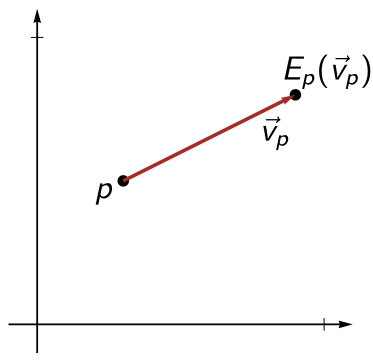
Occasionally it is useful to turn a tangent vector \(\vec{v}_p \in T_p\mathbb{R}^n\) into a point \(q \in \mathbb{R}^n.\) This is done by mapping a tangent vector \(\vec{v}_p \in T_p\mathbb{R}^n\) to its “endpoint”. More precisely, we define:
Definition 2.27 • Endpoint map
For all \(p \in \mathbb{R}^n\) we define \[E_p : T_p\mathbb{R}^n \to \mathbb{R}^n, \qquad \vec{v}_p\mapsto E_p(\vec{v}_p)=(x_1+v_1,\ldots,x_n+v_n),\] where \(p=(x_1,\ldots,x_n)\) and \[\vec{v}_p=\begin{pmatrix} v_1 \\ \vdots \\v_n \end{pmatrix}_p.\]
For a smooth immersed curve \(\gamma=(\gamma_1,\gamma_2) : I \to \mathbb{R}^2\) we define \[T : I \to T\mathbb{R}^2, \qquad t \mapsto T(t)=\frac{\dot{\gamma}(t)}{\Vert \dot{\gamma}(t)\Vert}\] and \[N : I \to T\mathbb{R}^2, \qquad t \mapsto N(t)=J(T(t)).\] We call \(T\) the unit tangent vector field along \(\gamma\) and \(N\) the unit normal vector field along \(\gamma\).
By construction, \(\{T(t),N(t)\}\) forms an orthonormal basis of \(T_{\gamma(t)}\mathbb{R}^2\) for all \(t \in I.\) A basis of some vector space is sometimes called a frame and the pair \(\{T,N\}\) is called a moving frame along \(\gamma\), since as time \(t\) progresses, the frame \(\{T(t),N(t)\}\) moves along \(\gamma.\)
Suppose the signed curvature \(\kappa : I \to \mathbb{R}\) of \(\gamma\) is non-vanishing for all \(t \in I\) and define \(\rho=1/\kappa : I \to \mathbb{R}.\) The curve \[\delta : I \to \mathbb{R}^2, \qquad t \mapsto \delta(t)=E_{\gamma(t)}\left(\rho(t)N(t)\right)\] is called the evolute of \(\gamma\). The circle with centre \(\delta(t)\) and radius \(r(t)=|\rho(t)|\) is called the osculating circle of \(\gamma\) at \(t\). We will discuss the osculating circle more thoroughly in the exercises. Notice that \[\tag{2.13} \gamma(t)=E_{\delta(t)}(-\rho(t)N(t))\] for all \(t \in I,\) where here we think of \(N\) as a vector field along \(\delta.\)
In what follows we will assume that \(\gamma=(\gamma_1,\gamma_2) : I \to \mathbb{R}^2\) has unit speed. In this case we obtain \[T : I \to T\mathbb{R}^2, \qquad t \mapsto T(t)=\dot{\gamma}(t)=\begin{pmatrix} \gamma_1^{\prime}(t) \\ \gamma_2^{\prime}(t)\end{pmatrix}_{\gamma(t)}\] and \[N : I \to T\mathbb{R}^2, \qquad t \mapsto N(t)=J(T(t))=\begin{pmatrix} -\gamma_2^{\prime}(t)\\ \gamma_1^{\prime}(t)\end{pmatrix}_{\gamma(t)}.\] We have the following equations known as the Frenet equations \[\dot{T}=\kappa N, \qquad \text{and} \qquad \dot{N}=-\kappa T.\] Written in “matrix notation” they become \[\tag{2.14} \begin{pmatrix} \dot{T} \\ \dot{N} \end{pmatrix} = \begin{pmatrix} 0 & \kappa \\ -\kappa & 0 \end{pmatrix} \begin{pmatrix} T \\ N \end{pmatrix}.\]
Exercise 2.28
Derive the Frenet equations (2.14) for a unit speed curve \(\gamma : I \to \mathbb{R}^2.\)
Using the Frenet equations we can compute the velocity vector field of the evolute \(\delta : I \to \mathbb{R}^2\) of a unit speed curve \(\gamma : I \to \mathbb{R}^2.\) Explicitly, we have for all \(t \in \mathbb{R}\) \[\delta(t)=\left(\gamma_1(t)-\frac{\gamma_2^{\prime}(t)}{\kappa(t)},\gamma_2(t)+\frac{\gamma_1^{\prime}(t)}{\kappa(t)}\right)=\left(\gamma_1(t)-\rho(t)\gamma_2^{\prime}(t),\gamma_2(t)+\rho(t)\gamma^{\prime}_1(t)\right)\] from which we compute \[\dot{\delta}(t)=\begin{pmatrix} \gamma_1^{\prime}(t)-\rho^{\prime}(t)\gamma^{\prime}_2(t)-\rho(t)\gamma^{\prime\prime}_2(t) \\ \gamma_2^{\prime}(t)+\rho^{\prime}(t)\gamma^{\prime}_1(t)+\rho(t)\gamma^{\prime\prime}_1(t) \end{pmatrix}_{\delta(t)}=\rho^{\prime}(t)\begin{pmatrix} -\gamma^{\prime}_2(t) \\ \gamma^{\prime}_1(t)\end{pmatrix}_{\delta(t)}=\rho^{\prime}(t)N(t),\] where we used the second Frenet equation \(\dot{N}(t)=-\kappa(t)T(t),\) which is equivalent to \[\begin{pmatrix} -\gamma^{\prime\prime}_2(t) \\ \gamma_1^{\prime\prime}(t)\end{pmatrix} =-\frac{1}{\rho(t)}\begin{pmatrix} \gamma^{\prime}_1(t) \\ \gamma_2^{\prime}(t)\end{pmatrix}.\] We can use the identity \(\dot{\delta}(t)=\rho^{\prime}(t)N(t)\) which holds for all \(t \in I\) to show:
Theorem 2.29 • Plane curves of constant curvature
Let \(\gamma : I \to \mathbb{R}^2\) be a smooth immersed curve whose signed curvature \(\kappa : I \to \mathbb{R}\) is constant, that is, there exists \(c\in \mathbb{R}\) such that \(\kappa(t)=c\) for all \(t\in I.\) Then either
\(c \neq 0\) and \(\gamma(I)\) is a segment of a circle of radius \(1/c\);
\(c=0\) and \(\gamma(I)\) is a segment of a line.
Proof. Without loss of generality, by (2.9) we can assume that \(\gamma\) is a unit speed curve. Suppose \(c\neq 0.\) Since \(\kappa\) is constant, so is \(\rho\) and hence \(\dot{\delta}(t)=0\) for all \(t \in I.\) The velocity vector of \(\delta\) thus vanishes for all \(t \in I\) and therefore \(\delta(I)\) consists of a single point \(q \in \mathbb{R}^2,\) that is, \(\delta(t)=q\) for all \(t \in I.\) Since for all \(t \in I\) the tangent vector \(N(t)\) has length \(1\) and since \(\rho(t)=1/c,\) (2.13) implies that all points of the curve \(\gamma\) have the same distance from \(q\) which means that \(\gamma(I)\) is a segment of a circle of radius \(1/c.\)
Suppose \(c=0.\) Then \(\ddot{\gamma}(t)=0\) for all \(t \in I\) which is equivalent to \[\gamma^{\prime\prime}_1(t)=\gamma^{\prime\prime}_2(t)=0\] for all \(t \in I.\) This implies that \(\gamma(t)=(x_1+tv_1,x_2+tv_2)=E_p(t\vec{v}_p)\) for some point \(p=(x_1,x_2) \in \mathbb{R}^2\) and tangent vector \(\vec{v}_p=\begin{pmatrix} v_1 \\ v_2\end{pmatrix}_p.\) Consequently, \(\gamma(I)\) is a segment of a straight line.
It is natural to ask to what extent the signed curvature of a curve in \(\mathbb{R}^2\) determines the curve. Phrased differently, can we recover the curve when we know its signed curvature? In order to answer this we need a bit more terminology:
Definition 2.30 • Euclidean motion
A map \[f_{\mathbf{R},q} : \mathbb{R}^n \to \mathbb{R}^n, \qquad p \mapsto \mathbf{R}p+q\] for some point \(q \in \mathbb{R}^n\) and orthogonal matrix \(\mathbf{R}\in \mathrm{O}(n)\) is called a Euclidean motion.
Example 2.31
For \(n=2,\) \(q=(y_1,y_2)\) and \[\mathbf{R}=\begin{pmatrix} \cos(\alpha) & -\sin(\alpha) \\ \sin(\alpha) & \cos(\alpha) \end{pmatrix}, \qquad \alpha \in \mathbb{R},\] we have \[f_{\mathbf{R},q}(p)=(\cos(\alpha)x_1-\sin(\alpha)x_2+y_1,\sin(\alpha)x_1+\cos(\alpha)x_2+y_2)\] where we write \(p=(x_1,x_2).\)
Exercise 2.32
Let \(\mathbf{R}\in \mathrm{O}(2)\) be an orthogonal \(2\times 2\)-matrix, \(q \in \mathbb{R}^2\) and \(\kappa : I \to \mathbb{R}\) the signed curvature of a smooth immersed curve \(\gamma : I \to \mathbb{R}^2.\) Show that \(\kappa\) is invariant under Euclidean motion, that is, the curve \[\delta : I \to \mathbb{R}^2, \qquad t \mapsto \delta(t)=f_{\mathbf{R},q}(\gamma(t))\] has the same signed curvature as \(\gamma.\)
From Exercise 2.32 we learn that the curvature alone is not sufficient to determine the curve. We can however rule out Euclidean motions by specifying a point on the curve as well as \(T\) and \(N\) at this point. More precisely, we have:
Proposition 2.33
Let \(I=[a,b]\) be an interval. For a smooth function \(\kappa : I \to \mathbb{R}\) there exists a unique smooth unit speed curve \(\gamma : I \to \mathbb{R}^2\) such that \(\gamma(a)=(0,0)=0_{\mathbb{R}^2}\) and \[\tag{2.15} T(a)=\begin{pmatrix} 1 \\ 0 \end{pmatrix}_{0_{\mathbb{R}^2}} \quad \text{and}\quad N(a)=\begin{pmatrix} 0 \\ 1 \end{pmatrix}_{0_{\mathbb{R}^2}}\] and so that the signed curvature of \(\gamma\) is given by \(\kappa.\)
For the proof we need:
Lemma 2.34
Let \(\delta : [a,b] \to \mathbb{R}^2\) be a smooth curve with \(\delta(t) \in S^1\) for all \(t \in [a,b],\) where \[S^1=\left\{(x,y) \in \mathbb{R}^2 \, |\, x^2+y^2=1\right\}.\] Then there exists a smooth function \(\phi : [a,b] \to \mathbb{R}\) – called a polar angle function – so that for all \(t \in [a,b]\) we have \[\delta(t)=\left(\cos(\phi(t)),\sin(\phi(t))\right).\]
Proof. Let \(\phi_0\) be a real number so that \(\delta(a)=(\cos(\phi_0),\sin(\phi_0)).\) Clearly \(\phi_0\) is unique up to adding an integer multiple of \(2\pi.\) We may define \(\phi(t)\) as the sum of \(\phi_0\) and the distance travelled on \(S^1\) from \(\delta(a)\) to \(\delta(t),\) where counter clockwise motion contributes positively and clockwise motion contributes negatively. First consider the case where \(\delta\) moves counter clockwise – and counter clockwise only – around the unit circle \(S^1.\) In this case we can define \[\phi(t)=\phi_0+\int_a^t\Vert \dot{\delta}(w)\Vert \mathrm{d}w.\] In general, \(\delta\) may move clock wise as well and we can account for this as follows. Observe that there exists a unique smooth function \(\xi : [a,b] \to \mathbb{R}\) so that \[\begin{pmatrix} \delta_1^{\prime}(t) \\ \delta_2^{\prime}(t) \end{pmatrix}=\xi(t)\begin{pmatrix} -\delta_2(t) \\ \delta_1(t)\end{pmatrix}\] for all \(t \in [a,b].\) With this definition we have \[\Vert \dot{\delta}(t)\Vert=|\xi(t)|\sqrt{\delta_1(t)^2+\delta_2(t)^2}=|\xi(t)|.\]Now define \[\phi(t)=\phi_0+\int_a^t\xi(w)\mathrm{d}w,\] then \(\phi : [a,b] \to \mathbb{R}\) is the desired polar angle function.
Proof of Proposition 2.33. Let \(\gamma=(\gamma_1,\gamma_2) : [a,b] \to \mathbb{R}^2\) be a unit speed curve. By the fundamental theorem of calculus we have \[\tag{2.16} \gamma_1(t)=\int_{a}^t \gamma_1^{\prime}(u)\mathrm{d}u +\text{const}_1 \quad \text{and} \quad \gamma_2(t)=\int_{a}^t \gamma_2^{\prime}(u)\mathrm{d}u +\text{const}_2\] Recall that \[T(t)=\begin{pmatrix} \gamma_1^{\prime}(t) \\ \gamma_2^{\prime}(t)\end{pmatrix}_{\gamma(t)},\] so that we can recover \(\gamma\) – up to translation in \(\mathbb{R}^2\) by \((\text{const}_1,\text{const}_2)\) – from its unit tangent vector field.
By Lemma 2.34 there exists a polar angle function \(\phi : [a,b] \to \mathbb{R}\) so that \[T(t)=\begin{pmatrix} \cos(\phi(t)) \\ \sin(\phi(t)) \end{pmatrix}_{\gamma(t)} \qquad \text{and} \qquad N(t)=\begin{pmatrix} -\sin(\phi(t)) \\ \cos(\phi(t)) \end{pmatrix}_{\gamma(t)}.\] From this we compute using the Frenet equations \[\dot{T}(t)=\begin{pmatrix} -\sin(\phi(t))\phi^{\prime}(t) \\ \cos(\phi(t))\phi^{\prime}(t)\end{pmatrix}_{\gamma(t)}=\kappa(t)\begin{pmatrix} -\sin(\phi(t)) \\ \cos(\phi(t)) \end{pmatrix}_{\gamma(t)},\] so that \(\phi^{\prime}(t)=\kappa(t)\) for all \(t \in [a,b].\) This gives the formula \[\tag{2.17} \phi(t)=\int_{a}^t \kappa(w)\mathrm{d}w + \text{const}.\] Consequently, we can recover the unit tangent vector field – up to rotation by the angle \(\text{const}\) – from the signed curvature \(\kappa.\) Combining (2.16) and (2.17) we thus obtain the formulas \[\gamma_1(t)=\int_a^t \cos\left(\int_{a}^u \kappa(w)\mathrm{d}w\right)\mathrm{d}u\qquad \text{and} \qquad \gamma_2(t)=\int_a^t \sin\left(\int_{a}^u \kappa(w)\mathrm{d}w\right)\mathrm{d}u.\] These last two formulas uniquely determine \(\gamma\) up to the choice of integration constants. The conditions (2.15) precisely state that we have to choose all integration constants to be zero.
2.5 Global geometric properties of plane curves
In order to compute the curvature of a smooth immersed curve \(\gamma : [a,b] \to \mathbb{R}^2\) at time \(t_0 \in [a,b],\) we only need to know the values of \(\gamma\) near \(t_0.\) We say that the curvature is a local property of a curve. Local properties are in contrast to global properties which try to capture geometric properties of the whole curve. The prototypical example of a global property of a plane curve is its total curvature:
Definition 2.35 • Total curvature of a plane curve
Let \(\gamma : [a,b] \to \mathbb{R}^2\) be a smooth unit speed curve. The total curvature of \(\gamma\) is given by the integral of its signed curvature over the interval \([a,b],\) that is, by the quantity \(\int_a^b \kappa(t)\mathrm{d}t.\)
A first observation about the total curvature is that it is quantised, that is, it is always an integer multiple of \(2\pi,\) provided the curve is closed. Recall that a function \(f : \mathbb{R}\to \mathbb{R}^m\) is called periodic with period \(L\) if \(f(t+L)=f(t)\) for all \(t \in \mathbb{R}.\)
Definition 2.36 • Closed curve
Let \(\gamma : [a,b] \to \mathbb{R}^m\) be a curve. Then \(\gamma\) is called closed if \(\gamma(a)=\gamma(b).\)
Let \(\gamma : [a,b] \to \mathbb{R}^m\) be a smooth curve. Then \(\gamma\) is called closed if there exists a smooth curve \(\delta : \mathbb{R}\to\mathbb{R}^m\) which is periodic with period \((b-a)\) so that \(\gamma(t)=\delta(t)\) for all \(t \in [a,b].\)
Remark 2.37
Notice that if a smooth curve \(\gamma : [a,b] \to \mathbb{R}^m\) is closed, then \[\gamma^{(i)}(a)=\gamma^{(i)}(b).\] for all \(i \in \mathbb{N},\) that is, its derivatives agree to all orders at \(a\) and \(b.\)
Example 2.38
The “right half“ of the figure \(8\) curve \[\gamma : [0,\pi] \to \mathbb{R}^2, \qquad t \mapsto (\cos(t),\sin(t)\cos(t))\] is closed as a continuous curve, but not as a smooth curve, since \[\gamma^{\prime}(0)\neq \gamma^{\prime}(\pi).\]
Recall that for the unit tangent vector field \(T : [a,b] \to T\mathbb{R}^2\) of a smooth unit speed curve \(\gamma\) we have \[T(t)=\begin{pmatrix} \cos(\phi(t)) \\ \sin(\phi(t))\end{pmatrix}_{\gamma(t)}\] where \[\phi(t)=\int_a^t \kappa(w)\mathrm{d}w+\textrm{const}\] and \(\kappa : [a,b]\to \mathbb{R}\) denotes the signed curvature of \(\gamma.\) If \(\gamma\) is closed, then \(\gamma(a)=\gamma(b)\) and \(T(a)=T(b)\) so that \[T(a)=\begin{pmatrix} \cos(\phi(a)) \\ \sin(\phi(a))\end{pmatrix}_{\gamma(a)}=T(b)=\begin{pmatrix} \cos(\phi(b)) \\ \sin(\phi(b))\end{pmatrix}_{\gamma(b)}\] This implies that \(\phi(b)-\phi(a)\) is an integer multiple of \(2\pi\) and hence \[\frac{1}{2\pi}\int_a^b\kappa(t)\mathrm{d}t=\frac{1}{2\pi}\left(\phi(b)-\phi(a)\right)=N, \qquad N \in \mathbb{N}.\]
Definition 2.39 • Rotation index
Let \(\gamma : [a,b] \to \mathbb{R}^2\) be a smooth closed unit speed curve with signed curvature \(\kappa : [a,b]\to \mathbb{R}.\) The integer \[R_{\gamma}=\frac{1}{2\pi}\int_{a}^b \kappa(t)\mathrm{d}t\] is called the rotation index of \(\gamma\).
Observe that if \(\gamma : [a,b] \to \mathbb{R}^2\setminus\{(0,0)\}\) is a smooth curve, then the curve \(\delta : [a,b] \to \mathbb{R}^2\) defined by the rule \[\delta(t)=\frac{1}{\sqrt{\gamma_1(t)^2+\gamma_2(t)^2}}\left(\gamma_1(t),\gamma_2(t)\right)\] for all \(t \in [a,b],\) is smooth and takes values in \(S^1\subset \mathbb{R}^2.\) Hence by Lemma 2.34 we can write \[\delta(t)=\left(\cos(\phi(t)),\sin(\phi(t))\right)\] for some smooth polar angle function \(\phi : [a,b] \to \mathbb{R}.\) In the case where \(\gamma\) is closed, it follows as above that \((1/2\pi)\left(\phi(b)-\phi(a)\right)\) is an integer known as the winding number of \(\gamma\). It counts the total number of times that \(\gamma\) travels counter clockwise around the point \((0,0) \in \mathbb{R}^2.\) A negative winding number indicates, that the curve travels clockwise around \((0,0).\)
Example 2.40 • Rotation index as winding number
The rotation index of a smooth closed unit speed curve \(\gamma : [a,b] \to \mathbb{R}^2\) can be interpreted as the winding number of the first derivative \(\gamma^{\prime} : [a,b] \to \mathbb{R}^2\setminus\{(0,0)\}.\)
A closed curve which has no self intersections is called simple:
Definition 2.41 • Simple closed curve
A closed curve \(\gamma : [a,b] \to \mathbb{R}^n\) is called simple if the restriction of \(\gamma\) to the half open interval \([a,b)\) is injective. Simple closed curves are often called Jordan curves.
Intuitively one might expect that the rotation index of a simple closed curve in the plane is either \(1,\) in the case where the curve moves counter clockwise or \(-1,\) in the case where the curve moves clockwise. This is indeed true, but somewhat tricky to prove.
Theorem 2.42
Let \(\gamma : [0,L] \to \mathbb{R}^2\) be a smooth unit speed curve that is simple and closed. Then its rotation index is \(\pm 1.\)
This fact was probably already known to Riemann. We present a proof of H. Hopf.
Proof. Without loss of generality we can assume that \(\gamma(0)=(0,0)\) and that the image of \(\gamma\) is contained in \(\{(x,y) \, |\, x \geqslant 0\}.\) For \(0\leqslant s \leqslant t\leqslant L\) with \(t-s< L\) denote by \(\phi(s,t)\) the angle between \((\gamma(t)-\gamma(s))\) and \((1,0).\) Since \(\gamma\) is simple, \(\gamma(t)-\gamma(s)\) is never equal to \((0,0).\) The function \(\phi\) is uniquely determined by the condition to be continuous and that \(|\phi(0,t)|\leqslant \pi/2\) for all \(t \in (0,L).\) We also have \(|\phi(s,L)-\pi|\leqslant \pi/2\) for all \(s \in (0,L)\) and \[\lim_{t \uparrow L}\phi(0,t)-\lim_{t\downarrow 0}\phi(0,t)=\lim_{s\uparrow L}\phi(s,L)-\lim_{s\downarrow 0}\phi(s,L)=\pm \pi.\] Observe that the function \[\phi(t):=\lim_{s \uparrow t}\phi(s,t)=\lim_{r\downarrow t}\phi(t,r)\] is a continuous polar angle function for \(\gamma^{\prime} : [0,L] \to \mathbb{R}^2,\) that is \[\gamma^{\prime}(t)=\left(\cos(\phi(t)),\sin(\phi(t))\right)\] for all \(t \in [0,L].\) Using \(\phi(L)=\lim_{s\uparrow L}\phi(s,L)\) and \(\phi(0)=\lim_{t \downarrow 0}\phi(0,t)\) as well as \[\lim_{t \uparrow L}\phi(0,t)=\lim_{s\downarrow 0}\phi(s,L),\] we compute \[\begin{aligned} \int_{0}^L\kappa(t)\mathrm{d}t&=\phi(L)-\phi(0)=\lim_{s\uparrow L}\phi(s,L)-\lim_{t \downarrow 0}\phi(0,t)\\ &=\lim_{s\uparrow L}\phi(s,L)-\lim_{s\downarrow 0}\phi(s,L)+\lim_{s\downarrow 0}\phi(s,L)-\lim_{t \downarrow 0}\phi(0,t)\\ &=\lim_{s\uparrow L}\phi(s,L)-\lim_{s\downarrow 0}\phi(s,L)+\lim_{t \uparrow L}\phi(0,t)-\lim_{t \downarrow 0}\phi(0,t)\\ &=\pm \pi\pm \pi=\pm 2\pi, \end{aligned}\] as claimed.
2.6 Curves in three-dimensional space
The Frenet frame along a smooth unit speed curve in \(\mathbb{R}^2\) assigns an orthonormal basis to every tangent space along \(\gamma.\) For a smooth unit speed curve \(\gamma : I \to \mathbb{R}^3\) into three-dimensional space we can carry out a similar construction, provided the second derivative \(\gamma^{\prime\prime} : I \to \mathbb{R}^3\) is non-vanishing for all \(t \in I.\) For such a curve – called a Frenet curve – we define the unit tangent vector field \[T : I \to T\mathbb{R}^3, \qquad t \mapsto T(t):=\dot{\gamma}(t)\] the unit normal vector field \[N : I \to T\mathbb{R}^3, \qquad t \mapsto N(t)=\frac{\dot{T}(t)}{\Vert \dot{T}(t)\Vert}\] and the unit binormal vector field \[B : I \to T\mathbb{R}^3, \qquad t \mapsto B(t)=T(t)\times N(t),\] where we think of the cross product \(\times\) as a map \(T_{\gamma(t)}\mathbb{R}^3 \times T_{\gamma(t)}\mathbb{R}^3 \to T_{\gamma(t)}\mathbb{R}^3\) for all \(t \in I.\)
Definition 2.43
For a smooth immersed curve \(\gamma=(\gamma_1,\gamma_2,\gamma_3) : I \to \mathbb{R}^3\) satisfying \(\dot{\gamma}(t)\times \ddot{\gamma}(t)\neq 0_{T_{\gamma(t)}\mathbb{R}^3}\) for all \(t \in I,\) we define the curvature \(\kappa : I \to \mathbb{R}\) and torsion \(\tau : I \to \mathbb{R}\) by \[\kappa(t)=\frac{\Vert \dot{\gamma}(t)\times \ddot{\gamma}(t)\Vert}{\Vert \dot{\gamma}(t)\Vert^3} \quad \text{and} \quad \tau(t)=\frac{\langle \dot{\gamma}(t),\ddot{\gamma}(t)\times \dddot{\gamma}(t)\rangle}{\Vert \dot{\gamma}(t)\times \ddot{\gamma}(t)\Vert^2}.\]
Exercise 2.44
Given a Frenet curve \(\gamma : I \to \mathbb{R}^3.\) Show that the Frenet equations \[\begin{pmatrix} \dot{T} \\ \dot{N} \\ \dot{B}\end{pmatrix}=\begin{pmatrix} 0 & \kappa & 0 \\ -\kappa & 0 & \tau \\ 0 & -\tau & 0 \end{pmatrix}\begin{pmatrix} T \\ N \\ B \end{pmatrix}.\] hold.
Let \(\mathbf{R}\in \mathrm{O}(3)\) and \(q \in \mathbb{R}^3.\) Show that the curvature and torsion are invariant under Euclidean motions. That is, if \(\gamma : I \to \mathbb{R}^3\) is a smooth immersed curve with \(\dot{\gamma}(t)\times \ddot{\gamma}(t)\neq 0_{T_{\gamma(t)}\mathbb{R}^3}\) and curvature \(\kappa : I \to \mathbb{R}\) and torsion \(\kappa : I \to \mathbb{R},\) then the curve \[\delta=f_{\mathbf{R},q}\circ \gamma\] has the same curvature and torsion as \(\gamma.\)
Similar to the case of plane curves we have:
Proposition 2.45
Let \(I=[a,b]\) be an interval. For smooth functions \(\kappa : I \to \mathbb{R}^+\) and \(\tau : I \to \mathbb{R}\) there exists a unique Frenet curve \(\gamma : I \to \mathbb{R}^3\) with \(\gamma(a)=(0,0,0) \in \mathbb{R}^3\) and \[T(a)=\begin{pmatrix} 1 \\ 0 \\ 0 \end{pmatrix}_{0_{\mathbb{R}^{3}}}, \qquad N(a)=\begin{pmatrix} 0 \\ 1 \\ 0 \end{pmatrix}_{0_{\mathbb{R}^{3}}}, \qquad B(a)=\begin{pmatrix} 0 \\ 0 \\ 1 \end{pmatrix}_{0_{\mathbb{R}^{3}}}\] and so that the curvature and torsion of \(\gamma\) are given by \(\kappa\) and \(\tau,\) respectively.
In order to prove this fact one needs to solve a system of ordinary differential equations (Proposition 2.45 and its proof are not examinable).
Remark 2.46
There is also a notion of Frenet curve into \(\mathbb{R}^m\) for \(m>3.\) We refer to the literature for further details.