Theorem 6.7 • about the derivative of the inverse function
Let \(I \subseteq {\mathbb{R}}\) be an interval and \(f:I \to {\mathbb{R}}\) be continuous and strictly monotonic (i. e., strictly monotonically increasing or strictly monotonically decreasing). If \(f\) is differentiable in \(x\) and \(f'(x) \neq 0,\) then \(f^{-1}\) is differentiable in \(y := f(x)\) and it holds that \[\left(f^{-1}\right)'(y) = \frac{1}{f'(x)} = \frac{1}{f'\left(f^{-1}(y)\right)}.\]
Proof. Let \({(y_n)}_{n \in {\mathbb{N}}}\) be an arbitrary sequence in \(f(I) \setminus \{y\}\) with \(\lim_{n \to \infty} y_n = y.\) We set \(x_n = f^{-1}(y_n)\) . Since by the continuous inverse theorem (cf. Theorem 4.14) \(f^{-1}\) is continuous, it follows that \[\lim_{n \to \infty} x_n = \lim_{n \to \infty} f^{-1}(y_n) = f^{-1}(y) = x.\] Moreover, it holds that \(x_n \in I \setminus \{x\},\) since \(f^{-1}\) is injective (cf. the proof of Theorem 4.14 ii, Step 2). With this we obtain \[\frac{f^{-1}(y_n)-f^{-1}(y)}{y_n-y} = \frac{x_n-x}{f(x_n)-f(x)} = \frac{1}{\frac{f(x_n)-f(x)}{x_n-x}}.\] This implies \[\lim_{n \to \infty}\frac{f^{-1}(y_n)-f^{-1}(y)}{y_n-y} = \frac{1}{f'(x)} = \frac{1}{f'\left(f^{-1}(y)\right)}.\]
Video 6.5. Derivatives of inverse functions.
Remark 6.6
Let \(I \subseteq {\mathbb{R}}\) be an interval. Note that the differentiability of \(f:I \to {\mathbb{R}}\) does not imply the differentiability of the inverse function, but only its differentiability in all \(x \in f(I)\) with \(f'(x) \neq 0.\) This condition is not only sufficient but also necessary. If \(f^{-1}\) is differentiable in \(f(x),\) then with the chain rule we obtain \[1 = (\operatorname{id}_{\mathbb{R}})'(x) = \left(f^{-1}\circ f\right)'(x) = \left(f^{-1}\right)'(f(x)) \cdot f'(x),\] i. e., we must have \(f'(x) \neq 0.\)
Example 6.7
The function \(\ln:(0,\infty) \to {\mathbb{R}}\) is differentiable in \((0,\infty)\) since \(\exp'(x) = \exp(x) \neq 0\) for all \(x \in {\mathbb{R}}.\) For all \(y \in (0,\infty)\) we have \[\ln'(y) = \frac{1}{\exp'(\ln y)} = \frac{1}{\exp(\ln y)} = \frac{1}{y}.\] As a result, we now have all the tools available to compute the limit of the sequence from Example 2.1 vi. It holds that \[\left( 1+\frac{1}{n} \right)^n = \exp\left(n\cdot\ln\left(1+\frac{1}{n} \right) \right) = \exp\left( \frac{\ln\left(1+\frac{1}{n}\right) - \ln 1}{\frac{1}{n}} \right).\] Because of the continuity of the exponential function it follows that \[\begin{aligned} \lim_{n \to \infty} \left( 1+\frac{1}{n} \right)^n &= \exp\left(\lim_{n \to \infty} \frac{\ln\left(1+\frac{1}{n}\right) - \ln 1}{\frac{1}{n}}\right) \\ &= \exp\left(\ln'(1)\right) = \exp(1) = \mathrm{e}. \end{aligned}\]
Consider the function \(f:(0,\infty) \to {\mathbb{R}},\) \(x \mapsto x^x.\) With the representation \(f(x) = \exp(x \cdot \ln x)\) and the product rule, the chain rule, as well as i we obtain for \(x>0\) that \[f'(x) = \exp(x\cdot\ln x)\cdot\left( 1\cdot \ln x + x \cdot \frac{1}{x} \right) = x^x \cdot(\ln x + 1).\]
We consider the square-root function \(g:[0,\infty) \to [0,\infty),\) \(y \mapsto \sqrt{y}.\) This is the inverse function of \(f:[0,\infty) \to [0,\infty),\) \(x \mapsto x^2.\) Because of \(f'(0) = 0,\) the function \(g\) is not differentiable in \(f(0) = 0.\) But it is differentiable for each \(y \in (0,\infty)\) and we obtain \[g'(y) = \left(f^{-1}\right)'(y) = \frac{1}{f'(f(y))} = \frac{1}{2\sqrt{y}}.\] An alternative way of determining the derivative of the square-root function is the following one. Let \(\alpha \in {\mathbb{R}}\) and consider the function \(h:(0,\infty) \to {\mathbb{R}},\) \(x \mapsto x^\alpha.\) Since \(x^\alpha = \exp(\alpha\cdot\ln x),\) \(h\) is differentiable and by the chain rule we obtain for \(x>0\) that \[h'(x) = \exp'(\alpha \cdot \ln x) \cdot\alpha\cdot\ln' x = x^\alpha\cdot\alpha\cdot\frac{1}{x} = \alpha\cdot x^{\alpha-1}.\] This is a generalization of the differentiation rules from Example 6.3 i where this result has been shown in the case \(\alpha \in {\mathbb{N}}.\)
In particular, for the special case \(\alpha = \frac{1}{2}\) we obtain \[h(x) = x^{\frac{1}{2}} = \sqrt{x} \quad \text{and} \quad h'(x) = \frac{1}{2}x^{-\frac{1}{2}} = \frac{1}{2\sqrt{x}}.\]
6.3 Local Extrema and the Mean Value Theorem
In Section 4.4 we have already considered global extrema. In this section we will discuss local extrema.
Definition 6.2
((Strict) local maximum and minimum). Let \(D\subseteq{\mathbb{R}},\) \(f:D \to {\mathbb{R}},\) and \(x_0 \in D.\)
The function \(f\) has a local maximum in \(x_0\), if there exists an \(\varepsilon > 0\) such that \(f(x_0) \ge f(x)\) is satisfied for all \(x \in D\cap U_\varepsilon(x_0),\) where \(U_\varepsilon(x_0) := (x_0-\varepsilon,x_0+\varepsilon).\)
The function \(f\) has a strict local maximum in \(x_0\), if there exists an \(\varepsilon > 0\) such that \(f(x_0) > f(x)\) is satisfied for all \(x \in \left(D\cap U_\varepsilon(x_0)\right)\setminus\{x_0\}.\)
The function \(f\) is said to have a (strict) local minimum in \(x_0\), if \(-f\) has a (strict) local maximum in \(x_0.\)
Example 6.8
The function \(f\) whose graph is displayed in Figure 6.6 has a strict local maximum at \(x_0 = -1\) and local minima in the points \(x_1 = 1\) and \(x_2 = 3.\) Moreover, there are simultaneously local maxima and minima in all points in the open interval \((x_1,x_2) = (1,3).\)
Note that the point \(x_0\) is not a local maximum, but only the point where the local maximum \(f(x_0)\) is attained. In general we call points at which local minima and maxima are attained minimizers and maximizers (or more generally, extremizers), respectively.
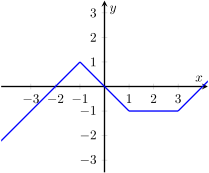
An extremum in the sense of Definition 4.6 (we call those global extrema to distinguish them from the local ones defined in Definition 6.2) is especially a local extremum, since the condition in Definition 6.2 is satisfied for each \(\varepsilon > 0.\) As the next step we would like to derive the so-called necessary condition for the existence of local extrema.
Theorem 6.8 • Necessary condition for local extrema
Let \(x_0 \in D \subseteq {\mathbb{R}}\) be an inner point of \(D\) and \(f:D \to {\mathbb{R}}\) be differentiable in \(x_0.\) If \(f\) has a local extremum in \(x_0,\) then \(f'(x_0) = 0.\)
Proof. W. l. o. g. let \(x_0\) be a local maximizer (otherwise consider \(-f\)). Since \(x_0\) is an inner point of \(D,\) there exists an \(\varepsilon > 0\) such that \(U_\varepsilon(x_0) \subseteq D\) and \(f(x_0) \ge f(x)\) for all \(x \in U_\varepsilon(x_0).\) Since \(f\) is differentiable in \(x_0,\) it follows that \[f'(x_0) = \lim_{x \nearrow x_0} \frac{f(x)-f(x_0)}{x-x_0} \ge 0,\] since \(f(x)-f(x_0) \le 0\) and \(x-x_0<0\) for all \(x \in (x_0-\varepsilon,x_0).\) Analogously, we can show \[f'(x_0) = \lim_{x \searrow x_0} \frac{f(x)-f(x_0)}{x-x_0} \le 0.\] However, both conditions can only be satisfied if \(f'(x_0) = 0.\)
Video 6.6. Necessary condition for local extrema.
Remark 6.7
The assumption that \(x_0\) is an inner point of \(D\) is essential in Theorem 6.8. Consider for example the function \(f=\operatorname{id}_{\mathbb{R}}\big|_{[0,1]},\) i. e., \[f:[0,1] \to {\mathbb{R}}, \quad x \mapsto x.\] Then \(f\) has a local minimum in \(x = 0\) and a local maximum in \(x = 1\) (both are even global extrema), but it holds that \(f'(0) = 1\) and \(f'(1) = 1.\)
The necessary condition for the existence of local extrema is indeed just necessary, but not sufficient. Consider, e. g., the function \(f: {\mathbb{R}}\to {\mathbb{R}},\) \(x \mapsto x^3.\) Its derivative is \(f':{\mathbb{R}}\to {\mathbb{R}},\) \(x \mapsto 3x^2\) and we have \(f'(0) = 0.\) However, \(f\) does not have a local extremum at the inner point \(0\) as one can easily check.
In the following we will restrict ourselves again to the analysis of functions on compact intervals \([a,b].\) We will assume without mentioning this explicitly that the interval \([a,b]\) is always nonempty, i. e., \(a < b.\)
Theorem 6.9 • Rolle’s theorem
Let \(f:[a,b] \to {\mathbb{R}}\) be continuous and differentiable in \((a,b)\) (i. e., differentiable in all \(x \in (a,b)\)). If \(f(a) = f(b),\) then there exists a \(\xi \in (a,b)\) with \(f'(\xi) = 0.\)
Proof. We distinguish two cases:
Case 1: \(f\) is constant. Then we have \(f'(x) = 0\) for all \(x \in (a,b).\)
Case 2: \(f\) is not constant. Then there exists an \(x \in (a,b)\) with \(f(x) \neq f(a) = f(b).\) Let w. l. o. g. \(f(x) > f(a).\) Since \(f\) is continuous in \([a,b],\) by the extreme value theorem (Theorem 4.9) it attains its maximum in one point \(\xi \in [a,b].\) Further we have \(f(\xi) \ge f(x) > f(a) = f(b),\) hence \(\xi \in (a,b)\) and it is an inner point of \([a,b].\) By Theorem 6.8 we obtain \(f'(\xi) = 0.\)
Video 6.7. Rolle’s theorem.
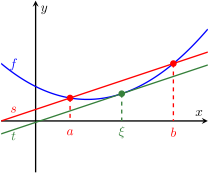
If we consider a differentiable function \(f:[a,b] \to {\mathbb{R}},\) then the difference quotient \[\frac{f(b)-f(a)}{b-a}\] is exactly the slope of the secant \(s\) through the points \((a,f(a))\) and \((b,f(b)).\) As Figure 6.7 suggests that there exists a point \(\xi \in (a,b)\) at which we can construct a tangent \(t\) that is parallel to the secant \(s.\) Since the slope of the tangent is given by \(f'(\xi),\) Figure 6.7 is the geometric interpretation of the following theorem.
Theorem 6.10 • Mean value theorem
Let \(f:[a,b] \to {\mathbb{R}}\) be continuous and differentiable in \((a,b).\) Then there exists a \(\xi \in (a,b)\) such that \[f'(\xi) = \frac{f(b)-f(a)}{b-a}.\]
Proof. First we note that Figure 6.7 does not only give us an illustration of the mean value theorem but also an idea for its proof, since the desired point \(\xi\) seems to be at the location where the distance between the secant and the graph of the function \(f\) is maximized. The secant is given by \[s:{\mathbb{R}}\to {\mathbb{R}}, \quad x \mapsto f(a) + \frac{f(b)-f(a)}{b-a} (x-a).\] In the following the constant \(f(a)\) is irrelevant since we will differentiate and hence we will omit right from the beginning.
Consider the auxiliary function \[g:[a,b] \to {\mathbb{R}}, \quad x \mapsto f(x) - \frac{f(b)-f(a)}{b-a}(x-a).\] Then \(g\) is obviously continuous and differentiable in \((a,b).\) Moreover, \[g(a) = f(a) = f(b) - \frac{f(b)-f(a)}{b-a} (b-a) = g(b).\] Hence, by Rolle’s theorem (Theorem 6.9) there exists a \(\xi \in (a,b)\) such that \[0 = g'(\xi) = f'(\xi) - \frac{f(b)-f(a)}{b-a}\] which implies the claim.
Video 6.8. Mean value theorem.
At first sight, the mean value theorem does not really look impressive since we only obtain the existence of a point \(\xi \in {\mathbb{R}}\) with \(f'(\xi) = \frac{f(b)-f(a)}{b-a},\) but we do not know how to determine \(\xi\) in practice. On the other hand, the mean value theorem is one of the most important statements in differential calculus since it has many important consequences as we will see now. For example, we can estimate the functions values of a function if we have bounds on its derivative.
Theorem 6.11
Let \(f:[a,b] \to {\mathbb{R}}\) be continuous and differentiable in \((a,b).\) Moreover, let \(s,\,S \in {\mathbb{R}}\) be such that \[s \le f'(x) \le S \quad \text{for all } x \in (a,b).\] Then for all \(x_1,\,x_2 \in [a,b]\) with \(x_1 < x_2\) it holds that \[s(x_2-x_1) \le f(x_2) - f(x_1) \le S(x_2-x_1).\]
Proof. Let \(x_1,\,x_2 \in [a,b]\) with \(x_1 < x_2.\) We apply the mean value theorem to the function \(f:[x_1,x_2] \to {\mathbb{R}}\) and obtain the existence of some \(\xi \in (x_1,\,x_2)\) with \[s \le f'(\xi) = \frac{f(x_2)-f(x_1)}{x_2-x_1} \le S.\] A multiplication with \(x_2-x_1\) gives the desired result.
Remark 6.8
With the notations and assumptions of Theorem 6.11 we obtain the following variant of Theorem 6.11: For all \(x,\,y \in [a,b]\) it holds that \[\tag{6.4} \left| f(x)-f(y) \right| \le \sup_{t \in I(x,y)} \left|f'(t) \right|\cdot |x-y|,\] where \(I(x,y) := (x,y) \cup (y,x).\) (At least one of the intervals \((x,y)\) and \((y,x)\) is nonempty, so this is a short notation for \(I(x,y) = (x,y)\) if \(x \le y\) and \(I(x,y) = (y,x)\) if \(x > y.\) Moreover, we define \(\sup\emptyset = 0\) to cover also the case \(x=y.\))
Note that in contrast to the assumptions in Theorem 6.11, (6.4) remains true, if \(f'\) is unbounded in \(I(x,y).\) However, then the supremum becomes \(\infty\) and the result becomes trivial.
Example 6.9
For the function \(\sin:{\mathbb{R}}\to {\mathbb{R}}\) we obtain \[\left|\sin(x) - \sin(y) \right| \le \sup_{t \in I(x,y)} |\cos(t)| \cdot |x-y| \le |x-y|.\] For the special case \(y = 0\) we obtain the estimate \(|\sin x| \le |x|\) for all \(x \in {\mathbb{R}},\) compare also with Corollary 5.10 ii.
Another important implication of the mean value theorem is the following result:
Theorem 6.12
Let \(I \subseteq {\mathbb{R}}\) be an interval and \(f:I \to {\mathbb{R}}\) be differentiable with \(f'(x) = 0\) for all \(x \in I.\) Then \(f\) is constant.
Proof. Let \(a,\,b \in I\) be arbitrary with \(a < b.\) Then by the mean value theorem there exists a \(\xi \in (a,b)\) with \[f(b) - f(a) = f'(\xi)\cdot(b-a) = 0.\] Since \(a\) and \(b\) have been chosen arbitrarily, the result follows.
Remark 6.9
The condition that \(I\) in Theorem 6.12 is an interval cannot be neglected. Consider for example the function \[f:{\mathbb{R}}\setminus\{0\} \to {\mathbb{R}}, \quad x \mapsto \frac{x}{|x|} = \begin{cases} 1, & \text{if } x > 0, \\ -1, & \text{if } x < 0. \end{cases}\] Then \(f\) is differentiable in entire \({\mathbb{R}}\setminus\{0\}\) and \(f'(x) = 0\) for all \(x \in {\mathbb{R}}\setminus\{0\},\) but \(f\) is not constant.
We already know that the derivative of a constant function is zero and Theorem 6.12 states the converse in case the domain is an interval. This gives us the opportunity to test functions for constancy. To illustrate this, we consider an application for ordinary differential equations that we have already briefly seen in Section 3.3. We have already noticed in Example 6.1 iii that the derivative of the exponential function \(\exp:{\mathbb{R}}\to {\mathbb{R}}\) is again the expontial function, i. e., \(\exp' = \exp.\) Thus we view the exponential function as a solution of the differential equation \[y' = y.\] Here, \(y\) is interpreted as a variable for a function, not a real number. A solution of the differential equation thus is a differentiable function \(y:I \to {\mathbb{R}}\) where \(I \subseteq {\mathbb{R}}\) is an interval such that \[y'(x) = y(x) \quad \text{for all } x \in I.\] The differential equation \(y' = y\) is a special case of the more general differential equation \(y' = \lambda y\) with \(\lambda \in {\mathbb{R}}.\) All functions of the form \(f_c: {\mathbb{R}}\to {\mathbb{R}},\) \(x \mapsto c\mathrm{e}^{\lambda x}\) for \(c \in {\mathbb{R}}\) are also solutions, since \[f_c'(x) = \lambda c \mathrm{e}^{\lambda x} = \lambda f_c(x) \quad \text{for all } x \in {\mathbb{R}}.\] The following corollary shows that every solution of the differential equation must have this form.
Theorem 6.13
Let \(\lambda \in {\mathbb{R}}\) and let the function \(y:{\mathbb{R}}\to {\mathbb{R}}\) be a solution of the differential equation \(y' = \lambda y.\) Set \(y_0 := y(0).\) Then it holds that \[y(x) = y_0 \cdot \exp(\lambda x) = y_0\cdot\mathrm{e}^{\lambda x}.\]
Proof. The function \(f:{\mathbb{R}}\to {\mathbb{R}},\) \(x \mapsto y(x)\exp(-\lambda x)\) is constant because \[f'(x) = y'(x)\exp(-\lambda x) - \lambda y(x) \exp(-\lambda x) = \left(y'(x) - \lambda y(x) \right) \exp(-\lambda x) = 0.\] By plugging in \(x_0 = 0\) as an argument for \(f\) we obtain \[y(x) \exp(-\lambda x) = f(x) = f(0) = y(0) = y_0 \quad \text{for all } x\in{\mathbb{R}}.\] By multiplying with \(\exp(\lambda x)\) on both sides, we obtain the claim.
Remark 6.10
The solution of the differential equation \(y' = \lambda y\) is uniquely determined by fixing the function value at \(x_0 = 0\) (or any other point). In particular, \(\exp\) is the only function that solves \(y'=y\) with \(y(0)=1.\)
Another important consequence of the mean value theorem is the possibility to test a function for monotonicity.
Theorem 6.14
Let \(f:[a,b] \to {\mathbb{R}}\) is continuous as well as differentiable in \((a,b).\) Then it holds that:
\(f'(x) \ge 0\) for all \(x \in (a,b) \quad \Longleftrightarrow \quad f\) is monotonically increasing,
\(f'(x) > 0\) for all \(x \in (a,b) \quad \Longrightarrow \quad f\) is strictly monotonically increasing,
\(f'(x) \le 0\) for all \(x \in (a,b) \quad \Longleftrightarrow \quad f\) is monotonically decreasing,
\(f'(x) < 0\) for all \(x \in (a,b) \quad \Longrightarrow \quad f\) is strictly monotonically decreasing.
Proof. We only show i, the other statements are analogous.
“\(\Longrightarrow\)”: Let \(x_1,\,x_2 \in [a,b]\) be arbitrary with \(x_1 < x_2.\) By the mean value theorem there exists a \(\xi \in (x_1,x_2)\) with \[\frac{f(x_2)-f(x_1)}{x_2-x_1} = f'(\xi).\] Since by assumption we have \(f'(\xi) \ge 0,\) it follows \(f(x_2) - f(x_1) \ge 0,\) hence \(f(x_1) \le f(x_2).\) Since \(x_1,\,x_2\) have been chosen arbitrarily, the result follows.
“\(\Longleftarrow\)”: Let \(x \in (a,b).\) Since \(f\) is monotonically increasing, it holds that \[\frac{f\left(\widetilde{x}\right) - f(x)}{\widetilde{x}-x} \ge 0\] for all \(\widetilde{x} \in (a,b)\setminus\{x\}.\) By taking limits we obtain \[f'(x) = \lim_{\widetilde{x} \to x}\frac{f\left(\widetilde{x}\right) - f(x)}{\widetilde{x}-x} \ge 0.\]
Remark 6.11
Theorem 6.14 has been formulated for closed and bounded intervals \([a,b].\) Indeed, it is no problem to generalize the result also to functions that are defined on unbounded intervals. If \(f:[a,\infty) \to {\mathbb{R}}\) is continuous and differentiable in \((a,\infty)\) with \(f'(x) \ge 0\) for all \(x \in (a,\infty),\) then \(f\) is monotonically increasing in every interval \([a,b] \subseteq [0,\infty)\) and hence also in \([a,\infty)\) itself. Analogously, the other implications can be extended and this also works for functions whose domain is \((-\infty,b]\) with \(b \in {\mathbb{R}},\) \({\mathbb{R}}\) itself, or an open interval \((a,b).\)
Example 6.10
The \(k\)-th root function \(f:[0,\infty) \to {\mathbb{R}},\) \(x \mapsto \sqrt[k]{x}\) is strictly monotonically increasing (cf. Remark 2.4 ii), because it holds that \[f'(x) = \frac{1}{k}\cdot x^{\frac{1}{k}-1} = \frac{1}{k}\cdot x^{\frac{k-1}{k}} = \frac{1}{k\sqrt[k]{x^{k-1}}} > 0 \quad \text{for all } x > 0.\] At this point it is beneficial that Theorem 6.14 only requires differentiability in the open interval \((0,\infty)\) and not in \([0,\infty),\) since \(f\) is not differentiable in \(0.\) We still obtain the monotonicity in the entire domain \([0,\infty).\)
Consider the function \(f:{\mathbb{R}}\to {\mathbb{R}},\) \(x \mapsto x^3.\) Then we have \(f'(x) = 3x^2 \ge 0\) for all \(x \in {\mathbb{R}}.\) By Theorem 6.14, \(f\) is monotonically increasing. Indeed, \(f\) is even strictly monotonically increasing. Since \(x_0 = 0\) is the only root of \(f',\) Theorem 6.14 and Remark 6.11 imply that \(f\) is strictly monotonically increasing in the intervals \([0,\infty)\) and \((-\infty,0]\) and hence in entire \({\mathbb{R}}.\) This is confirmed by looking at the function values which are \[f(x)\begin{cases} >0, & \text{if } x > 0, \\ =0, & \text{if } x = 0, \\ <0, & \text{if } x < 0. \end{cases}\] This example illustrates that the converse of Theorem 6.14 ii is not true in general.
It holds that \(\sin'(x) = \cos(x) > 0\) for all \(x \in \left(-\frac{\pi}{2},\frac{\pi}{2}\right).\) This follows from Theorem 5.12 and the fact that \(\cos(x) = \cos(-x)\) for all \(x \in {\mathbb{R}}.\) Consequently, the function \(\sin:\left[-\frac{\pi}{2},\frac{\pi}{2}\right] \to [-1,1]\) is strictly monotonically increasing. By Theorem 4.14 i and since \(\sin\left(\left[-\frac{\pi}{2},\frac{\pi}{2}\right]\right) = [-1,1],\) this restricted sine function is bijective and hence its inverse exists. The inverse function \[\arcsin:[-1,1] \to \left[-\frac{\pi}{2},\frac{\pi}{2}\right]\] is called arcsine. By Theorem 6.7, \(\arcsin\) is differentiable in the open interval \((-1,1).\) For all \(y \in (-1,1)\) and by defining \(x:=\arcsin(y)\) (i. e., \(y = \sin x\)) we obtain \[\arcsin'(y) = \frac{1}{\sin'(x)} = \frac{1}{\cos x} = \frac{1}{\sqrt{1-\sin^2 x}} = \frac{1}{\sqrt{1-y^2}}.\] Here we have used that \(\cos x = \sqrt{1-\sin^2 x},\) since \(\cos x > 0\) for all \(x \in \left(-\frac{\pi}{2},\frac{\pi}{2}\right).\)
Analogously, one can show the existence of the inverse functions \(\arccos:[-1,1] \to [0,\pi]\) and \(\arctan: {\mathbb{R}}\to \left(-\frac{\pi}{2},\frac{\pi}{2}\right)\) of \(\cos:[0,\pi] \to [-1,1]\) and \(\tan:{\mathbb{R}}\to \left(-\frac{\pi}{2},\frac{\pi}{2}\right),\) respectively which are called arccosine and arctangent. Moreover, we have \[\begin{alignedat}{3} \arccos'(y) &= \frac{1}{\sqrt{1-y^2}} && \quad \text{for all } y \in (-1,1), \\ \arctan'(y) &= \frac{1}{1+y^2} && \quad \text{for all } y \in {\mathbb{R}}. \end{alignedat}\]
The mean value theorem can be further generalized and will result in a new tool to compute limits such as \[\lim_{x \to 0} \frac{1-\cos x}{\sin x}.\] The limits of both denominator and numerator exist but they are zero, hence we cannot apply our results for determining limits of quotients.
Lemma 6.15 • Cauchy’s mean value theorem
Let \(f,\,g:[a,b] \to {\mathbb{R}}\) be continuous as well as differentiable in \((a,b).\) Let further \(g'(x) \neq 0\) for all \(x \in (a,b).\) Then \(g(a) \neq g(b)\) and there exists a \(\xi \in (a,b)\) such that \[\frac{f(b)-f(a)}{g(b)-g(a)} = \frac{f'(\xi)}{g'(\xi)}.\]
Proof. If \(g(a) = g(b),\) then by Rolle’s theorem (Theorem 6.9) there exists an \(x_0 \in (a,b)\) with \(g'(x_0) = 0\) which is excluded by our assumption. Hence we have \(g(a) \neq g(b).\)
Consider now the auxiliary function \[h:[a,b] \to {\mathbb{R}}, \quad x\mapsto (f(b)-f(a))g(x) - (g(b)-g(a))f(x).\] Then it holds that \(h(a) = f(b)g(a) - g(b)f(a) = h(b).\) By Rolle’s theorem there exists a \(\xi \in (a,b)\) such that \[0 = h'(\xi) = (f(b)-f(a))g'(\xi) - (g(b)-g(a))f'(\xi),\] then the claim follows.
Video 6.9. Cauchy’s mean value theorem.
Remark 6.12
In the case that \(g = \operatorname{id}_{\mathbb{R}}\big|_{[a,b]},\) we obtain the original mean value theorem.
Theorem 6.16 • L’Hôpital’s rule/Bernoulli’s rule
Let \(I \subseteq {\mathbb{R}}\) be an interval, \(x_0 \in I\) and let \(f,\,g: I \setminus \{x_0\} \to {\mathbb{R}}\) be differentiable. Moreover, let \[\tag{6.6} \lim_{x \to x_0} f(x) = 0 = \lim_{x \to x_0} g(x)\] and \(g'(x) \neq 0\) for all \(I\setminus\{x_0\}.\) If the limit \[a:=\lim_{x \to x_0} \frac{f'(x)}{g'(x)}\] exists, then also the limit \(\lim_{x \to x_0} \frac{f(x)}{g(x)}\) exists and it holds that \[\lim_{x \to x_0} \frac{f(x)}{g(x)} = \lim_{x \to x_0} \frac{f'(x)}{g'(x)} = a.\]
Proof. First we note that by the definition \(f(x_0):=0\) and \(g(x_0):=0,\) both functions \(f\) and \(g\) can be continuously continued to \(I.\) Because of \(g'(x) \neq 0\) for all \(I \setminus \{x_0\}\) we also have \(g(x) \neq 0\) for all \(x \in I \setminus \{x_0\}\) — otherwise, by Rolle’s theorem, there would exist a zero of \(g'\) in \(I \setminus \{x_0\}.\) Then by Cauchy’s mean value theorem (Lemma 6.15) there exists a point \(\xi_x \in I \setminus \{x_0\}\) (more precisely, between \(x\) and \(x_0\)) such that \[\frac{f(x)}{g(x)} = \frac{f(x)-f(x_0)}{g(x)-g(x_0)} = \frac{f'(\xi_x)}{g'(\xi_x)}.\] Even though the point \(\xi_x\) depends on \(x\) in an unclear way we know that it lies between \(x\) and \(x_0,\) hence \(\lim_{x \to x_0} \xi_x = x_0.\) With this observation at hand we obtain \[\lim_{x \to x_0} \frac{f(x)}{g(x)} = \lim_{x \to x_0} \frac{f'(\xi_x)}{g'(\xi_x)} = \lim_{\xi \to x_0} \frac{f'(\xi)}{g'(\xi)}.\]
Video 6.10. L’Hôpital’s rule.
In the literature, Theorem 6.16 is most often only called “L’Hôpital’s rule”, named after the French mathematician Guillaume de L’Hôpital. However, it was actually first formulated by the Swiss mathematician Johann Bernoulli.
Example 6.11
For our motivating example with \(f:{\mathbb{R}}\to {\mathbb{R}},\) \(x \mapsto 1-\cos x\) and \(g:{\mathbb{R}}\to {\mathbb{R}},\) \(x \mapsto \sin x\) we obtain \[\lim_{x \to x_0} \frac{f'(x)}{g'(x)} = \lim_{x \to x_0} \frac{\sin x}{\cos x} = \frac{0}{1} = 0,\] and hence, \[\lim_{x \to x_0} \frac{f(x)}{g(x)} = \lim_{x \to x_0} \frac{1-\cos x}{\sin x} = 0.\]
The assumption (6.6) that both denominator and numerator tend towards zero for \(x \to x_0\) is essential for the applicability of L’Hôpital’s rule. For instance we have \[\lim_{x \to 0} \frac{x^2}{1+x^4} = 0, \quad\text{but}\quad \lim_{x \to 0} \frac{2x}{4x^3} = \infty.\] L’Hôpital’s rule is thus not applicable in this case.
Remark 6.13
L’Hôpital’s rule can be generalized to other cases. For example, the result remains valid for \(x_0 = \pm \infty,\) for improper limits with \(a = \pm \infty,\) and also for one-sided limits. Moreover, the assumption (6.6) can be replaced by \[\lim_{x \to x_0} |f(x)| = \lim_{x \to x_0} |g(x)| = \infty.\]
Theorem 6.16 does not deliver a result, if the limit \(\lim_{x \to x_0} \frac{f'(x)}{g'(x)}\) does not exist. For example, we have \[\lim_{x \to \infty} \frac{x+\sin x}{x} = \lim_{x \to \infty} \left( 1 + \frac{\sin x}{x}\right) = 1,\] even though \[\lim_{x \to x_0} \frac{1+\cos x}{1} = \lim_{x \to x_0} \left(1+\cos x\right)\] does not exist.