3 Series
A well-known phenomenon in mathematics is the paradox of Achilles and the tortoise. Achilles – known for his speed – is doing a race against the tortoise. The tortoise is ten times slower than Achilles, so Achilles allows it to start 100 m ahead of him. When Achilles has run 100 m, the tortoise is 10 m ahead of him. When Achilles has finished these 10 m, the tortoise is further 1 m ahead of him. These considerations can be continued up to infinity. Every time Achilles has cought up the tortoise’s lead, he will still be a little bit behind it. The ancient Greek philosophers then argued that Achilles would never be able to overtake the tortoise and win the race or even meet it to achieve a draw.
Our practical experience teaches us that Achilles is still able to overtake the tortoise and we can even calculate, after which distance they meet. This is the case after \[100 + 10 + 1 + \frac{1}{10} + \frac{1}{100} + \ldots\] meters. Obviously, the result seems to be \(111.\overline{1}\,{\rm m},\) so infinitely summands can still result in a finite sum – a phenomenon that the ancient Greeks viewed as paradox.
However, there are also “infinite sums” whose result is far from obvious. Consider e. g., the sum \[1-1+1-1+1-1 \pm \ldots,\] then the numbers 0 or 1 would be possible as result, depending on where we put the brackets: \[\begin{aligned} \underbrace{(1-1)}_{=0} + \underbrace{(1-1)}_{=0} + \underbrace{(1-1)}_{=0} + \ldots &= 0, \\ 1+\underbrace{(-1+1)}_{=0} + \underbrace{(-1+1)}_{=0} + \underbrace{(-1+1)}_{=0} + \ldots &= 1. \end{aligned}\] We will reconsider this phenomenon later.
Luckily, “sums with infinitely many summands” can be viewed as special sequences. Hence, we can make use of the theory we have developed in Chapter 2.
3.1 Convergence of Series
Definition 3.1 • Series, partial sum, convergence, divergence, sum
Let \({(a_n)}_{n \in {\mathbb{N}}}\) be a sequence of real numbers.
The sequence \({(s_n)}_{n \in {\mathbb{N}}}\) with \(s_n = \sum_{k = 0}^n a_k\) is called a series. We write \[\sum_{k = 0}^\infty a_k.\] The element \(s_n\) is called the \(n\)-th partial sum of the series.
A series as in i is called convergent (resp. divergent), if \({(s_n)}_{n \in {\mathbb{N}}}\) is convergent (resp. divergent). If the series is convergent, then \[s := \lim_{n \to \infty} s_n\] is called the sum of the series.
Note that here, \(\sum_{k = 0}^\infty a_k\) denotes the sequence of the partial sums \({(s_n)}_{n \in {\mathbb{N}}},\) no matter whether the series is convergent or not. Moreover, when we write \[\sum_{k = 0}^\infty a_k = s,\] we indicate that the series converges and moreover, that its sum is \(s.\)
Video 3.1. Series.
Example 3.1
Consider the series \(\sum_{k = 0}^\infty \left(\frac{1}{2}\right)^k.\) If we consider the first partial sums, we obtain \[\begin{alignedat}{3} s_0 &= 1, \\ s_1 &= 1 + \frac{1}{2} &&= 1.5, \\ s_2 &= 1 + \frac{1}{2} + \frac{1}{4} &&= 1.75, \\ s_3 &= 1 + \frac{1}{2} + \frac{1}{4} + \frac{1}{8} &&= 1.875. \end{alignedat}\] By looking at the first partial sums, one might think that the series converges to \(2.\) We will prove this in more detail in the next point.
Let \(q \in {\mathbb{R}}.\) Then the series \(\sum_{k = 0}^\infty q^k\) is called a geometric series. If \(|q|<1,\) then the series is convergent and \[\sum_{k = 0}^\infty q^k = \frac{1}{1-q}.\] For the proof we use the fact (exercise!) that \[\sum_{k=0}^n q^k = \frac{1-q^{n+1}}{1-q}.\] Moreover, for \(|q|<1,\) \(\big(q^{n+1}\big)_{n \in {\mathbb{N}}}\) is a null sequence. Thus, we get \[\sum_{k = 0}^\infty q^k = \lim_{n \to \infty} \sum_{k = 0}^n q^k = \lim_{n \to \infty} \frac{1-q^{n+1}}{1-q} = \frac{1}{1-q}.\] Analogously, one can show that the series diverges for \(|q| > 1.\)
For the special cases \(q = \frac{1}{2}\) and \(q = \frac{1}{10},\) we obtain \[\sum_{k = 0}^\infty \left(\frac{1}{2}\right)^k = \frac{1}{1-\frac{1}{2}} = 2, \quad \sum_{k = 0}^\infty \left(\frac{1}{10}\right)^k = \frac{1}{1-\frac{1}{10}} = \frac{10}{9}.\] So Achilles meets the tortoise after \(110+\frac{10}{9}\) meters.
Next we consider an example of a so-called telescoping series. Consider \[\sum_{k=1}^\infty \frac{1}{k(k+1)} = \frac{1}{2} + \frac{1}{6} + \frac{1}{12} + \frac{1}{20} + \ldots.\] Rewriting \[\frac{1}{k(k+1)} = \frac{k+1-k}{k(k+1)} = \frac{1}{k} - \frac{1}{k+1},\] then we obtain the \(n\)-th partial sum \(s_n\) of the series as \[\begin{aligned} s_n &= \sum_{k=1}^{n} \left( \frac{1}{k} - \frac{1}{k+1}\right) \\& = \left( 1 - \frac{1}{2} \right) + \left( \frac{1}{2} - \frac{1}{3} \right) + \ldots + \left( \frac{1}{n} - \frac{1}{n+1} \right) \\ &= 1 -\frac{1}{n+1}. \end{aligned}\] Such a sum is called telescoping sum, since the summands can be “pushed together” like a telescope, i. e., all summands – except the first and the last one – cancel out each other. Now it easy to see that \[\sum_{k=1}^\infty \frac{1}{k(k+1)} = \lim_{n \to \infty} \left(1 -\frac{1}{n+1} \right)= 1.\]
From the calculation rules for convergent sequences (Theorem 2.4) we directly obtain the following result.
Theorem 3.1
Let \(\sum_{k=0}^\infty a_k\) and \(\sum_{k=0}^\infty b_k\) be convergent series and \(c \in {\mathbb{R}}.\) Then also the series \(\sum_{k=0}^\infty (a_k+b_k)\) and \(\sum_{k=0}^\infty ca_k\) are convergent and it holds that \[\sum_{k=0}^\infty (a_k+b_k) = \sum_{k=0}^\infty a_k + \sum_{k=0}^\infty b_k, \quad \sum_{k=0}^\infty ca_k = c \sum_{k=0}^\infty a_k.\]
As for sequences, also for series we have a necessary criterion for convergence. This will be useful to quickly identify series that are divergent.
Theorem 3.2
Let \(\sum_{k=0}^\infty a_k\) be a convergent series. Then \({(a_n)}_{n \in {\mathbb{N}}}\) is a null sequence.
Proof. Let \({(s_n)}_{n \in {\mathbb{N}}}\) be the sequence of partial sums of the series \((a_n)_{n \in {\mathbb{N}}}\) and \(s:=\lim_{n \to \infty} s_n.\) Then \[s_n - s_{n-1} = \sum_{k=0}^n a_k - \sum_{k=0}^{n-1} a_k = a_n.\] Therefore we have \[\lim_{n \to \infty} a_n = \lim_{n \to \infty} s_n - \lim_{n \to \infty}s_{n-1} = s - s = 0.\]
Example 3.2
When considering the geometric series for the special case \(q = -1\) we obtain the so-called Grandi series (named after the Italian mathematician Guido Grandi) \[\sum_{k=0}^\infty (-1)^k = 1 - 1 + 1 - 1 + 1 \pm \ldots.\] In the introduction we have already discussed that \(0\) and \(1\) are possible values of the sum. However, Grandi assigned the sum the value \(\frac{1}{2},\) since the formula for the sum of a geometric series (Example 3.1 ii) gives \[\frac{1}{1-(-1)} = \frac{1}{2}.\] This value of the sum is not unjustified – in fact, it is the so-called Cesàro sum of the Grandi series. We will not discuss the details at this point. Note that according to our definition, the series is divergent since \(\big( (-1)^n \big)_{n \in {\mathbb{N}}}\) is not a null sequence. Indeed, we can also directly check that \[s_n = \begin{cases} 0, & \text{if $n$ is odd,} \\ 1, & \text{if $n$ is even.} \end{cases}\] Hence, the sequence of partial sums \({(s_n)}_{n \in {\mathbb{N}}}\) is divergent.
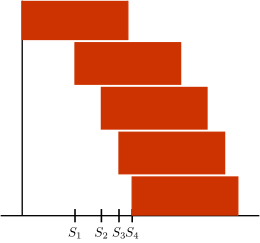
We want to construct a brick tower with “maximal overhang”. We assume that the length of each brick is \(1\) and that its mass is \(1\) (we ignore the units here). We enumerate the bricks from the top down from \(1\) to \(n.\) The center of mass of the tower with the bricks \(1\) to \(n-1\) has the \(x\)-coordinate \(S_{n-1}.\) We would like to build a tower with maximal overhang. Thus, we must place the tower consisting of bricks \(1\) to \(n-1\) on top of the \(n\)-th brick such that the left side of this brick is exactly on the coordinate \(S_{n-1},\) see Figure 3.1 for an illustration.
The formula for the \(x\)-coordinate of the joint center of mass of two bodies \(A\) and \(B\) with individual centers of mass \(S_A\) and \(S_B\) and weights \(m_A\) and \(m_B\) is given by \[S = \frac{m_AS_A + m_BS_B}{m_A + m_B}.\] Since the center of mass of brick \(n\) has the \(x\)-coordinate \(S_{n-1} + \frac{1}{2}\) (we assume a uniform distribution of the mass inside the brick), we obtain \[S_n = \frac{(n-1)S_{n-1} + 1\cdot (S_{n-1} + \frac{1}{2})}{n} = S_{n-1} + \frac{1}{2n}.\] Inductively we arrive at the formula \[S_n = \sum_{k=1}^n \frac{1}{2k} = \frac{1}{2}\sum_{k=1}^n \frac{1}{k} = \frac{1}{2}\left( 1 + \frac{1}{2} +\frac{1}{3} + \ldots + \frac{1}{n}\right).\] Thus, let us consider the harmonic series \[\sum_{k=1}^\infty \frac{1}{k}.\] We will show now that this series is divergent. We consider the \(n\)-th partial sum \(s_n\) for \(n = 2^m\) with \(m \in {\mathbb{N}}.\) Since we have \[\sum_{k = 2^{\ell-1}+1}^{2^\ell} \frac{1}{k} = \underbrace{\frac{1}{2^{\ell-1}+1} + \ldots + \frac{1}{2^{\ell}}}_{2^{\ell-1} \text{ summands}} \ge 2^{\ell-1} \frac{1}{2^\ell} = \frac{1}{2}\] for all \(\ell = 1,\,\ldots,\,m,\) we obtain \[s_{2^m} = \sum_{k=1}^{2^m} \frac{1}{k} = 1 + \sum_{\ell=1}^m \sum_{k=2^{\ell-1}+1}^{2^\ell} \frac{1}{k} \ge 1 + \sum_{\ell=1}^m \frac{1}{2} = 1 + \frac{m}{2}.\] Since the latter is true for arbitrary \(m \in {\mathbb{N}},\) the sequence \({(s_n)}_{n \in {\mathbb{N}}}\) of partial sums is unbounded and the series is divergent. This example illustrates two things:
At least in theory it is possible to construct a brick tower of arbitrarily large overhang.
Even though the sequence \(\left( \frac{1}{n} \right)_{n \ge 1}\) is a null sequence, the series \(\sum_{k=1}^\infty \frac{1}{k}\) does not converge. So our necessary convergence criterion (Theorem 3.2) is indeed only necessary but not sufficient for convergence.
The sequence of partial sums of the harmonic sequence diverges properly towards \(\infty,\) hence we also write \[\sum_{k=1}^{\infty} \frac{1}{k} = \infty.\]
Video 3.2. The harmonic series.
3.2 Convergence Criteria for Series
The convergence criteria we have derived for sequences are of course also valid for series. However, for series there are also further results that we are going to discuss in this section. Let us first begin by translating Cauchy’s convergence criterion into the language of series.
Theorem 3.3 • Cauchy’s convergence criterion
The series \(\sum_{k=0}^\infty a_k\) converges, if and only if for every \(\varepsilon > 0\) there exists an \(N_\varepsilon \in {\mathbb{N}}\) such that for all \(n,\,m \in {\mathbb{N}}\) with \(n \ge m \ge N_\varepsilon\) it holds that \[\left| \sum_{k=m}^n a_k \right| < \varepsilon.\]
Proof. Let \(s_n\) be the \(n\)-th partial sum of \(\sum_{k=0}^\infty a_k,\) then the result follows directly from Cauchy’s convergence criterion for sequences (Theorem 2.14), since \[\left| \sum_{k=m}^n a_k \right| = |s_n - s_{m-1}|\] for \(n \ge m \ge 1.\)
Another easy-to-check convergence criterion can be derived for a special class of series, namely alternating series
Definition 3.2 • Alternating series
A series \(\sum_{k=0}^\infty b_k\) is called alternating, if \(b_nb_{n+1} < 0\) for all \(n \in {\mathbb{N}}.\)
Remark 3.1
A series is alternating, if and only if it can also be written in the form \[\sum_{k=0}^\infty (-1)^k a_k,\] where \(a_n\) is either positive for all \(n \in {\mathbb{N}}\) or negative for all \(n \in {\mathbb{N}}.\) This also explains the term “alternating”, since the coefficients \((-1)^k a_k\) are alternatingly positive and negative.
For the proof of the subsequent result we need a lemma.
Lemma 3.4
Let \({(a_n)}_{n \in {\mathbb{N}}}\) be a sequence of real numbers such that the subsequences \({(a_{2m})}_{m \in {\mathbb{N}}}\) and \({(a_{2m+1})}_{m \in {\mathbb{N}}}\) both converge towards \(a \in {\mathbb{R}}.\) Then also \({(a_{n})}_{n \in {\mathbb{N}}}\) converges towards \(a.\)
Proof. Exercise!
Theorem 3.5 • Leibniz criterion/alternating series test
Let \({(a_n)}_{n \in {\mathbb{N}}}\) be a monotonically decreasing null sequence. Then the series \[\sum_{k=0}^\infty (-1)^k a_k\] is convergent.
Proof. We consider the subsequences \({(s_{2m})}_{m \in {\mathbb{N}}}\) and \({(s_{2m+1})}_{m \in {\mathbb{N}}}\) of the sequence of partial sums \({(s_n)}_{n \in {\mathbb{N}}}.\) Since \({(a_n)}_{n \in {\mathbb{N}}}\) is monotonically decreasing, for all \(m \in {\mathbb{N}}\) we get \[\begin{aligned} s_{2m+2} &= s_{2m} - a_{2m+1} + a_{2m+2} \le s_{2m}, \\ s_{2m+3} &= s_{2m+1} + a_{2m+2} - a_{2m+3} \ge s_{2m+1}, \end{aligned}\] i. e., \({(s_{2m})}_{m \in {\mathbb{N}}}\) is monotonically decreasing and \({(s_{2m+1})}_{m \in {\mathbb{N}}}\) is monotonically increasing. Moreover, \[s_{2m+1} = s_{2m} - a_{2m+1} \le s_{2m},\] this shows that both sequences are bounds for each other. In particular, \({(s_{2m})}_{m \in {\mathbb{N}}}\) is bounded from below and \({(s_{2m+1})}_{m \in {\mathbb{N}}}\) is bounded from above. By the monotone convergence theorem (Theorem 2.8) we get \[s := \lim_{m \to \infty} s_{2m+1} \le \lim_{m \to \infty} s_{2m} =: \widetilde{s}.\] We even have \(s = \widetilde{s}.\) This follows from the assumption that \({(a_n)}_{n \in {\mathbb{N}}}\) is a null sequence and \[s-\widetilde{s} = \lim_{m \to \infty} s_{2m+1} - \lim_{m \to \infty} s_{2m} = \lim_{m \to \infty} (s_{2m+1} - s_{2m}) = \lim_{m \to \infty} (-a_{2m+1}) = 0.\] By Lemma 3.4, also \({(s_n)}_{n \in {\mathbb{N}}}\) converges towards \(s.\)
Video 3.3. Leibniz criterion.
Example 3.3
We consider the alternating harmonic series \[\sum_{k = 1}^\infty (-1)^{k+1} \frac{1}{k} = 1 - \frac{1}{2} + \frac{1}{3} - \frac{1}{4} \pm \ldots.\] Since \(\left( \frac{1}{n}\right)_{n \in {\mathbb{N}}}\) is a monotonically decreasing null sequence, Theorem 3.5 implies the convergence of the alternating harmonic series.
Note that the theorem only makes a statement about the convergence of the series, but does not say anything about its limit. By the monotonicity of the subsequences of partial sums \({(s_{2m})}_{m \in {\mathbb{N}}}\) and \({(s_{2m+1})}_{m \in {\mathbb{N}}}\) used in the proof of Theorem 3.5 we immediately obtain the estimates \[s_1 = \frac{1}{2} \le s \le 1 = s_0.\] We will calculate the exact value of the limit later, but at the moment we still do not know all the techniques needed for this calculation.
Another example of a series that is convergent by Theorem 3.5 is the so-called Leibniz series \[\sum_{k=0}^\infty (-1)^k \frac{1}{2k+1} = 1- \frac{1}{3} + \frac{1}{5} - \frac{1}{7} \pm \ldots.\] Also for this series we will only be able to compute its limit \(s \in \big[\frac{2}{3},1\big]\) later.
For finite sums, the commutative law is satisfied, i. e., it does not matter in which order the summands are added. Surprisingly, this is not the case for series. To analyze this phenomenon in detail, we first define what we understand by a rearrangement.
Definition 3.3 • Rearrangement
Let \(\sigma : {\mathbb{N}}\to {\mathbb{N}}\) be bijective and let \(\sum_{k = 0}^\infty a_k\) be a series. Then the series \(\sum_{k = 0}^\infty a_{\sigma(k)}\) is called a rearrangement of the series \(\sum_{k = 0}^\infty a_k.\)
Example 3.4
We consider again the alternating harmonic series \[\sum_{k=0}^\infty a_k = \sum_{k=0}^\infty (-1)^k \frac{1}{k+1}\] and we know already that its sum is \(s \in \big[\frac{1}{2},1\big].\) As first rearrangement we consider the series \[\begin{gathered} \sum_{m = 0}^\infty \left( \frac{1}{2m+1} - \frac{1}{4m+2} - \frac{1}{4m+4} \right) \\= \left( 1- \frac{1}{2}-\frac{1}{4} \right) + \left( \frac{1}{3}- \frac{1}{6}-\frac{1}{8} \right) + \left( \frac{1}{5}- \frac{1}{10}-\frac{1}{12} \right) + \ldots. \end{gathered}\] This is indeed a rearrangement of the alternating harmonic series, where we have rearranged three summands in triples. We can choose the bijection \[\sigma(n) = \begin{cases} \frac{2}{3}n, & \text{if } n = 3m \text{ for } m \in {\mathbb{N}}, \\ 4m+1, & \text{if } n = 3m +1 \text{ for } m \in {\mathbb{N}}, \\ 4m+3, & \text{if } n = 3m +2 \text{ for } m \in {\mathbb{N}} \end{cases}\] to represent this rearranged series in the form \(\sum_{k=0}^\infty a_{\sigma(k)}.\)
Also the new series is convergent and we have \[\begin{aligned} \sum_{m = 0}^\infty \left( \frac{1}{2m+1} - \frac{1}{4m+2} - \frac{1}{4m+4} \right) &= \sum_{m = 0}^\infty \left( \frac{1}{2m+1} - \frac{1}{2} \frac{1}{2m+1} - \frac{1}{2} \frac{1}{2m+2} \right) \\ &= \frac{1}{2}\sum_{m = 0}^\infty \left(\frac{1}{2m+1} - \frac{1}{2m+2} \right) \\ &= \frac{1}{2}\sum_{k = 0}^\infty (-1)^{k} \frac{1}{k+1} = \frac{1}{2}s. \end{aligned}\] In other words, we obtain only half of the sum of the original series.
A second rearrangement of the series is \[\begin{gathered} 1 - \frac{1}{2} + \sum_{n=1}^\infty \left( \left( \sum_{m=1}^{2^{n-1}} \frac{1}{2^n + 2m - 1} \right) - \frac{1}{2n+2} \right) \\ = 1 - \frac{1}{2} + \left( \frac{1}{3} - \frac{1}{4} \right) + \left( \frac{1}{5} + \frac{1}{7} - \frac{1}{6} \right) + \left( \frac{1}{9} + \frac{1}{11} + \frac{1}{13} + \frac{1}{15} - \frac{1}{8} \right) + \ldots. \end{gathered}\] We obtain \[\underbrace{\frac{1}{2^n+1} + \ldots + \frac{1}{2^{n+1}-1}}_{2^{n-1} \text{ summands}} - \frac{1}{2n+2} \ge \frac{2^{n-1}}{2^{n+1}} - \frac{1}{2n+2} \ge \frac{1}{4} - \frac{1}{6} = \frac{1}{12}.\] Thus, the sequence of partial sums is unbounded and the rearrangement is even divergent.
Fortunately, we can impose an additional assumption that ensures that any rearrangement of a convergent series will still be convergent.
Definition 3.4 • Absolute convergence
A series \(\sum_{k=0}^\infty a_k\) is called absolutely convergent, if the series \(\sum_{k=0}^\infty |a_k|\) is convergent.
Theorem 3.6
An absolutely convergent series \(\sum_{k=0}^\infty a_k\) of real numbers is convergent.
Proof. Let \(\varepsilon > 0\) be arbitrary. Because of the absolute convergence and by using Cauchy’s convergence criterion, there exists an \(N \in {\mathbb{N}}\) such that \[\sum_{k = m}^n |a_k| = \left| \sum_{k = m}^n |a_k| \right| < \varepsilon \quad \text{for all } n \ge m \ge N.\] By the triangle inequality we get \[\left| \sum_{k = m}^n a_k \right| \le \sum_{k = m}^n |a_k| < \varepsilon.\] By Cauchy’s convergence criterion, we also obtain convergence of the series \(\sum_{k=0}^\infty a_k.\)
Remark 3.2
Absolute converge is a stronger term than convergence, because the converse of Theorem 3.6 is not valid. The alternating harmonic series \[\sum_{k=0}^\infty (-1)^k \frac{1}{k+1}\] is convergent, but not absolutely convergent.
Video 3.4. Absolute convergence.
Theorem 3.7
Let \(\sigma: {\mathbb{N}}\to {\mathbb{N}}\) be bijective and let \(\sum_{k=0}^\infty a_k\) be absolutely convergent. Then also the series \(\sum_{k=0}^\infty a_{\sigma(k)}\) converges and it holds that \[\sum_{k=0}^\infty a_k = \sum_{k=0}^\infty a_{\sigma(k)}.\]
Proof. Let \(s := \sum_{k=0}^\infty a_k\) be the sum of the series as well as \(\varepsilon > 0\) be arbitrary. Since the series is absolutely convergent, by Theorem 3.6 it is also convergent. Thus, by the definition of convergence and Cauchy’s convergence criterion, there exists an \(N \in {\mathbb{N}}\) such that \[\tag{3.2} \left| s - \sum_{k=0}^n a_k\right| < \frac{\varepsilon}{2} \quad \text{for all } n \ge N\] as well as \[\tag{3.3} \sum_{k=m}^n |a_k| < \frac{\varepsilon}{2} \quad \text{for all } n \ge m \ge N.\] Since \(\sigma\) is surjective, there exists an \(\ell_N \in {\mathbb{N}}\) such that \[\{0,\,1,\,2,\,\ldots,\,N\} \subseteq \{\sigma(0),\,\sigma(1),\,\sigma(2),\,\ldots,\,\sigma(\ell_N)\},\] one can simply choose \(\ell_N := \max\{ \ell \in {\mathbb{N}}\;| \; \sigma(\ell) \le N\}.\) Let \(\ell \ge \ell_N.\) By the triangle inequality it holds that \[\tag{3.4} \left| s - \sum_{k=0}^\ell a_{\sigma(k)}\right| \le \left| s - \sum_{k=0}^N a_{k}\right| + \left| \sum_{k=0}^N a_{k} - \sum_{k=0}^\ell a_{\sigma(k)}\right|.\] By (3.2) we have \[\tag{3.5} \left| s - \sum_{k=0}^N a_{k}\right| < \frac{\varepsilon}{2}.\] Since \(\sigma\) is injective, the sum \(\sum_{k=0}^\ell a_{\sigma(k)}\) contains all of the summands \(a_0,\,a_1,\,\ldots,\,a_N\) (and each one exactly once). Thus, the difference \[\sum_{k=0}^N a_{k} - \sum_{k=0}^\ell a_{\sigma(k)}\] contains only summands \(a_k\) with \(k \ge N+1.\) Thus, with the triangle inequality and (3.3) we obtain the estimate \[\tag{3.6} \left| \sum_{k=0}^N a_{k} - \sum_{k=0}^\ell a_{\sigma(k)}\right| \le \sum_{k = N+1}^n |a_k| < \frac{\varepsilon}{2},\] where \(n:= \max\{\sigma(0),\,\ldots,\,\sigma(\ell)\}.\) Combining (3.5) and (3.6) with (3.4) yields \[\left| s - \sum_{k=0}^\ell a_{\sigma(k)}\right| < \frac{\varepsilon}{2} + \frac{\varepsilon}{2} = \varepsilon,\] Since \(\varepsilon\) is arbitrary, the series \(\sum_{k=0}^\infty a_{\sigma(k)}\) is convergent with sum \(s.\)
Video 3.5. Rearranging absolutely convergent series.
As we have already seen, Theorem 3.7 is not satisfied for series that are only convergent (but not absolutely convergent). Such series are also sometimes called conditionally convergent. Indeed, one can show that in this case, one can achieve any value for the sum by a rearrangement. This is the statement of the following theorem which we will not prove here.
Theorem 3.8 • Riemann’s rearrangement theorem
Let the series \(\sum_{k=0}^\infty a_k\) be conditionally convergent (i. e., convergent, but not absolutely convergent). Then for any \(s \in {\mathbb{R}}\cup\{-\infty,\infty\}\) there exists a bijection \(\sigma : {\mathbb{N}}\to {\mathbb{N}}\) such that \[\sum_{k=0}^\infty a_{\sigma(k)} = s.\]
Next we discuss a result that shows absolute convergence (and hence convergence) of a series that can – in a certain sense – be bounded from above by a convergent series.
Theorem 3.9 • Majorant criterion
Let \({(a_n)}_{n \in {\mathbb{N}}}\) and \({(b_n)}_{n \in {\mathbb{N}}}\) be two sequences of real numbers with the condition that \[|a_n| \le b_n \quad \text{for all } n \ge N.\] If \(\sum_{k = 0}^\infty b_k\) is convergent, then the series \(\sum_{k = 0}^\infty a_k\) is absolutely convergent and moreover, \[\tag{3.7} \sum_{k = N}^\infty a_k \le \sum_{k = N}^\infty |a_k| \le \sum_{k = N}^\infty b_k.\] (The series \(\sum_{k = 0}^\infty b_k\) is then called a convergent majorant (series) of \(\sum_{k = 0}^\infty a_k.\))
Proof. We prove this result with the help of Cauchy’s convergence criterion. Let \(\varepsilon > 0\) be arbitrary. Then because of the convergence of the series \(\sum_{k=0}^\infty b_k,\) there exists an \(\widetilde{N} \in {\mathbb{N}}\) such that \[\left| \sum_{k=m}^n b_k \right| < \varepsilon \quad \text{for all } n\ge m \ge \widetilde{N}.\] If we set \(N_\varepsilon := \max\big\{ N,\,\widetilde{N} \big\},\) then we obtain \[\sum_{k = m}^n |a_k| \le \sum_{k = m}^n b_k \le \left|\sum_{k = m}^n b_k\right| < \varepsilon \quad \text{for all } n\ge m\ge N_\varepsilon.\] Thus, with Cauchy’s convergence criterion we get the absolute convergence of the series \(\sum_{k=0}^\infty a_k.\) The inequalities in (3.7) follow from Theorem 2.5 since it holds that \[\sum_{k = N}^n a_k \le \sum_{k = N}^n |a_k| \le \sum_{k = N}^n b_k \quad \text{for all } n \ge N.\]
Video 3.6. Majorant criterion.
Example 3.5
The series \(\sum_{k=0}^\infty \frac{1}{2^k + k + 1}\) is convergent because for each \(k \in {\mathbb{N}}\) it holds that \[\frac{1}{2^k + k+ 1} \le \frac{1}{2^k}.\] Therefore, the geometric series \(\sum_{k=0}^\infty \left( \frac{1}{2} \right)^k\) is a convergent majorant (see also Example 3.1 ii) of \(\sum_{k=0}^\infty \frac{1}{2^k + k+ 1}.\) We further have \[\sum_{k=0}^\infty \frac{1}{2^k + k+ 1} \le \sum_{k=0}^\infty \left( \frac{1}{2} \right)^k = \frac{1}{1-\frac{1}{2}} = 2.\]
Remark 3.3 • Minorant criterion
By contraposition we obtain the following minorant criterion from the majorant criterion: If \(\sum_{k=0}^\infty |a_k|\) is divergent and there exists an \(N \in {\mathbb{N}}\) such that \(|a_n| \le b_n\) for all \(n \ge N,\) then also the series \(\sum_{k=0}^\infty b_k\) is divergent. In this case, we call \(\sum_{k=0}^\infty |a_k|\) a divergent minorant (series) of \(\sum_{k=0}^\infty b_k.\)