3.7 Local parametrisations
An affine \(2\)-plane in \(\mathbb{R}^3\) is the set \(M\) of solutions to an equation of the form \[Ax+By+Cz=D\] for some coefficients \(A,B,C\) not all zero. We thus obtain the plane as the level set of the smooth function the defined by the rule \(p=(x,y,z) \mapsto f(p)=Ax+By+Cz,\) that is, \(M=f^{-1}\left(\{D\}\right).\)
Alternatively, we can describe the affine plane as the image of a smooth map \[F : \mathbb{R}^2 \to \mathbb{R}^3, \qquad q=(u,v)\mapsto p_0+uw_1+vw_2,\] for points \(p_0,w_1,w_2 \in \mathbb{R}^3\) such that \(f(p_0)=D\) and \(f(w_1)=f(w_2)=0.\)
Many surfaces are much easier to describe as the image of a smooth map, rather than as a level set. Unfortunately, it is exceptional that the whole surface is the image of single map, as it is the case for an affine \(2\)-plane in \(\mathbb{R}^3.\) In general one needs several maps that parametrise a surface. This leads to the notion of a local parametrisation.
Definition 3.50 • Local parametrisation of a surface
Given an embedded surface \(M\subset \mathbb{R}^3,\) a smooth map \(F : U \to \mathbb{R}^3\) defined on some open subset \(U\subset \mathbb{R}^2\) so that
\(\operatorname{Im}(F)\subset M\);
\(F\) is injective;
\(F\) is an immersion. This means that \(F_*|_q : T_qU \to T_{F(q)}\mathbb{R}^3\) is injective for all \(q \in U\);
\(F\) is a homeomorphism onto its image. This means that there exists an open subset \(W\) of \(\mathbb{R}^3\) which contains the image of \(F\) and a continuous map \(\Phi : W \to U\) so that \(\Phi(F(q))=q\) for all \(q \in U\);
is called a local parametrisation of \(M\) (or more precisely a local parametrisation of \(\operatorname{Im}(F)\)). The restriction of \(\Phi\) to \(W\cap M\) is called a local coordinate system on \(W\cap M\).
Exercise 3.51
Consider the injective immersion \(F : (0,2\pi)\times (0,1) \to \mathbb{R}^3\) defined by \((u,v)\mapsto (\sin(u),\sin(u)\cos(u),v).\) Show that \(F\) is not a homeomorphism onto its image (compare Figure 4.1).

Exercise 3.52
Write \(q=(u,v)\) for a point of \(U \subset \mathbb{R}^2.\) Show that \(F_*|_q\) is injective if and only if the cross product \[\frac{\partial F}{\partial u}(q) \times \frac{\partial F}{\partial v}(q):=\begin{pmatrix} \frac{\partial F_1}{\partial u}(q) \\\frac{\partial F_2}{\partial u}(q)\\\frac{\partial F_3}{\partial u}(q) \end{pmatrix}\times \begin{pmatrix} \frac{\partial F_1}{\partial v}(q) \\\frac{\partial F_2}{\partial v}(q)\\\frac{\partial F_3}{\partial v}(q) \end{pmatrix}\] is non-vanishing, where we write \(F=(F_1,F_2,F_3)\) for smooth functions \(F_i : U \to \mathbb{R}.\)
Example 3.53 • Stereographic projection
Consider the \(2\)-sphere \(S^2\) and the map \[F : \mathbb{R}^2 \to \mathbb{R}^3, \qquad q=(u,v) \mapsto \left(\frac{2u}{1+u^2+v^2},\frac{2v}{1+u^2+v^2},\frac{-1+u^2+v^2}{1+u^2+v^2}\right)\] Clearly \(F\) is smooth and injective and we have \[\frac{\partial F}{\partial u}(q)=\frac{1}{(1+u^2+v^2)^2}\begin{pmatrix} 2-2u^2+2v^2 \\ -4uv \\ 4u\end{pmatrix}\] and \[\frac{\partial F}{\partial v}(q)=\frac{1}{(1+u^2+v^2)^2}\begin{pmatrix} -4uv \\ 2(1+u^2-v^2) \\ 4v \end{pmatrix}\] From which we obtain \[\frac{\partial F}{\partial u}(q)\times \frac{\partial F}{\partial v}(q)=-\frac{1}{(1+u^2+v^2)^3}\begin{pmatrix} 8u \\ 8v \\ 4(-1+u^2+v^2)\end{pmatrix}\neq {0}_{\mathbb{R}^3}\] so that \(F : \mathbb{R}^2 \to \mathbb{R}^3\) is an immersion. Notice that the image of \(F\) is contained in \(S^2\subset \mathbb{R}^3,\) it does however not contain the north pole \((0,0,1)\in S^2.\) Consider the open subset of \(\mathbb{R}^3\) defined by \(W=\mathbb{R}^3\setminus\{(x,y,1)\,|\,x,y \in \mathbb{R}\}\) and \[\tag{3.7} \Phi : W \to \mathbb{R}^2, \qquad p=(x,y,z) \mapsto \Phi(p)=\left(\frac{x}{1-z},\frac{y}{1-z}\right).\] The map \(\Phi\) is called the stereographic projection from the north pole. It is continuous and moreover, a direct calculation shows that \(\Phi(F(q))=q\) for all \(q \in \mathbb{R}^2.\) It follows that \(F : \mathbb{R}^2 \to \mathbb{R}^3\) is a local parametrisation of \(S^2\) with the north pole removed.
Likewise, consider the map \[\hat{F} : \mathbb{R}^2 \to \mathbb{R}^3, \qquad q=(u,v) \mapsto \left(\frac{2u}{1+u^2+v^2},\frac{-2v}{1+u^2+v^2},\frac{1-u^2-v^2}{1+u^2+v^2}\right)\] As above, one chan check that \(\hat{F}\) is a smooth injective immersion and defining \(\hat{W}=\mathbb{R}^3\setminus\{(x,y,-1)\,|\,x,y \in \mathbb{R}\}\) and \[\hat{\Phi} : \hat{W} \to \mathbb{R}^2, \qquad p=(x,y,z) \mapsto \hat{\Phi}(p)=\left(\frac{x}{1+z},\frac{-y}{1+z}\right).\] we have \(\hat{\Phi}(\hat{F}(p))=p\) for all \(p \in \mathbb{R}^2.\) The map \(\hat{\Phi}\) is called the stereographic projection from the south pole and the \(\hat{F}\) is a local parametrisation of \(S^2\) with the south pole removed. We conclude that we can parametrise \(S^2\) in terms of two maps \(F\) and \(\hat{F}.\)
Exercise 3.54
Show that for a point \(p=(x,y,z)\in S^2\setminus\{(0,0,1)\},\) the equatorial plane \(\{(x,y,0)\,|\,x,y,\in\mathbb{R}\}\subset \mathbb{R}^3\) intersects the straight line through \((0,0,1)\) and \(p\) in the point \[\left(\frac{x}{1-z},\frac{y}{1-z},0\right).\] Because of this fact the map \(\Psi\) from (3.7) is called the stereographic projection from the north pole. Likewise, the straight line through \((0,0,-1)\) and \(p \in S^2\setminus\{(0,0,-1)\}\) intersects the equatorial plane in the point \[\left(\frac{x}{1+z},\frac{-y}{1+z},0\right).\]
Another local parametrisation of the sphere is given by the following map:
Example 3.55 • Spherical coordinates
The \(2\)-sphere \(S^2(r)\) with half a meridian removed is parametrised by the map \(F : (0,2\pi)\times (-\pi/2,\pi/2) \to S^2(r)\subset \mathbb{R}^3\) defined by the rule \[(u,v)\mapsto(r\cos(v)\cos(u),r\cos(v)\sin(u),r\sin(v)).\] The coordinates associated with this parametrisation are known as spherical coordinates.
Example 3.56 • Torus
Recall that the torus is the level set of the function \(f(p)=\left(R-\sqrt{x^2+y^2}\right)^2+z^2\) with level \(r^2.\) A local parametrisation of the torus is given by the map \(F : (0,2\pi)\times (0,2\pi) \to \mathbb{R}^3\) defined by the rule \[(u,v) \mapsto ((R+r\cos(v))\cos(u),(R+r\cos(v))\sin(u),r\sin(v)).\]
Example 3.57 • Graph of a function
Let \(U\subset \mathbb{R}^2\) be an open set and \(h : U \to \mathbb{R}\) a smooth function. Recall that the graph \(\mathcal{G}_h\) of \(h\) is an embedded surface. Consider \[F : U \to \mathbb{R}^3, \qquad q=(u,v) \mapsto (u,v,h(u,v)).\] Then \(F\) is smooth, injective and moreover an immersion since \[\frac{\partial F}{\partial u}(q)\times \frac{\partial F}{\partial v}(q)=\begin{pmatrix} -\frac{\partial h}{\partial u}(q) \\ -\frac{\partial h}{\partial v}(q) \\ 1 \end{pmatrix} \neq {0}_{\mathbb{R}^3}\] Let \(W=U\times \mathbb{R}\subset \mathbb{R}^3\) and define \[\Phi : W \to \mathbb{R}^2, \qquad p=(x,y,z) \mapsto \Phi(p)=(x,y).\] Clearly \(\Phi\) is continuous and \(\Phi(F(q))=q\) for all \(q \in U.\) It follows that the graph \(\mathcal{G}_h\) of \(h\) is parametrised by \(F.\)
Remark 3.58
Choosing the function \(h(u,v)=uv\) in the previous example gives the hyperbolic paraboloid.
Having the notion of a local parametrisation of a surface, we should make sure that sufficiently small pieces of an embedded surface admit a local parametrisation. This is a consequence of the implicit function theorem.
Theorem 3.59 • Special case of the implicit function theorem
Every embedded surface \(M\subset \mathbb{R}^3\) is locally the composition of a Euclidean motion and the graph of a smooth function. That is, for every point \(p \in M\) there exists a Euclidean motion \(f_{\mathbf{R},q} : \mathbb{R}^3\to \mathbb{R}^3,\) an open set \(W\subset \mathbb{R}^3\) containing \(\mathbf{R}p+q,\) an open set \(U \subset \mathbb{R}^2\) and a smooth function \(h : U \to \mathbb{R}\) so that \(W\cap f_{\mathbf{R},q}(M)=\mathcal{G}_h.\)
Proof. Notice that if \(\mathbf{A}\) is an invertible \(3\times 3\)-matrix and \(b \in \mathbb{R}^3,\) then \(f_{\mathbf{A},b}(M)\) is also an embedded surface. Fix \(p \in M\) and choose a Euclidean motion \(f_{\mathbf{R},q} : \mathbb{R}^3 \to \mathbb{R}^3\) so that \(f_{\mathbf{R},q}(p)=0_{\mathbb{R}^3}\) and so that the tangent space of \(\tilde{M}=f_{\mathbf{R},q}(M)\) at \(0_{\mathbb{R}^3}\) is spanned by \[\begin{pmatrix} 1 \\ 0 \\ 0 \end{pmatrix}_{0_{\mathbb{R}^3}} \qquad \text{and} \qquad \begin{pmatrix} 0 \\ 1 \\ 0 \end{pmatrix}_{0_{\mathbb{R}^3}}.\] We want to argue that \(\tilde{M}\) is locally a graph near \(0_{\mathbb{R}^3}.\) For \(q=(u,v) \in \mathbb{R}^2\) consider the curve \(\gamma_{q}\) through \((u,v,0)\) which is perpendicular to the plane \(\{(x,y,0)\,|x,y\in \mathbb{R}\}\) \[\gamma_q : \mathbb{R}^2 \to \mathbb{R}^3, \qquad q=(u,v) \mapsto \gamma_{q}(t)=(u,v,t)\] Since the tangent plane of \(\tilde{M}\) at \(0_{\mathbb{R}^3}\) is horizontal, the curve \(\gamma_q\) will intersect \(\tilde{M}\) for sufficiently small values of \((u,v)=q.\) Mapping \(q=(u,v)\) to the smallest (in absolute value) time \(t\) for which \(\gamma_q\) intersects \(\tilde{M},\) we obtain a smooth real-valued function \(h\) on some open neighbourhood \(U\) of \(0_{\mathbb{R}^2}.\) By construction, \(\tilde{M}\) is locally the graph of \(h,\) that is, there exists an open set \(W\subset \mathbb{R}^3\) so that \(W\cap \tilde{M}=\mathcal{G}_h.\)
Exercise 3.60 Show that Theorem 3.59
Theorem 3.59 • Special case of the implicit function theorem ➔
is still true when the Euclidean motion is replaced with \(f_{\mathbf{P}_{\sigma}} : \mathbb{R}^3 \to \mathbb{R}^3\) and \(\mathbf{P}_{\sigma} \in M_{3,3}(\mathbb{R})\) denotes the permutation matrix of a permutation \(\sigma : \{1,2,3\} \to \{1,2,3\}.\)Every embedded surface \(M\subset \mathbb{R}^3\) is locally the composition of a Euclidean motion and the graph of a smooth function. That is, for every point \(p \in M\) there exists a Euclidean motion \(f_{\mathbf{R},q} : \mathbb{R}^3\to \mathbb{R}^3,\) an open set \(W\subset \mathbb{R}^3\) containing \(\mathbf{R}p+q,\) an open set \(U \subset \mathbb{R}^2\) and a smooth function \(h : U \to \mathbb{R}\) so that \(W\cap f_{\mathbf{R},q}(M)=\mathcal{G}_h.\)
Theorem 3.59 • Special case of the implicit function theorem ➔
that for each point \(p \in M\) we can find an open set \(W\subset \mathbb{R}^3\) containing \(p\) so that \(W\cap M\) is parametrised by the map \[F : U \to \mathbb{R}^3, \qquad q=(u,v) \mapsto f_{\mathbf{R},q}(u,v,h(u,v)),\] where \(f_{\mathbf{R},q} : \mathbb{R}^3 \to \mathbb{R}^3\) is a Euclidean motion and \(h : U \to \mathbb{R}\) a smooth function defined on some open set \(U\subset \mathbb{R}^2.\) A sufficiently small piece of an embedded surface thus always admits a local parametrisation.Every embedded surface \(M\subset \mathbb{R}^3\) is locally the composition of a Euclidean motion and the graph of a smooth function. That is, for every point \(p \in M\) there exists a Euclidean motion \(f_{\mathbf{R},q} : \mathbb{R}^3\to \mathbb{R}^3,\) an open set \(W\subset \mathbb{R}^3\) containing \(\mathbf{R}p+q,\) an open set \(U \subset \mathbb{R}^2\) and a smooth function \(h : U \to \mathbb{R}\) so that \(W\cap f_{\mathbf{R},q}(M)=\mathcal{G}_h.\)
3.8 Calculations in local parametrisations
If \(M=f^{-1}\left(\{c\}\right)\) is an embedded surface and \(F : U \to \mathbb{R}^3\) a local parametrisation of \(M,\) we have that \(f(F(q))=c\) for all \(q \in U.\) Taking the exterior derivative of this identity, we conclude that \[\mathrm{d}f|_{F(q)}(F_*|_q(\vec{w}_q))=0\] for all \(\vec{w}_q \in T_q U.\) Since \(F_*|_q\) is injective, this means that \[T_{F(q)}M=\left\{ F_*|_q(\vec{w}_q)\,|\, \vec{w}_q \in T_qU\right\}.\] That is, the linear map \(F_*|_q : T_q U \to T_{F(q)}\mathbb{R}^3\) maps the tangent space of \(U\) at \(q \in U\) onto the tangent space of \(M\) at \(F(q).\) In particular, writing \[\partial_1F(q):=\frac{\partial F}{\partial u}(q) \qquad \text{and} \qquad \partial_2F(q):=\frac{\partial F}{\partial v}(q)\] it follows that \[\mathbf{b}_{F(q)}=\left(\left(\partial_1F(q)\right)_{F(q)},\left(\partial_2F(q)\right)_{F(q)}\right)\] is an ordered basis \(\mathbf{b}_{F(q)}\) of \(T_{F(q)}M\) for all \(q \in U.\)
With respect to a choice of local parametrisation \(F\) of \(M\) we can thus encode the first fundamental form \(\mathrm{I}\) of \(M\) in terms of a map \(g\) on \(U\) with values in the symmetric \(2\times 2\)-matrices \(g : U \to M_{2,2}(\mathbb{R}).\) The map \(g\) assigns to a point \(q\in U\) the matrix representation of the inner product \(\mathrm{I}_{F(q)}=\langle\cdot{,}\cdot\rangle_{F(q)}\) with respect to the ordered basis \(\mathbf{b}_{F(q)}\) \[q \mapsto g(q)=\mathbf{M}(\mathrm{I}_{F(q)},\mathbf{b}_{F(q)})=\begin{pmatrix} \partial_1F(q)\cdot \partial_1F(q) & \partial_1F(q)\cdot \partial_2F(q) \\ \partial_2F(q)\cdot \partial_1F(q) & \partial_2F(q)\cdot \partial_2F(q)\end{pmatrix},\] where \(\cdot\) denotes the standard scalar product of column vectors. For \(1\leqslant i,j\leqslant 2\) we write \(g_{ij}(q)=\left[\mathbf{M}(\langle\cdot{,}\cdot\rangle_{F(q)},\mathbf{b}_{F(q)}\right]_{ij}\) so that \[\tag{3.8} \boxed{\begin{aligned} g_{11}(q)&=\partial_1F(q)\cdot \partial_1F(q),\\ g_{12}(q)&=\partial_1F(q)\cdot \partial_2F(q)=\partial_2F(q)\cdot \partial_1F(q)=g_{21}(q),\\ g_{22}(q)&=\partial_2F(q)\cdot \partial_2F(q). \end{aligned}}\] or written more succintly (while surpressing the base point) \[\tag{3.9} g_{ij}=\partial_i F \cdot \partial_j F\]
Example 3.61 Consider the local parametrisation of the \(2\)-sphere of radius \(1\) given in Example 3.55
Example 3.55 • Spherical coordinates ➔
\[F(u,v)=(\cos(v)\cos(u),\cos(v)\sin(u),\sin(v)).\] In this case we obtain \[\partial_1F(q)=\begin{pmatrix} -\cos(v)\sin(u) \\ \cos(v)\cos(u) \\ 0\end{pmatrix} \quad \text{and}\quad \partial_2F(q)=\begin{pmatrix} -\sin(v)\cos(u) \\ -\sin(v)\sin(u) \\ \cos(v)\end{pmatrix}\] where we write \(q=(u,v).\) From this we compute \[g_{11}(q)=\left(-\cos(v)\sin(u)\right)^2+\left(\cos(v)\cos(u)\right)^2+\left(0\right)^2=\cos(v)^2\] and likewise \(g_{12}=0\) and \(g_{22}=1\) so that \[g(q)=\begin{pmatrix} \cos(v)^2 && 0 \\ 0 && 1 \end{pmatrix}.\]The \(2\)-sphere \(S^2(r)\) with half a meridian removed is parametrised by the map \(F : (0,2\pi)\times (-\pi/2,\pi/2) \to S^2(r)\subset \mathbb{R}^3\) defined by the rule \[(u,v)\mapsto(r\cos(v)\cos(u),r\cos(v)\sin(u),r\sin(v)).\] The coordinates associated with this parametrisation are known as spherical coordinates.
Example 3.62
For the parametrisation of the hyperbolic paraboloid \[F : \mathbb{R}^2 \to \mathbb{R}^3, \qquad q=(u,v)\mapsto (u,v,uv)\] we obtain \[g(q)=\begin{pmatrix} 1+v^2 & uv \\ uv & 1+u^2 \end{pmatrix}.\]
Exercise 3.63 Show that for the parametrisation of the torus given in Example 3.56
Example 3.56 • Torus ➔
we obtain \[g(q)=\begin{pmatrix} (R+r\cos(v))^2 & 0 \\ 0 & r^2\end{pmatrix}\] where we write \(q=(u,v).\)Recall that the torus is the level set of the function \(f(p)=\left(R-\sqrt{x^2+y^2}\right)^2+z^2\) with level \(r^2.\) A local parametrisation of the torus is given by the map \(F : (0,2\pi)\times (0,2\pi) \to \mathbb{R}^3\) defined by the rule \[(u,v) \mapsto ((R+r\cos(v))\cos(u),(R+r\cos(v))\sin(u),r\sin(v)).\]
We can also encode the second fundamental form \(\mathrm{I}\!\,\mathrm{I}\) of \(M\) in terms of a matrix-valued map on \(U.\) We define \[A : U \to M_{2,2}(\mathbb{R}), \qquad q \mapsto A(q)=\mathbf{M}(\mathrm{I}\!\,\mathrm{I}_{F(q)},\mathbf{b}_{F(q)}).\] To compute the matrix entries of \(A\) explicitly, first observe that we may choose the unit normal field \(N : M \to TM^{\perp}\) so that \[\tag{3.10} G(q):=\nu(F(q))=\frac{\partial_1F(q)\times \partial_2F(q)}{|\partial_1F(q)\times \partial_2F(q)|},\] where we write \(N(p)=(\nu(p))_p\) for some smooth function \(\nu : M \to S^2\subset M_{3,1}(\mathbb{R})\) and where \(|\vec{w}|=\sqrt{\vec{w}\cdot\vec{w}}\) for \(\vec{w} \in M_{3,1}(\mathbb{R}).\) This follows from the fact that the cross-product of two linearly independent vectors is orthogonal to the \(2\)-plane spanned by the vectors. Recall that \(\nu : M \to S^2\) is called the Gauss map of \(M\) and – by abusing language – \(G : U \to S^2\) is sometimes also called Gauss map. Observe that \[(\partial_1F(q))_{F(q))}=F_*((\vec{e}_1)_q) \qquad \text{and} \qquad (\partial_2F(q))_{F(q))}=F_*((\vec{e}_2)_q)\] where \(\{(\vec{e}_1)_q,(\vec{e}_2)_q\}\) denotes the standard basis of \(T_q\mathbb{R}^2.\) Suppressing base points to simplify notation and denoting the entries of \(A(q)\) by \(A_{ij}(q)\) for \(1\leqslant i,j\leqslant 2,\) we have \[\begin{aligned} A_{ij}(q)&=-\langle \mathrm{d}\nu(F_*(\vec{e}_i)),F_*(\vec{e}_j)\rangle=-\langle \mathrm{d}(\nu \circ F)(\vec{e}_i),F_*(\vec{e}_j)\rangle\\ &=-\langle \mathrm{d}G(\vec{e}_i),F_*(\vec{e}_j)\rangle, \end{aligned}\] where the second equality follows from the chain rule and the third equality uses that \(G=\nu \circ F.\) Explicitly we thus have \[\begin{aligned} A_{11}(q)&=-\partial_1G(q)\cdot \partial_1F(q),\\ A_{12}(q)&=-\partial_1G(q)\cdot \partial_2F(q)=-\partial_2G(q)\cdot \partial_1F(q)=A_{21}(q),\\ A_{22}(q)&=-\partial_2G(q)\cdot \partial_2F(q), \end{aligned}\] where we write \[\partial_1G(q):=\frac{\partial G}{\partial u}(q) \qquad \text{and} \qquad \partial_2G(q):=\frac{\partial G}{\partial v}(q)\] Since \(G(q)\cdot \partial_1F(q)=0\) for all \(q \in U,\) we have \[\frac{\partial}{\partial u}\left(G\cdot F_u\right)(q)=0=\partial_1G(q)\cdot \partial_1F(q)+G(q)\cdot \partial^2_{11}F(q)\] so that \(\partial_1G(q)\cdot \partial_1F(q)=-G(q)\cdot \partial^2_{11}F(q),\) where we write \[\partial^2_{11}F(q):=\frac{\partial^2 F}{\partial u\partial u}(q)\] Using corresponding notation, we obtain likewise \[\partial_2G(q)\cdot \partial_2F(q)=-G(q)\cdot \partial^2_{22}F(q)\] and \[\partial_1G(q)\cdot \partial_2F(q)=-G(q)\cdot \partial^2_{12}F(q)=-G(q)\cdot \partial^2_{21}F(q)=\partial_2G(q)\cdot \partial_1F(q).\] In summary, we thus have \[\tag{3.11} \boxed{\begin{aligned} A_{11}(q)&=G(q)\cdot \partial^2_{11}F(q), \\ A_{12}(q)&=G(q)\cdot \partial^2_{12}F(q)=G(q)\cdot \partial^2_{21}F(q)=A_{21}(q),\\ A_{22}(q)&=G(q)\cdot \partial^2_{22}F(q), \end{aligned}}\] or written more succintly (while surpressing the base point) \[\tag{3.12} A_{ij}=G\cdot \partial^2_{ij}F.\]
We next derive explicit identities for the functions \(K \circ F : U \to \mathbb{R}\) and \(H\circ F : U \to \mathbb{R}.\) Recall that for all \(q \in U\) the matrix \(g(q)\) is the matrix representation with respect to the basis \(\mathbf{b}_{F(q)}\) of the inner product \(\langle\cdot{,}\cdot\rangle_{F(q)}\) on \(T_{F(q)}\mathbb{R}^3\) restricted to \(T_{F(p)}M.\) From M06 Linear Algebra II we know that the restriction of an inner product to a subspace is non-degenerate. This is equivalent to \(g(q)\) being an invertible matrix for all \(q \in U.\) We write \(g^{-1} : U \to M_{2,2}(\mathbb{R})\) for the map which assign to a point \(q \in U\) the inverse matrix of \(g(q),\) that is, for all \(q \in U\) we have \(g^{-1}(q)g(q)=\mathbf{1}_2,\) where \(\mathbf{1}_2\) denotes the identity matrix of size \(2.\)
Fix \(q \in U\) and let \(\mathbf{S}(q)\in M_{2,2}(\mathbb{R})\) denote the matrix representation of the shape operator \(S_{F(q)}\) at \(F(q)\) with respect to the ordered basis \(\mathbf{b}_{F(q)}\) of \(T_{F(q)}M\) \[\mathbf{S}(q)=\mathbf{M}(S_{F(q)},\mathbf{b}_{F(q)})\] Write \(\mathbf{S}(q)=(S_{ij}(q))_{1\leqslant i,j\leqslant 2}\) for unique scalars \(S_{ij}(q) \in \mathbb{R}.\) Moreover let \(X_1,X_2\) denote the basis vectors of the ordered basis \(\mathbf{b}_{F(q)}.\) Then we have \[S_p(X_i)=\sum_{k=1}^2S_{ki}(q)X_k\] Using this we compute \[\begin{aligned} A_{ij}(q)&=-\langle S_p(X_i),X_j\rangle=-\left\langle \sum_{j=1}^2S_{ki}(q)X_k,X_j\right\rangle=-\sum_{k=1}^2S_{ki}(q)\langle X_k,X_j\rangle\\ &=-\sum_{k=1}^2S_{ki}(q)g_{kj}(q)=-\sum_{k=1}^2g_{jk}S_{ki}(q)=A_{ji}(q). \end{aligned}\] In matrix notation we thus obtain the identity \[\tag{3.13} A(q)=-g(q)\mathbf{S}(q) \qquad \iff \qquad \mathbf{S}(q)=-g^{-1}(q)A(q).\] Recall that the Gauss curvature at \(p \in M\) is the determinant of \(S_p.\) Hence we conclude \[K(F(q))=\det \mathbf{S}(q)=\det\left(-g^{-1}(q)A(q)\right)=\det\left(g^{-1}(q)A(q)\right)=\frac{\det A(q)}{\det g(q)},\] where the third equality uses that the determinant of a \(2\times 2\)-matrix is unchanged when the matrix is multiplied by \(-1\) and the last equality uses the product rule for the determinant.
For the mean curvature we obtain correspondingly \(H(F(q))=-\frac{1}{2}\operatorname{Tr}\left(g^{-1}(q)A(q)\right)\) so that in summary we have for all \(q \in U\) \[\tag{3.14} \boxed{\begin{aligned} K(F(q))&=\frac{\det A(q)}{\det g(q)},\\ H(F(q))&=-\frac{1}{2}\operatorname{Tr}\left(g^{-1}(q)A(q)\right). \end{aligned}}\]
Example 3.64 For the hyperbolic paraboloid with \(F(q)=(u,v,uv)\) where \(q=(u,v)\) we compute \[G(q)=\frac{1}{\sqrt{1+u^2+v^2}}\begin{pmatrix} -v \\ -u \\ 1\end{pmatrix}.\] From this one can calculate that \[A(q)=\begin{pmatrix} 0 & \frac{1}{\sqrt{1+u^2+v^2}} \\ \frac{1}{\sqrt{1+u^2+v^2}} & 0 \end{pmatrix}\] and Example 3.62
Example 3.62 ➔
gives \[g(q)=\begin{pmatrix} 1+v^2 & uv \\ uv & 1+u^2\end{pmatrix}.\] From this we obtain \(\det g(q)=1+u^2+v^2\) so that at \(F(q)=(u,v,uv)\) we have Gauss curvature \[K(F(q))=-\frac{1}{(1+u^2+v^2)^2}\] which is in agreement with (3.5). We also obtain \[H(F(q))=\frac{uv}{(1+u^2+v^2)^{3/2}},\] which differs from (3.6) by a minus sign. This is no error however, since \(G(q)=-\operatorname{grad}f(F(q))\) for all \(q \in U,\) where \(f : \mathbb{R}^3 \to \mathbb{R}, p=(x,y,z)\mapsto xy-z\) is the defining function of the hyperbolic paraboloid.For the parametrisation of the hyperbolic paraboloid \[F : \mathbb{R}^2 \to \mathbb{R}^3, \qquad q=(u,v)\mapsto (u,v,uv)\] we obtain \[g(q)=\begin{pmatrix} 1+v^2 & uv \\ uv & 1+u^2 \end{pmatrix}.\]
Example 3.65 • Torus For the torus we obtain \[G(q)=\begin{pmatrix} \cos(u)\cos(v) \\ \cos(v)\sin(u) \\ \sin(v)\end{pmatrix}\] and we can compute \[A(q)=-\begin{pmatrix} \cos(v)(R+r\cos(v)) & 0 \\ 0 & r \end{pmatrix}\] From which we deduce together with Exercise 3.63
Exercise 3.63 ➔
\[K(F(q))=\frac{\cos(v)}{r(R+r\cos(v))}\] and \[H(F(q))=\frac{1}{2}\left(\frac{1}{r}+\frac{\cos(v)}{R+r\cos(v)}\right).\]Show that for the parametrisation of the torus given in Example 3.56 we obtain \[g(q)=\begin{pmatrix} (R+r\cos(v))^2 & 0 \\ 0 & r^2\end{pmatrix}\] where we write \(q=(u,v).\)
3.9 Immersed surfaces
All the calculations in the previous section also make sense if \(F\) is a smooth injective immersion. This motivates:
Definition 3.66 • Immersed surface
Let \(U\subset \mathbb{R}^3\) be open and \(F : U \to \mathbb{R}^3\) a smooth injective immersion. Then:
the image \(M:=F(U)\subset \mathbb{R}^3\) is called an immersed surface;
the tangent space of \(M\) at \(p=F(q)\) is defined as \[T_{F(q)}M:=\operatorname{span}\{(\partial_1F(q))_{F(q)},(\partial_2F(q))_{F(q)}\}.\]
Remark 3.67
In what follows, whenever we speak of a surface \(M\subset \mathbb{R}^3\) we mean an immersed or embedded surface.
While we can define the tangent space at each point of an immersed surface, we have to be aware that immersed surfaces can have self intersections, compare with Figure 4.1.
The Gauss curvature, mean curvature, shape operator, first and second fundamental form and Gauss map are defined in terms of the expressions from the previous sections. Often, these quantities are interpreted as being defined on \(U.\) For instance, the Gauss curvature of an immersed surface is often interpreted as a function \(K : U \to \mathbb{R}.\)
We will occasionally also allow \(U\) to be non open, provided there exists an open subset \(\tilde{U}\subset \mathbb{R}^2\) containing \(U\) and a smooth immersion \(\tilde{F} : \tilde{U} \to \mathbb{R}^3\) so that the restriction of \(\tilde{F}\) to \(U\subset \tilde{U}\) is injective.
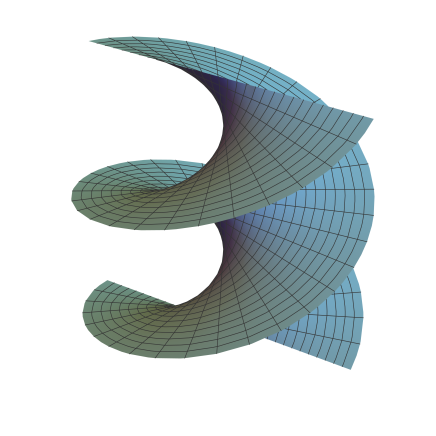
Example 3.68 • Helicoid
Consider \[F : \mathbb{R}^2 \to \mathbb{R}^3, \qquad q=(u,v) \mapsto F(q)=(u\cos(v),u\sin(v),v)\] Clearly, \(F\) is smooth and injective and a calculation shows that \(F\) is an immersion, hence \(M=F(\mathbb{R}^2)\subset \mathbb{R}^3\) is an immersed surface called the Helicoid. Here we compute \[g(q)=\begin{pmatrix} 1 & 0 \\ 0 & 1+u^2\end{pmatrix} \qquad \text{and} \qquad G(q)=\frac{1}{\sqrt{1+u^2}}\begin{pmatrix} \sin(v) \\ -\cos(v) \\ u \end{pmatrix}\] as well as \[A(q)=\begin{pmatrix} 0 & -\frac{1}{\sqrt{1+u^2}} \\ -\frac{1}{\sqrt{1+u^2}} & 0 \end{pmatrix}.\] Which gives \[K(q)=-\frac{1}{(1+u^2)^2} \qquad \text{and} \qquad H(q)=0.\]
The mean curvature of a Helicoid is identically \(0.\) Such surfaces are called minimal surfaces.
Definition 3.69 • Minimal surface
An immersed or embedded surface \(M\subset \mathbb{R}^3\) whose mean curvature is identically \(0\) is called a minimal surface.
Remark 3.70
Minimal surfaces are mathematical idealisations of soap films and belong to the most intensively studied surfaces in geometry. Despite having mathematical origins that date back to the 18th century, they are still actively studied.
An interesting class of immersed surfaces arises from rotating a curve in the \(xz\)-plane around the \(z\)-axis.
Example 3.71 • Surface of revolution
Let \(I\) be an interval and \(\gamma=(\gamma_1,\gamma_2) : I \to \mathbb{R}^2\) a smooth injective immersed curve with \(\gamma_1(t)>0\) for all \(t \in I.\) Consider \(F : [0,2\pi) \times I \to \mathbb{R}^3\) defined by \[(u,v)\mapsto f_{\mathbf{R}_{u}}(\gamma_1(v),0,\gamma_2(v))=(\gamma_1(v)\cos(u),\gamma_1(v)\sin(u),\gamma_2(v))\] where \(\mathbf{R}_u\) is the matrix corresponding to rotation around the \(z\)-axis with angle \(u\) \[\mathbf{R}_u=\begin{pmatrix} \cos(u) & -\sin(u) & 0 \\ \sin(u) & \cos(u) & 0 \\ 0 & 0 & 1\end{pmatrix}.\] Then, one can easily check that \(M=\operatorname{Im}(F)\subset \mathbb{R}^3\) is an immersed surface known as a surface of revolution. We compute the Gauss and mean curvature in the case where \(\gamma\) is a unit speed curve. We have \[\partial_1F(q)=\begin{pmatrix} -\gamma_1(v)\sin(u) \\ \gamma_1(v)\cos(u) \\ 0 \end{pmatrix} \qquad \text{and} \qquad \partial_2F(q)=\begin{pmatrix} \gamma^{\prime}_1(v)\cos(u) \\ \gamma_1^{\prime}(v)\sin(u) \\ \gamma_2^{\prime}(v)\end{pmatrix}.\] from which we compute \[g(q)=\begin{pmatrix} \gamma_1(v)^2 & 0 \\ 0 & 1 \end{pmatrix} \qquad \text{and} \qquad G(q)=\begin{pmatrix}\cos(u)\gamma_2^{\prime}(v) \\ \sin(u)\gamma_2^{\prime}(v) \\ -\gamma_1^{\prime}(v)\end{pmatrix}\] as well as \[A(q)=\begin{pmatrix} -\gamma_1(v)\gamma_2^{\prime}(v) & 0 \\ 0 & \gamma_1^{\prime\prime}(v)\gamma_2^{\prime}(v)-\gamma_1^{\prime}(v)\gamma_2^{\prime\prime}(v)\end{pmatrix}.\] Hence we obtain \[K(q)=\frac{\gamma_2^{\prime}(v)\left(\gamma_1^{\prime}(v)\gamma_2^{\prime\prime}(v)-\gamma_1^{\prime\prime}(v)\gamma_2^{\prime}(v)\right)}{\gamma_1(v)}\] Differentiating \[\gamma_1^{\prime}(v)^2+\gamma_2^{\prime}(v)^2=1\] with respect to \(v\) we deduce \[\gamma_1^{\prime}(v)\gamma_1^{\prime\prime}(v)=-\gamma_2^{\prime}(v)\gamma_2^{\prime\prime}(v),\] so that \[K(q)=\frac{-\gamma_1^{\prime\prime}(v)\gamma_1^{\prime}(v)^2-\gamma_1^{\prime\prime}(v)\gamma_2^{\prime}(v)^2}{\gamma_1(v)}=-\frac{\gamma_1^{\prime\prime}(v)}{\gamma_1(v)}.\] For the mean curvature we obtain \[H(q)=\frac{1}{2}\left(\frac{\gamma_2^{\prime}(v)}{\gamma_1(v)}+\gamma_1^{\prime}(v)\gamma^{\prime\prime}_2(v)-\gamma^{\prime}_2(v)\gamma_1^{\prime\prime}(v)\right).\] Notice that if \(\kappa : I \to \mathbb{R}\) denotes the signed curvature of the plane curve \(\gamma=(\gamma_1,\gamma_2) : I \to \mathbb{R}^2,\) then we can write \[H(q)=\frac{1}{2}\left(\kappa(v)+\frac{\gamma_2^{\prime}(v)}{\gamma_1(v)}\right).\]
Exercise 3.72 • Catenoid The surface of revolution arising from \(\gamma_1(v)=\cosh(v)\) and \(\gamma_2(v)=v\) is known as the Catenoid. Show that the Catenoid has mean curvature identical to \(0.\) Warning: The formula for \(H\) from Example 3.71
Example 3.71 • Surface of revolution ➔
cannot be used, since \(\gamma=(\gamma_1,\gamma_2) : \mathbb{R}\to \mathbb{R}^2\) is not a unit speed curve.Let \(I\) be an interval and \(\gamma=(\gamma_1,\gamma_2) : I \to \mathbb{R}^2\) a smooth injective immersed curve with \(\gamma_1(t)>0\) for all \(t \in I.\) Consider \(F : [0,2\pi) \times I \to \mathbb{R}^3\) defined by \[(u,v)\mapsto f_{\mathbf{R}_{u}}(\gamma_1(v),0,\gamma_2(v))=(\gamma_1(v)\cos(u),\gamma_1(v)\sin(u),\gamma_2(v))\] where \(\mathbf{R}_u\) is the matrix corresponding to rotation around the \(z\)-axis with angle \(u\) \[\mathbf{R}_u=\begin{pmatrix} \cos(u) & -\sin(u) & 0 \\ \sin(u) & \cos(u) & 0 \\ 0 & 0 & 1\end{pmatrix}.\] Then, one can easily check that \(M=\operatorname{Im}(F)\subset \mathbb{R}^3\) is an immersed surface known as a surface of revolution. We compute the Gauss and mean curvature in the case where \(\gamma\) is a unit speed curve. We have \[\partial_1F(q)=\begin{pmatrix} -\gamma_1(v)\sin(u) \\ \gamma_1(v)\cos(u) \\ 0 \end{pmatrix} \qquad \text{and} \qquad \partial_2F(q)=\begin{pmatrix} \gamma^{\prime}_1(v)\cos(u) \\ \gamma_1^{\prime}(v)\sin(u) \\ \gamma_2^{\prime}(v)\end{pmatrix}.\] from which we compute \[g(q)=\begin{pmatrix} \gamma_1(v)^2 & 0 \\ 0 & 1 \end{pmatrix} \qquad \text{and} \qquad G(q)=\begin{pmatrix}\cos(u)\gamma_2^{\prime}(v) \\ \sin(u)\gamma_2^{\prime}(v) \\ -\gamma_1^{\prime}(v)\end{pmatrix}\] as well as \[A(q)=\begin{pmatrix} -\gamma_1(v)\gamma_2^{\prime}(v) & 0 \\ 0 & \gamma_1^{\prime\prime}(v)\gamma_2^{\prime}(v)-\gamma_1^{\prime}(v)\gamma_2^{\prime\prime}(v)\end{pmatrix}.\] Hence we obtain \[K(q)=\frac{\gamma_2^{\prime}(v)\left(\gamma_1^{\prime}(v)\gamma_2^{\prime\prime}(v)-\gamma_1^{\prime\prime}(v)\gamma_2^{\prime}(v)\right)}{\gamma_1(v)}\] Differentiating \[\gamma_1^{\prime}(v)^2+\gamma_2^{\prime}(v)^2=1\] with respect to \(v\) we deduce \[\gamma_1^{\prime}(v)\gamma_1^{\prime\prime}(v)=-\gamma_2^{\prime}(v)\gamma_2^{\prime\prime}(v),\] so that \[K(q)=\frac{-\gamma_1^{\prime\prime}(v)\gamma_1^{\prime}(v)^2-\gamma_1^{\prime\prime}(v)\gamma_2^{\prime}(v)^2}{\gamma_1(v)}=-\frac{\gamma_1^{\prime\prime}(v)}{\gamma_1(v)}.\] For the mean curvature we obtain \[H(q)=\frac{1}{2}\left(\frac{\gamma_2^{\prime}(v)}{\gamma_1(v)}+\gamma_1^{\prime}(v)\gamma^{\prime\prime}_2(v)-\gamma^{\prime}_2(v)\gamma_1^{\prime\prime}(v)\right).\] Notice that if \(\kappa : I \to \mathbb{R}\) denotes the signed curvature of the plane curve \(\gamma=(\gamma_1,\gamma_2) : I \to \mathbb{R}^2,\) then we can write \[H(q)=\frac{1}{2}\left(\kappa(v)+\frac{\gamma_2^{\prime}(v)}{\gamma_1(v)}\right).\]
Remark 3.73
The Catenoid is the first non-trivial example of a minimal surface (the plane is a trivial example). It was discovered in 1744 by the Swiss Mathematician Leonard Euler.
Exercise 3.74
Show that the surface of revolution arising from the tractrix – known as the pseudo-sphere – has constant negative Gauss curvature.